On this page
January 2027 at a glance
| Phase | Date and time |
|---|---|
| New Moon | |
| First Quarter | |
| Full Moon | |
| Last Quarter |
Times mark when the Moon reaches each phase. Select a date to see the sky near Honavar that evening.
| Landmark | Altitude | Azimuth |
|---|---|---|
| Betelgeuse | 48° | 95° |
| Rigel | 51° | 123° |
| Aldebaran | 68° | 81° |
Regional reference: 14.3° N, 74.4° E. Geometric positions rounded to whole degrees. North 0°, east 90°, south 180° and west 270°. Terrain, refraction and weather are not included.
THE BIG IDEAS
- The example map is for one stated date, hour and regional reference.
- Primary Moon-phase times are in IST and are not rise or set predictions.
- Choose one achievable task and record conditions alongside the result.
Orion and Taurus in the early evening
January offers a useful early-evening comparison between Orion’s bright stars and the Taurus region. Start with Betelgeuse and Rigel, then confirm the belt between them using the separate Orion guide. Aldebaran provides a third landmark in a different constellation. The map here plots selected stars rather than every connecting line in those patterns.
Compare the apparent colours of Betelgeuse and Rigel without forcing a result. A warm or cool impression can be subtle and haze can interfere. Write no definite difference if that is your observation. Aldebaran is another useful colour comparison, but the three stars are at very different physical distances and their apparent spacing does not establish a group in space.
Use the dated example with your own horizon
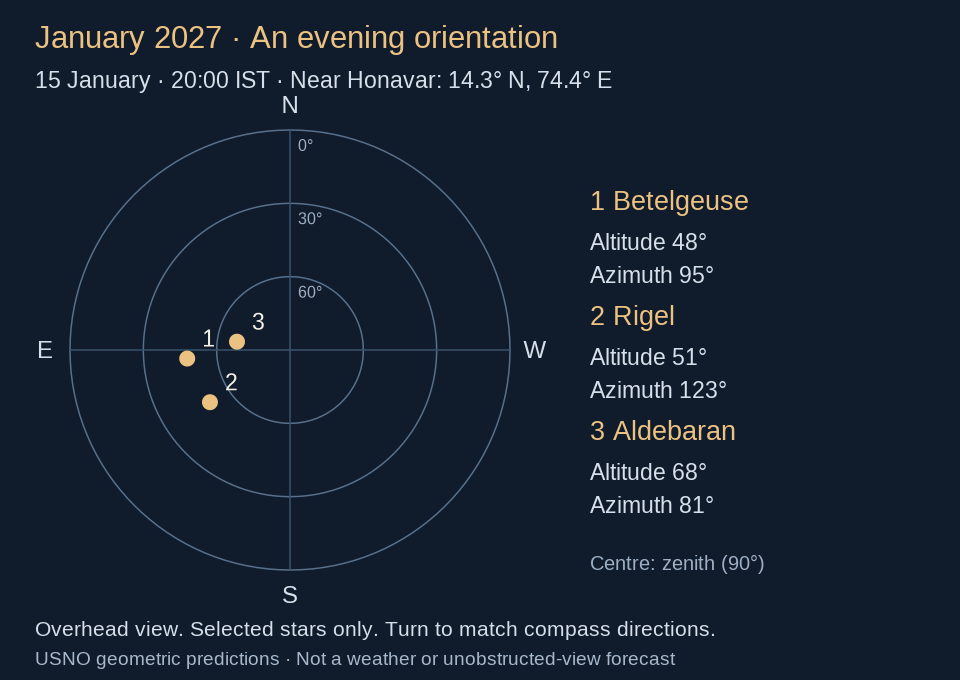
The example is calculated for 15 January 2027 at 20:00 IST, using a rounded regional reference near Honavar at 14.3° north and 74.4° east. It gives Betelgeuse at about 48° altitude and 95° azimuth; Rigel at about 51° altitude and 123° azimuth; Aldebaran at about 68° altitude and 81° azimuth. Azimuth is measured clockwise from true north: east is 90°, south 180° and west 270°.
The diagram is an overhead horizon map with the zenith at its centre. Turn it to match compass directions. Positions are geometric predictions rounded to whole degrees; atmospheric refraction, local obstructions and weather are not modelled. Use a chart set to your actual location, date and time for a different session.
Choose a lunar or darker-sky task
This month’s New Moon instant is 8 January at 01:54 IST. Full Moon is 22 January at 17:47 IST. The complete primary-phase table on this page includes the quarter phases, with all dates and clock times in Indian Standard Time.
A phase instant is shared worldwide and is different from local Moonrise or Moonset. New Moon does not guarantee that every hour of the surrounding nights is moonless. Use the phase table to begin planning, then check the Moon’s location and the actual sky brightness for the observing hour.
Make one useful record
On paper, place the two Orion landmarks first and add the belt only when you can identify it. Record the hour, local obstructions and whether each identification is secure. Revisit at the same clock time later in the month to see the pattern shifted west. A sketch with three reliable points is a sound start.
Use the brighter-Moon part of the month for identifying the main pattern or examining lunar features with appropriate equipment. Save a faint-nebula attempt for a night when the Moon is not bright in the observing sky. A phase date alone does not tell you the Moon’s local rise or set time.
PAUSE AND THINK
Does the 15 January map show the sky at the same time every night of the month?
Explore the answer
No. It represents one stated instant. Stars shift relative to the horizon at the same civil clock time as the month progresses. Set a location-aware chart to the actual planned session.