On this page
June 2027 at a glance
| Phase | Date and time |
|---|---|
| New Moon | |
| First Quarter | |
| Full Moon | |
| Last Quarter |
Times mark when the Moon reaches each phase. Select a date to see the sky near Honavar that evening.
| Landmark | Altitude | Azimuth |
|---|---|---|
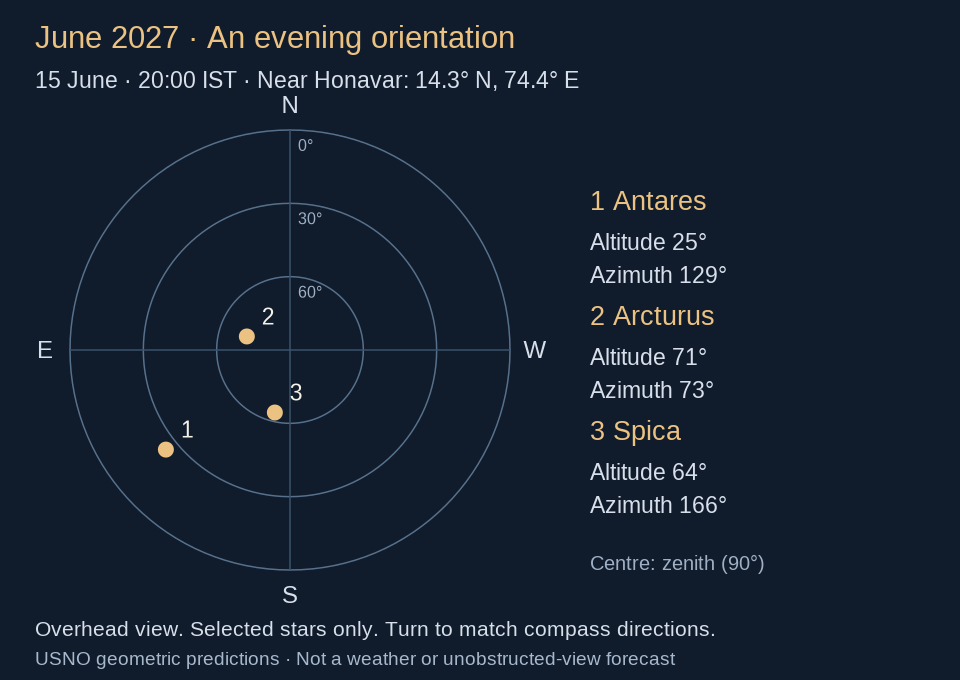
| Antares | 25° | 129° |
| Arcturus | 71° | 73° |
| Spica | 64° | 166° |
Regional reference: 14.3° N, 74.4° E. Geometric positions rounded to whole degrees. North 0°, east 90°, south 180° and west 270°. Terrain, refraction and weather are not included.
THE BIG IDEAS
- The example map is for one stated date, hour and regional reference.
- Primary Moon-phase times are in IST and are not rise or set predictions.
- Choose one achievable task and record conditions alongside the result.
An early look toward the Scorpius region
June’s example shows Antares in the southeastern part of the evening sky while Arcturus and Spica provide higher reference points. Antares marks the heart of Scorpius, but one reddish bright point is not sufficient identification. Confirm the surrounding star pattern with the dedicated finder before assigning the name.
Use the altitude comparison to understand why a target can be seasonally well placed yet still look less clear than a higher star. Lower directions pass through more atmosphere and are more affected by trees, local lights and haze. A regional chart cannot know the silhouette of your own observing site.
Use the dated example with your own horizon
The example is calculated for 15 June 2027 at 20:00 IST, using a rounded regional reference near Honavar at 14.3° north and 74.4° east. It gives Antares at about 25° altitude and 129° azimuth; Arcturus at about 71° altitude and 73° azimuth; Spica at about 64° altitude and 166° azimuth. Azimuth is measured clockwise from true north: east is 90°, south 180° and west 270°.
The diagram is an overhead horizon map with the zenith at its centre. Turn it to match compass directions. Positions are geometric predictions rounded to whole degrees; atmospheric refraction, local obstructions and weather are not modelled. Use a chart set to your actual location, date and time for a different session.
Choose a lunar or darker-sky task
This month’s New Moon instant is 5 June at 01:10 IST. Full Moon is 19 June at 06:14 IST. The complete primary-phase table on this page includes the quarter phases, with all dates and clock times in Indian Standard Time.
A phase instant is shared worldwide and is different from local Moonrise or Moonset. New Moon does not guarantee that every hour of the surrounding nights is moonless. Use the phase table to begin planning, then check the Moon’s location and the actual sky brightness for the observing hour.
Make one useful record
Make a horizon sketch from a safe accessible position before carrying equipment outside. Mark the direction in which Antares should appear and the height of any obstruction. On a clear interval, compare the predicted position with the real horizon. If the star is hidden, record the obstruction instead of changing the identification to a convenient nearby light.
June is within the southwest-monsoon season on this coast. Treat any outdoor opportunity as weather-dependent and do not leave equipment exposed while waiting for rain clouds to pass. An indoor alternative is to use the monthly positions and the Scorpius finder together, explaining why the two diagrams show different coordinate frames.
PAUSE AND THINK
Does the 15 June map show the sky at the same time every night of the month?
Explore the answer
No. It represents one stated instant. Stars shift relative to the horizon at the same civil clock time as the month progresses. Set a location-aware chart to the actual planned session.