On this page
February 2027 at a glance
| Phase | Date and time |
|---|---|
| New Moon | |
| First Quarter | |
| Full Moon | |
| Last Quarter |
Times mark when the Moon reaches each phase. Select a date to see the sky near Honavar that evening.
| Landmark | Altitude | Azimuth |
|---|---|---|
| Sirius | 51° | 141° |
| Canopus | 21° | 168° |
| Capella | 58° | 3° |
Regional reference: 14.3° N, 74.4° E. Geometric positions rounded to whole degrees. North 0°, east 90°, south 180° and west 270°. Terrain, refraction and weather are not included.
THE BIG IDEAS
- The example map is for one stated date, hour and regional reference.
- Primary Moon-phase times are in IST and are not rise or set predictions.
- Choose one achievable task and record conditions alongside the result.
Bright stars at different heights
February’s example compares Sirius, Canopus and Capella at the same early-evening hour. The three bright stars occupy very different parts of the sky. Canopus is the southern challenge: even near its best placement from this latitude it is much lower than many familiar northern landmarks. A clear low horizon is therefore part of the target choice.
Use Sirius to investigate apparent twinkling without assuming that every flash of colour is a change inside the star. Atmospheric turbulence and a long path through near-horizon air can produce strong effects. Canopus offers a second bright point at a different altitude, while Capella provides another direction for a comparison. Record the heights and conditions with your descriptions.
Use the dated example with your own horizon
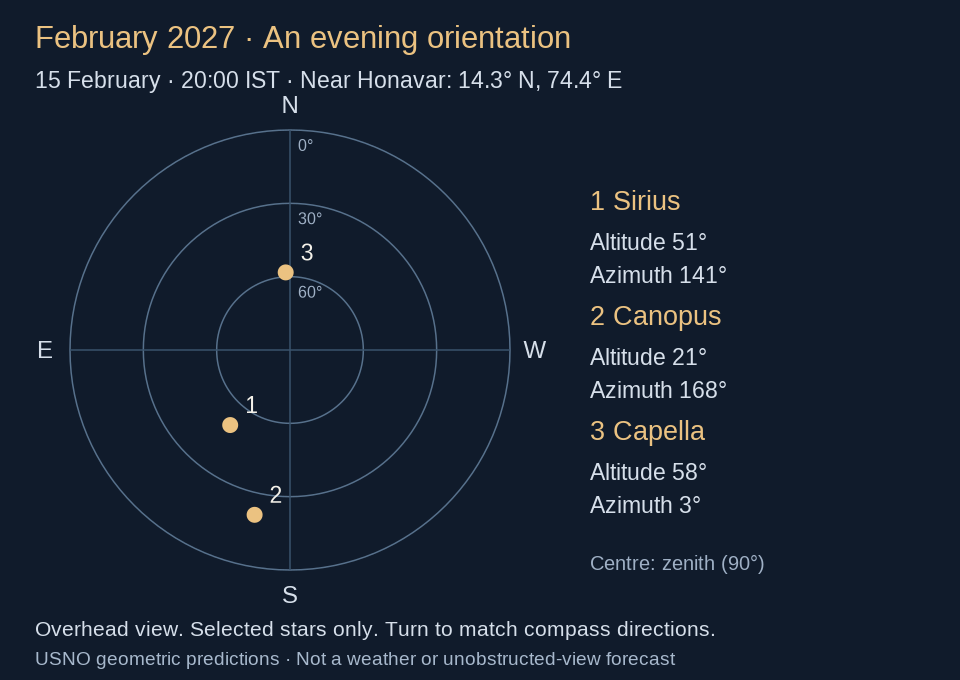
The example is calculated for 15 February 2027 at 20:00 IST, using a rounded regional reference near Honavar at 14.3° north and 74.4° east. It gives Sirius at about 51° altitude and 141° azimuth; Canopus at about 21° altitude and 168° azimuth; Capella at about 58° altitude and 3° azimuth. Azimuth is measured clockwise from true north: east is 90°, south 180° and west 270°.
The diagram is an overhead horizon map with the zenith at its centre. Turn it to match compass directions. Positions are geometric predictions rounded to whole degrees; atmospheric refraction, local obstructions and weather are not modelled. Use a chart set to your actual location, date and time for a different session.
Choose a lunar or darker-sky task
This month’s New Moon instant is 6 February at 21:26 IST. Full Moon is 21 February at 04:53 IST. The complete primary-phase table on this page includes the quarter phases, with all dates and clock times in Indian Standard Time.
A phase instant is shared worldwide and is different from local Moonrise or Moonset. New Moon does not guarantee that every hour of the surrounding nights is moonless. Use the phase table to begin planning, then check the Moon’s location and the actual sky brightness for the observing hour.
Make one useful record
Choose two short viewing periods separated by about twenty minutes. At each, note whether the stars appear steady, gently flickering or strongly flashing. Keep the comparison qualitative unless you have a defined measuring instrument. Do not use a phone’s automatic brightness changes as if they were calibrated stellar measurements.
If trees hide the southern horizon, concentrate on the stars that are safely visible from your observing position. There is no need to climb or move into an unsafe roadside location to complete a list. The geometry table explains an upper viewing opportunity; weather and actual access decide whether an observation is practical.
PAUSE AND THINK
Does the 15 February map show the sky at the same time every night of the month?
Explore the answer
No. It represents one stated instant. Stars shift relative to the horizon at the same civil clock time as the month progresses. Set a location-aware chart to the actual planned session.