On this page
March 2027 at a glance
| Phase | Date and time |
|---|---|
| New Moon | |
| First Quarter | |
| Full Moon | |
| Last Quarter |
Times mark when the Moon reaches each phase. Select a date to see the sky near Honavar that evening.
| Landmark | Altitude | Azimuth |
|---|---|---|
| Pollux | 72° | 37° |
| Regulus | 44° | 87° |
| Sirius | 59° | 186° |
Regional reference: 14.3° N, 74.4° E. Geometric positions rounded to whole degrees. North 0°, east 90°, south 180° and west 270°. Terrain, refraction and weather are not included.
THE BIG IDEAS
- The example map is for one stated date, hour and regional reference.
- Primary Moon-phase times are in IST and are not rise or set predictions.
- Choose one achievable task and record conditions alongside the result.
From Gemini toward the Beehive region
March brings Gemini and Leo into a useful evening comparison. Pollux marks one end of the Gemini heads while Regulus anchors Leo farther east in the seasonal sequence. Their broad separation helps place the Cancer region, but the Beehive Cluster is not exactly at a midpoint between two bright stars.
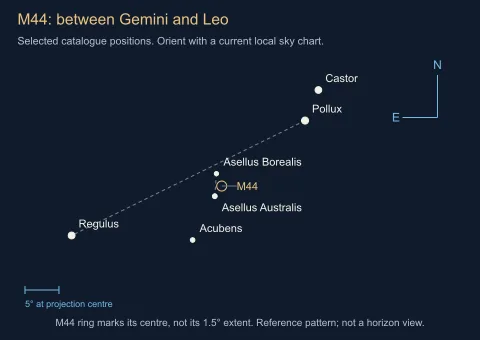
Identify Pollux with Castor and the fainter Gemini chains before following the detailed M44 finder. A telescope field is much smaller than the whole Pollux-to-Regulus gap. Binoculars can give a more convenient first look at the cluster region when held steadily under a suitably dark sky. A bright background can hide the cluster even when its position is above the horizon.
Use the dated example with your own horizon
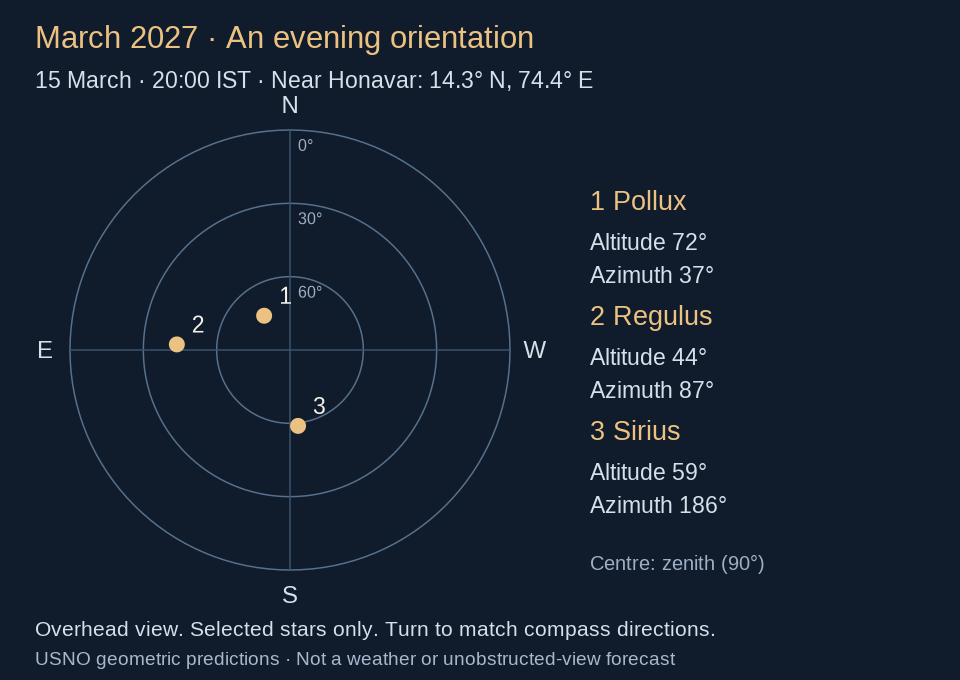
The example is calculated for 15 March 2027 at 20:00 IST, using a rounded regional reference near Honavar at 14.3° north and 74.4° east. It gives Pollux at about 72° altitude and 37° azimuth; Regulus at about 44° altitude and 87° azimuth; Sirius at about 59° altitude and 186° azimuth. Azimuth is measured clockwise from true north: east is 90°, south 180° and west 270°.
The diagram is an overhead horizon map with the zenith at its centre. Turn it to match compass directions. Positions are geometric predictions rounded to whole degrees; atmospheric refraction, local obstructions and weather are not modelled. Use a chart set to your actual location, date and time for a different session.
Choose a lunar or darker-sky task
This month’s New Moon instant is 8 March at 14:59 IST. Full Moon is 22 March at 16:14 IST. The complete primary-phase table on this page includes the quarter phases, with all dates and clock times in Indian Standard Time.
A phase instant is shared worldwide and is different from local Moonrise or Moonset. New Moon does not guarantee that every hour of the surrounding nights is moonless. Use the phase table to begin planning, then check the Moon’s location and the actual sky brightness for the observing hour.
Make one useful record
For a practical task, sketch the bright landmarks with your eyes, then add the patch where you expect M44 from the finder. Mark predicted position separately from a confirmed detection. If binoculars reveal stars, describe their distribution rather than copying a long-exposure photograph. A non-detection with recorded conditions is useful preparation for another attempt.
Sirius is included in the example as a familiar bright point in a different part of the sky. It helps demonstrate that several winter and spring patterns can share one evening. Choose one main task instead of repeatedly repointing a telescope across the entire sky.
PAUSE AND THINK
Does the 15 March map show the sky at the same time every night of the month?
Explore the answer
No. It represents one stated instant. Stars shift relative to the horizon at the same civil clock time as the month progresses. Set a location-aware chart to the actual planned session.