On this page
THE BIG IDEAS
- M44 is an extended open cluster in Cancer.
- Wide fields help show its overall arrangement.
- A projected star in the field is not automatically a cluster member.
Look for a gathering rather than a single star
The Beehive Cluster is an open star cluster also called M44 or Praesepe. Its light is spread across a patch roughly 1.5° wide, so a bright-sky view can be much harder than the cluster’s combined brightness suggests. From a dark site it can look like a faint blur to your eyes; binoculars separate that blur into a group of points.
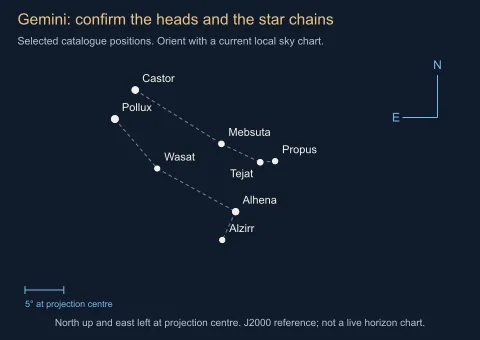
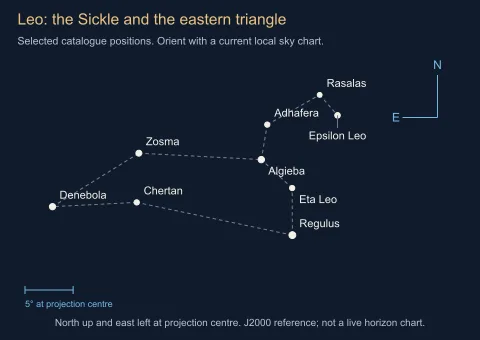
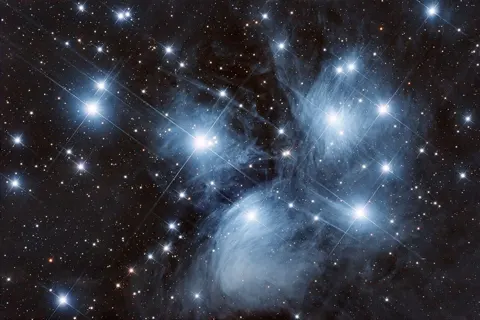
The surrounding constellation Cancer is less conspicuous than neighbouring Gemini and Leo. Start with those brighter frameworks rather than expecting the cluster to announce itself. A colourful space image of stars or background galaxies is not a prediction of what a small visual instrument will show.
Choose the view before increasing power
From coastal Karnataka, evenings roughly February through May commonly offer a convenient seasonal window. Check the actual date, time and horizon with a current chart. Near its culmination at latitude 14.3° north, the cluster’s geometric altitude can be about 85°, but it will be lower at other hours.
Begin with binoculars or a telescope eyepiece that has a wide true field. For comparison, a 1° field covers less than the cluster’s roughly 1.5° extent. Higher magnification might reveal more individual points while losing the overall arrangement. A steady wide view is a useful first result.
Use the bright-star bridge and then the closer pair
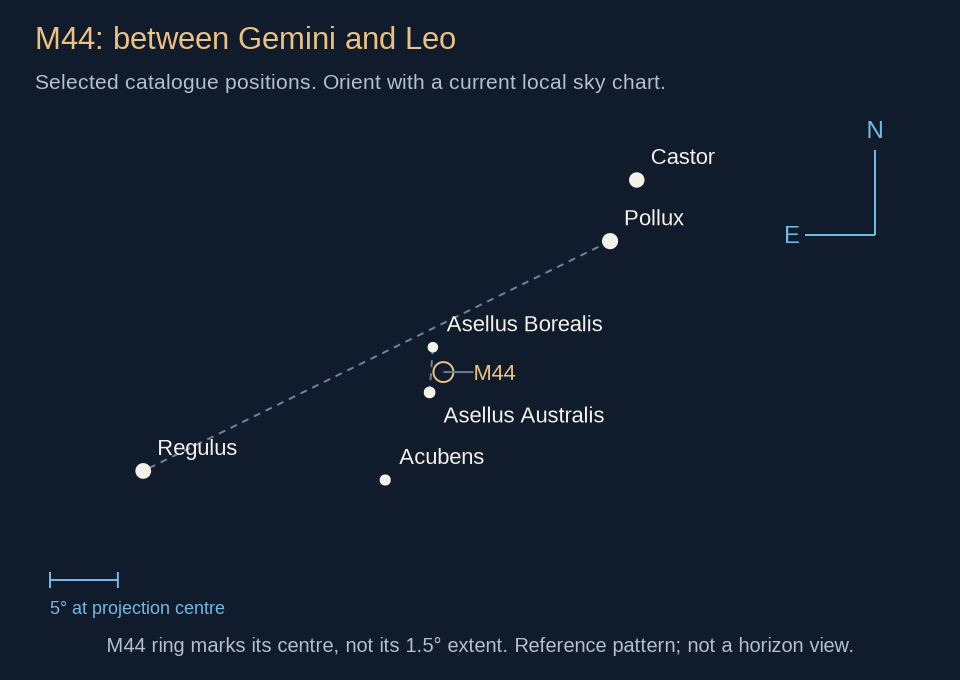
The reference chart locates M44 broadly between Pollux in Gemini and Regulus in Leo. The cluster centre is approximately 15.1° from Pollux and 22.5° from Regulus, so it is not exactly halfway between them. These large-scale checks keep the search in the right region.
Closer to M44, Asellus Borealis and Asellus Australis provide a more local north-south reference. The cluster lies just west of their connecting line in this north-up, east-left chart. Its circle is a finder symbol rather than a drawing of every member star. Match the field with a timed chart before pointing equipment.
Record the difference between two views
Sketch the patch with unaided eyes if it is visible, then sketch the same region through steady binoculars. Use the same paper orientation and label the approximate field width. Record only the points you can separate confidently. Mark a suspected unresolved glow differently from an individual star.
If the unaided-eye patch is absent, keep that result. Note Moon brightness, haze and nearby glare, then compare with the binocular view. A nondetection in one method does not invalidate a secure pattern seen with another method. Avoid turning a rough sketch into a claimed count of all cluster members.
Connect the view with the science
An open cluster is a physical stellar grouping, unlike a constellation outline assembled from unrelated distances. The visible field also contains foreground and background objects. A point projected within the patch is not automatically a confirmed member; astronomers use distance and motion information to investigate membership.
Compare M44 with the Pleiades on another suitable night. Keep equipment and recording style similar so that apparent concentration and field size can be discussed sensibly. The purpose is a repeatable comparison, not a competition to produce a photograph-like view.
PAUSE AND THINK
Would a telescope field only 1° wide show the whole approximately 1.5° Beehive Cluster at once?
Explore the answer
No. The field would be narrower than the cluster’s approximate extent. A wider field is more suitable for the overall pattern, though a narrow field can examine a smaller part.