On this page
THE BIG IDEAS
- Identify both the Sickle and the eastern triangle.
- Leo’s bright endpoints are about 24.6° apart.
- A naked-eye pattern can remain visible when nearby faint galaxies cannot.
Build Leo from two shapes
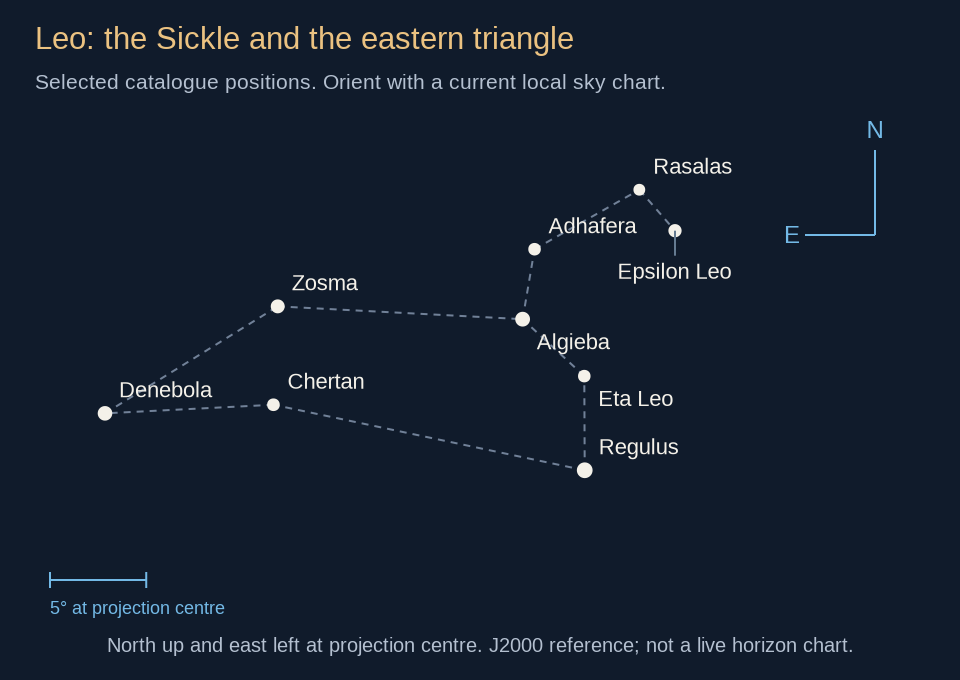
Leo is easier to identify as two linked parts than as a complete lion. Regulus anchors the lower end of the curved Sickle, a pattern often compared with a backward question mark. Farther east, Denebola, Zosma and Chertan make a broad triangle. Confirm both parts before deciding that a bright candidate is Regulus.
The figure is a mnemonic within the IAU constellation region. Its lines are not objects visible between the stars and the drawing does not imply that every star lies at the same distance. You are matching an angular arrangement seen from Earth.
Plan around the date and your neck
Evenings from roughly February into June provide a useful seasonal range from coastal Karnataka, with later months placing the figure farther west after dark. Use a current horizon chart for the actual date and time. A seasonal label by itself cannot tell you whether a particular star is behind your roof.
Regulus and Denebola can pass almost overhead near latitude 14.3° north. Their approximate maximum geometric altitudes are about 88° for Regulus and almost 90° for Denebola. A high target avoids some near-horizon haze but can be awkward for a straight-through finder or handheld binoculars. Choose a comfortable position rather than prolonging a strained look.
Use Regulus and Denebola as a scale check
The two bright endpoints are about 24.6° apart. The entire figure therefore exceeds a normal binocular field and is far too broad to see at once in an ordinary telescope. Locate the lion-shaped framework with your eyes. Then inspect smaller sections with optical help if you have it.
The supplied chart puts celestial north upward and east leftward. It includes the Sickle stars and eastern triangle using catalogue positions. Rotate the chart to match your timed sky view. A chart’s left side does not mean the same compass direction for every observer facing every part of the sky.
Test an identification in two stages
First, sketch Regulus, Algieba and the upper bend of the Sickle. Then locate the eastern triangle independently. Compare the angle between the two groups with the reference diagram. If only one part matches, keep the overall identification provisional and check the date, direction and scale.
Write a short record containing time in IST, the stars confirmed and one uncertain point. Repeat the sketch on another clear evening at the same clock time. Compare the position relative to the horizon while keeping the internal pattern separate from the changing viewpoint.
Let the constellation organise further observing
Leo is a signpost for fainter deep-sky objects, but finding its outline does not make every nearby galaxy an easy target. Before attempting one, check its angular extent, surface brightness and recommended equipment. Bright Moon or haze can erase a faint object while leaving the bright Sickle obvious.
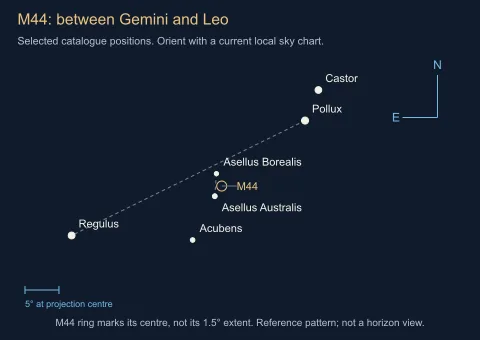
The broad line from Regulus toward Pollux also helps orient the Cancer region and the Beehive Cluster. Use the cluster’s own reference chart for the final identification. A successful session can simply be a carefully checked Leo sketch rather than a long list of objects.
PAUSE AND THINK
Why is a telescope a poor first tool for identifying the whole outline of Leo?
Explore the answer
The outline covers tens of degrees, much more than an ordinary telescope field. A broad unaided-eye view provides the framework before you examine small regions.