On this page
THE BIG IDEAS
- Castor and Pollux are about 4.5° apart.
- Confirm the heads with the fainter star chains.
- Apparent colour and chart symbol size are different kinds of information.
Start with two different heads
Castor and Pollux form the most recognisable bright pair in Gemini. Their separation is about 4.5°, wide enough to compare easily with your eyes. Pollux usually appears a little warmer in colour while Castor looks whiter, although haze, eyesight and nearby glare can make that comparison subtle.
Do not identify the pair only because two bright points seem close. Check their spacing against the reference chart and confirm stars extending away from them. Gemini is an entire constellation region; the traditional twin-shaped drawing is one way of remembering selected stars within it.
Choose a useful evening window
From coastal Karnataka, roughly January through April offers convenient evening opportunities for the pattern, with the exact placement changing across those months. A location-based chart should supply the direction and altitude for the hour you choose. A late-evening view in one month can resemble an earlier view a month later.
The heads can pass high in the sky from a latitude near 14.3° north. Approximate geometric culmination altitudes are 72° for Castor and 76° for Pollux. Those limits assume a level horizon and say nothing about current clouds. A comfortable viewing position helps more than trying to hold a strained stance under a high target.
Follow the chains rather than an imagined picture
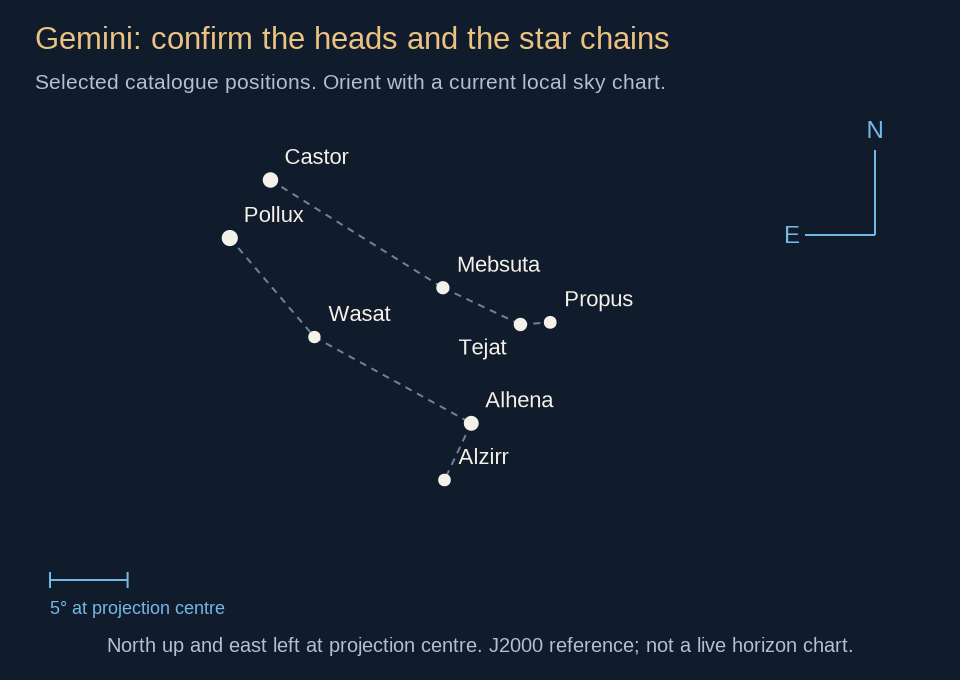
The diagram marks a route from Castor toward Mebsuta and the Tejat region, with another chain from Pollux through Wasat toward Alhena and Alzirr. Use these as separate checks rather than forcing every visible dot into a stick figure. Some stars will be lost in bright sky.
The chart uses selected catalogue positions in a north-up, east-left projection. Its guide lines are not physical connections. Rotate the pattern to match a chart for your location and time. A telescope can rotate or reverse a small field, so the broad identification is easier with your eyes first.
Make one comparison you can repeat
On paper, place Castor and Pollux first, then add two fainter stars from each chain. Record the time, Moon brightness and any obstruction. Mark a star as uncertain if you are not sure which chart point matches it. Your goal is a reliable small set rather than a complete decorative drawing.
For a colour comparison, alternate your gaze between the heads without staring at a bright phone screen between looks. Record “no definite difference” when that is what you see. A qualitative colour impression is not a measured temperature and a large symbol on a chart does not represent the physical diameter of a star.
Move from a pattern to another target
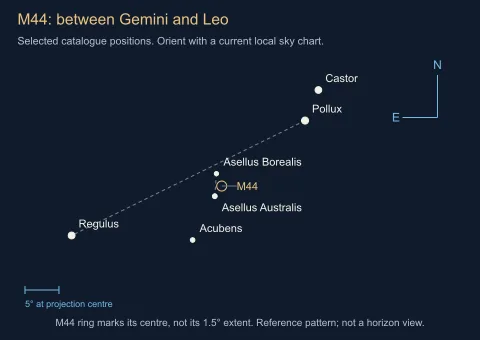
The Beehive Cluster lies farther toward the Cancer region, broadly between Pollux and Regulus in Leo. Its dedicated chart provides the next scale of navigation. A line joining familiar landmarks is helpful, but the cluster is not exactly at a geometric midpoint.
If binoculars are available, steady them before examining the richer parts of the field. Start with a wide view and return to the unaided-eye pair whenever you lose orientation. Recognising Gemini is useful practice even when no optical equipment is available.
PAUSE AND THINK
Why should you check fainter stars after choosing two bright candidates for Castor and Pollux?
Explore the answer
The additional pattern checks reduce the chance of accepting an unrelated bright pair. Consistent spacing and directions across several stars make the identification more secure.