On this page
September 2027 at a glance
| Phase | Date and time |
|---|---|
| First Quarter | |
| Full Moon | |
| Last Quarter | |
| New Moon |
Times mark when the Moon reaches each phase. Select a date to see the sky near Honavar that evening.
| Landmark | Altitude | Azimuth |
|---|---|---|
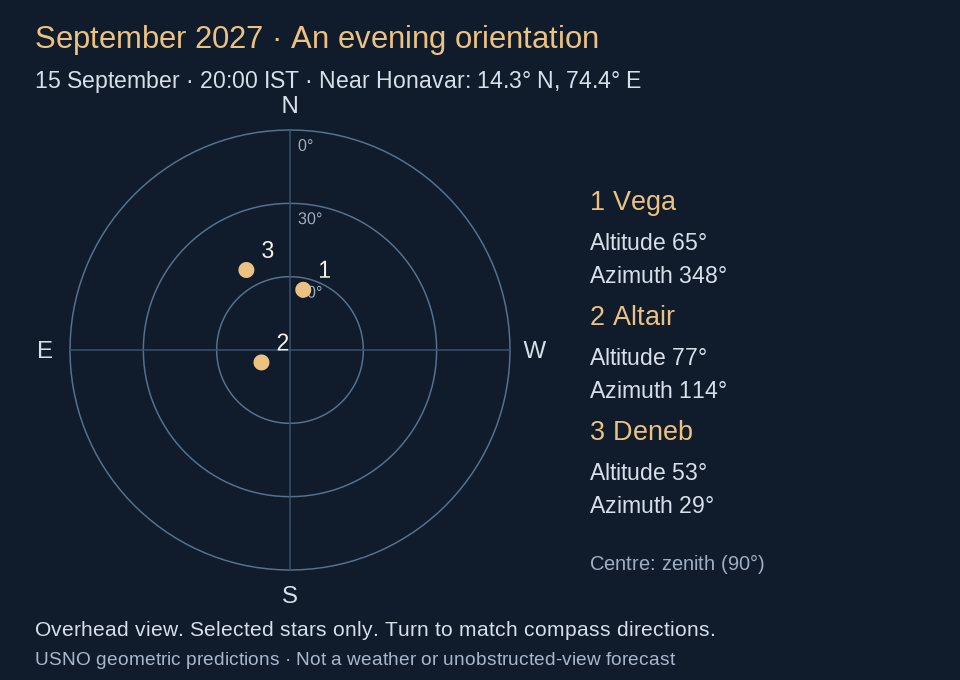
| Vega | 65° | 348° |
| Altair | 77° | 114° |
| Deneb | 53° | 29° |
Regional reference: 14.3° N, 74.4° E. Geometric positions rounded to whole degrees. North 0°, east 90°, south 180° and west 270°. Terrain, refraction and weather are not included.
THE BIG IDEAS
- The example map is for one stated date, hour and regional reference.
- Primary Moon-phase times are in IST and are not rise or set predictions.
- Choose one achievable task and record conditions alongside the result.
From a broad asterism to a small double-star field
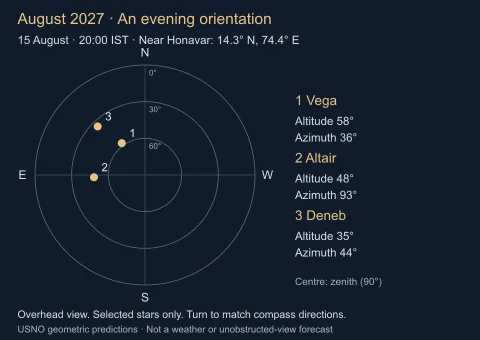
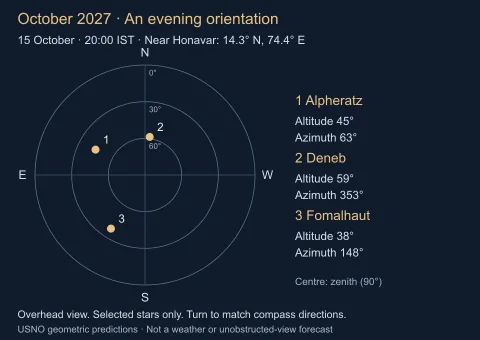
September keeps the Summer Triangle useful at the example evening hour, with a different position and orientation from August. Compare the two dated charts at the same clock time to see the seasonal displacement. The stellar triangle remains effectively the same pattern while Earth’s viewing direction changes through its orbit.
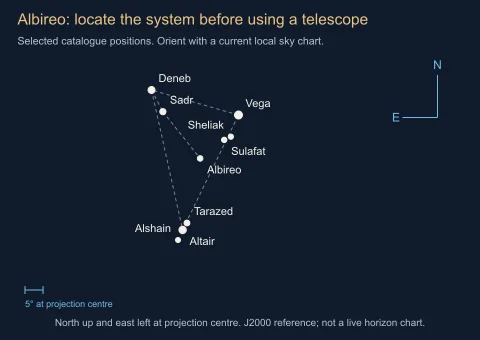
Choose Cygnus for a more focused task and locate the Albireo region using the checked finder. The small double-star field is a separate scale from the entire triangle. A telescope may show two coloured points when the optics, focus and atmosphere allow, while an ordinary unaided-eye view presents the broad landmark pattern.
Use the dated example with your own horizon
The example is calculated for 15 September 2027 at 20:00 IST, using a rounded regional reference near Honavar at 14.3° north and 74.4° east. It gives Vega at about 65° altitude and 348° azimuth; Altair at about 77° altitude and 114° azimuth; Deneb at about 53° altitude and 29° azimuth. Azimuth is measured clockwise from true north: east is 90°, south 180° and west 270°.
The diagram is an overhead horizon map with the zenith at its centre. Turn it to match compass directions. Positions are geometric predictions rounded to whole degrees; atmospheric refraction, local obstructions and weather are not modelled. Use a chart set to your actual location, date and time for a different session.
Choose a lunar or darker-sky task
This month’s New Moon instant is 30 September at 08:06 IST. Full Moon is 16 September at 04:33 IST. The complete primary-phase table on this page includes the quarter phases, with all dates and clock times in Indian Standard Time.
A phase instant is shared worldwide and is different from local Moonrise or Moonset. New Moon does not guarantee that every hour of the surrounding nights is moonless. Use the phase table to begin planning, then check the Moon’s location and the actual sky brightness for the observing hour.
Make one useful record
If the pair is securely identified, make a two-dot sketch with a note about brightness and colour. Determine the actual optical orientation rather than automatically putting north at the top. Record an uncertain colour impression as uncertain. This is a description of the view, not a measurement of stellar surface temperature.
Late-monsoon conditions can still interrupt the session. A short, well-documented look is enough for the exercise. For an indoor alternative, rotate the fixed Albireo chart to compare it with the wide monthly horizon map and explain why a mirror-reversed telescope field requires an additional transformation.
PAUSE AND THINK
Does the 15 September map show the sky at the same time every night of the month?
Explore the answer
No. It represents one stated instant. Stars shift relative to the horizon at the same civil clock time as the month progresses. Set a location-aware chart to the actual planned session.