On this page
THE BIG IDEAS
- Confirm the Cygnus framework before using a telescope.
- A close-looking visual pair does not prove an orbit.
- Record your own colour impression and instrument settings.
Use the Summer Triangle to establish the neighbourhood
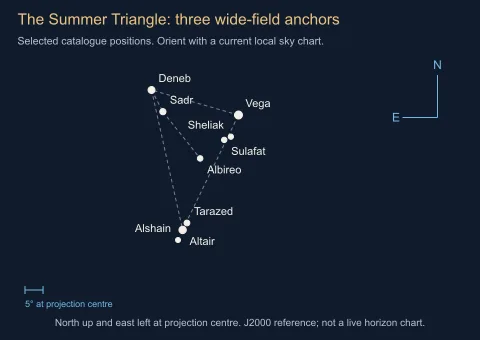
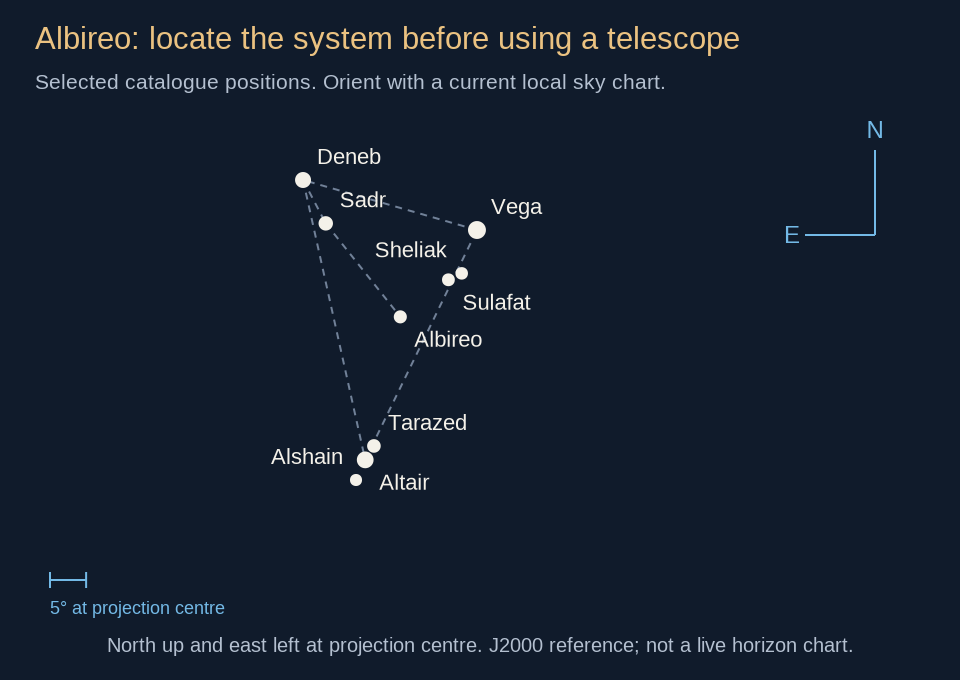
Albireo lies in Cygnus, within the broad region framed by Vega, Deneb and Altair. In the traditional swan figure it marks the head end of the long line from Deneb through Sadr. Recognising that framework is more dependable than centring an isolated bright-looking point and hoping it is the target.
The overview chart uses catalogue positions for the bright landmarks and Albireo. Vega and Albireo are about 15.6° apart, so the jump is far larger than a normal telescope field. Locate the region with your eyes and a current chart before making a careful finder identification.
Choose an hour with a comfortable target height
From coastal Karnataka, evenings roughly July through November commonly provide a useful part of the annual cycle, although clouds can limit many attempts. Select the date and time using a chart for your own location. The same target can move from an eastern to a western view as the months advance.
At latitude 14.3° north, Albireo’s maximum geometric altitude is about 76°. This describes a possible culmination, not its height tonight. A target comfortably clear of trees and local glare is preferable to forcing an observation through a narrow gap near a horizon.
Move from a point to a pair
Begin with low power, focus carefully and wait for vibration to settle. A small telescope can reveal the familiar brighter warm-coloured point and fainter bluish companion. Increase power only while the pair remains sharp and the field is easy to manage. Atmospheric shimmer can make a defocused star look irregular without actually producing a resolved companion.
The two points need not appear as saturated gold and blue. Colour perception varies between observers and depends on contrast and conditions. Describe your own view before reading another person’s colour labels. The chart’s highlighted marker locates the system; it does not draw the close components at the overview scale.
Record an observation without inventing a physical relationship
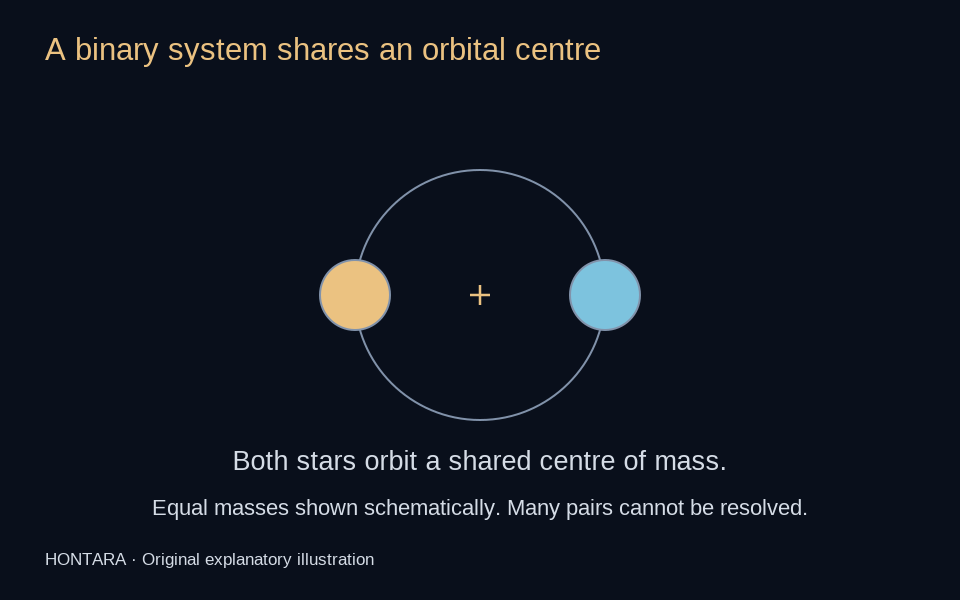
A visual double means two points appear close on the sky. It does not by itself establish that the two visible points form a gravitationally bound pair. Distances, motions and longer-term measurements are needed to investigate physical relationships. This guide does not ask you to infer an orbit from one view.
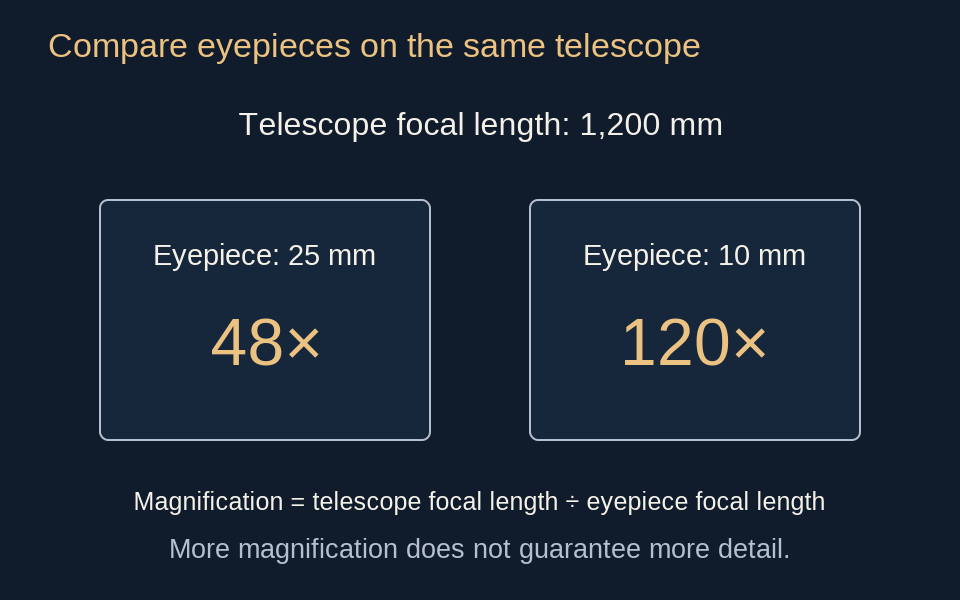
Sketch the two points with the direction of the brighter one marked in your eyepiece orientation. Record the eyepiece, calculated magnification, time in IST and a cautious colour impression. An uncalibrated sketch can record orientation and contrast without claiming an accurate angular separation.
Compare two powers and explain the trade-off
Try a second eyepiece after making the first sketch. Does the pair become easier to separate and does the image remain steady? Write down both benefits and disadvantages. More apparent separation may help, while dimming or vibration may make the comparison less comfortable.
For a group, let each observer describe the pair before discussing shared labels. Different impressions are useful evidence about the observing process. Avoid telling a learner that a particular colour must be visible; a careful uncertain result is more valuable than repeating an expected answer.
PAUSE AND THINK
Can a single view of two stars close together prove that they orbit each other?
Explore the answer
No. Apparent closeness is a projection. Astronomers need additional distance, motion and time-dependent evidence to establish a physical relationship.