On this page
Both stars move
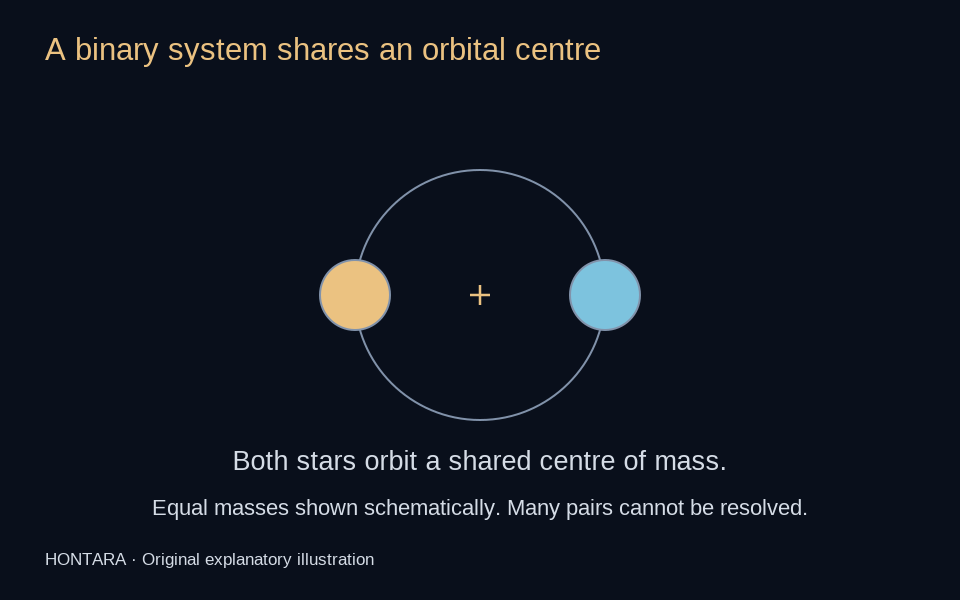
In a physical binary system, two stars orbit their common centre of mass. Neither needs to be a perfectly stationary pivot. In a simple isolated pair, the more massive star has the smaller orbit about that shared centre. Gravity links the two motions.
The word double can also describe two star-like points seen close together in the sky. They may be a physical binary or unrelated stars aligned along the same line of sight. A pleasant coloured pair in an eyepiece does not by itself establish a shared orbit.
THE BIG IDEAS
- Both members of a binary orbit a shared centre of mass.
- A close-looking double star is not necessarily a physical pair.
- Orbital, spectral and eclipse evidence answer different questions.
A balance-point example
Consider an invented pair with masses in the ratio two to one. If their instantaneous separation is divided into three equal parts, the centre of mass lies one part from the heavier star and two parts from the lighter one. The distances are inversely related to mass. This is a geometry exercise, not a measurement of a named system.
Place two different-sized paper circles at those positions around a marked point. Move them through matching angles while preserving that relationship. The model helps show why the lighter member moves farther. It does not reproduce the varying speeds of an eccentric orbit or interactions with other bodies.
Resolved and unresolved evidence
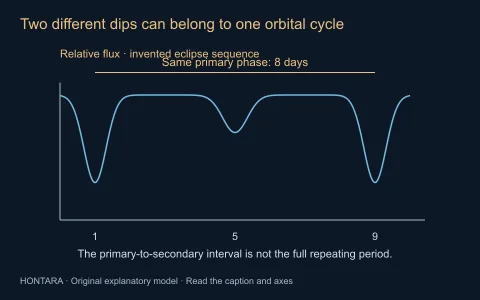
A visual binary can be separated into two points and followed over time. An unresolved system may reveal itself through alternating Doppler shifts in spectral lines as components move toward and away from us. Some binaries eclipse, producing repeating brightness changes when the viewing geometry allows one component to pass in front of the other.
These labels describe methods of detection and can overlap. A physical binary need not eclipse from our viewing direction. Two stars may remain unresolved because their angular separation is too small for a particular instrument even when their physical separation is substantial.
Why a physical pair is valuable
When an orbit is sufficiently measured and its geometry and distance are known, it can constrain stellar masses. This connects observations with one of the most important quantities in stellar evolution. Measuring apparent separation at a single moment is not enough to determine a complete orbit.
Close systems can also exchange material and evolve differently from isolated stars. Some X-ray binaries contain a compact object and a companion supplying material. The high-energy emission comes from hot material in the system, not from seeing inside an event horizon. Many ordinary binaries are not such extreme systems.
Record the right claim
If you observe a double star, sketch the orientation and relative appearance of its components. Record the eyepiece, time, conditions and how you established direction in the field. A telescope can rotate or reverse the view. Keep a colour impression separate from a calibrated temperature measurement.
For the physical interpretation, read an identified catalogue or a mission study and note what evidence it uses. Does it present an orbital solution, common motion, spectra or only a photograph? A useful final caption says both what you saw and what further evidence supports the word binary. It need not turn an attractive first view into a claim you cannot test.
PAUSE AND THINK
In the invented two-to-one mass example, which star moves farther from the shared centre?
Explore the answer
The lower-mass star. For that mass ratio, its distance from the centre is twice the heavier star’s distance. Both still participate in the orbital motion.