
On this page
The same interaction at different scales
Gravity attracts objects that have mass. On Earth it holds the atmosphere close and gives falling objects their familiar downward motion. Across the Solar System it helps keep planets moving around the Sun and moons around planets. Gravity does not stop at the top of the atmosphere. It becomes weaker with increasing distance, but it remains important far beyond the region where people can breathe.
THE BIG IDEAS
- Gravity acts in space as well as on Earth.
- Mass and weight describe different quantities.
- Orbital weightlessness is a shared free fall.
Mass and distance
For two point masses, Newton’s model makes the attraction proportional to their masses and inversely proportional to the square of their separation. The same centre-to-centre rule applies outside non-overlapping spherically symmetric bodies and approximates many planetary calculations. Double that distance while keeping the masses fixed and the force becomes one quarter as large. This is a relationship between centre-to-centre distance and force, not a rule that every object twice as high above the ground weighs one quarter as much.
Mass is not the same as weight
Mass describes how much matter an object contains and its resistance to changes in motion. Weight is the gravitational force acting on it. The same astronaut has essentially the same mass on Earth and the Moon but a smaller weight on the Moon. A balance and a spring scale measure in different ways, which is why scientists specify the physical quantity rather than treating mass and weight as interchangeable words.
Why astronauts float
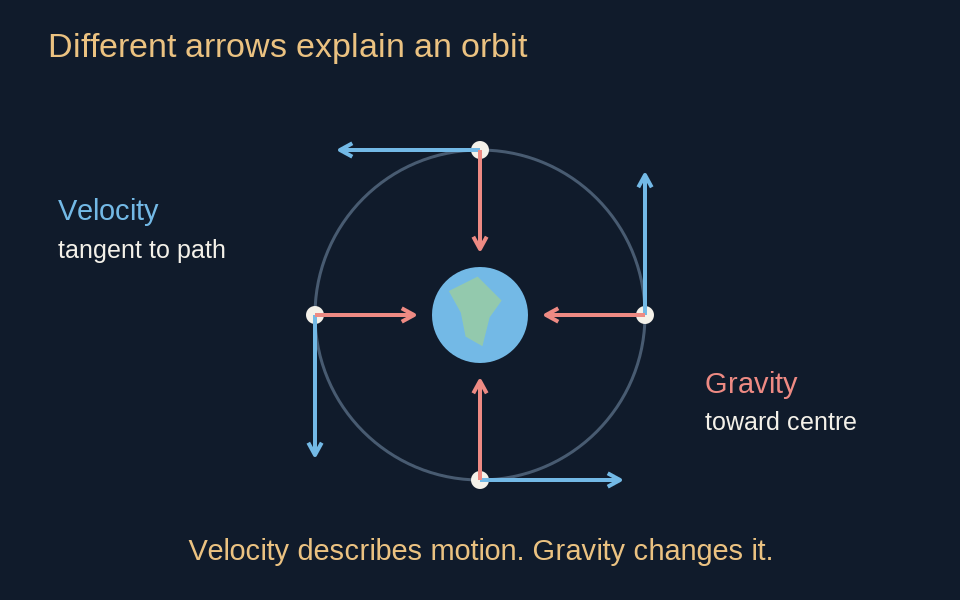
Astronauts aboard an orbiting spacecraft are falling around Earth with the spacecraft. They float relative to the cabin because everything is accelerating together, not because gravity has disappeared. An orbit combines sideways speed with continuous gravitational acceleration. There are small residual accelerations and disturbances, so the environment is commonly called microgravity. This distinction matters when interpreting videos of water, flames or people behaving differently in orbit.
Where the simple model reaches its limits
Newton’s description works extremely well for many classroom calculations and spacecraft trajectories. Einstein’s general relativity describes gravity through the geometry of spacetime and is needed for effects such as precise satellite timing and strong gravity near compact objects. A stretched-sheet demonstration can suggest curved paths, but it uses Earth’s gravity to pull objects down into the sheet. It is an analogy, not a literal picture of space.
PAUSE AND THINK
Does a floating astronaut provide evidence that there is no gravity nearby?
Explore the answer
No. The astronaut and spacecraft are falling together under gravity, so the astronaut does not rest against the cabin floor.