
On this page
THE BIG IDEAS
- Gravity acts on orbiting objects.
- Changing direction is a form of acceleration.
- Velocity and force arrows must be interpreted differently.
Lesson purpose
Students will distinguish velocity from force and explain an ideal circular orbit as motion continually redirected by gravity. Prepare paper circles, rulers and two pencil colours. No launching, swinging or dropping apparatus is needed. The lesson assumes students can identify a direction of movement; numerical calculations of gravitational force are optional extensions rather than prerequisites.
Teaching sequence
- Minutes 0-6: Ask whether gravity acts on an orbiting satellite and collect explanations without immediately correcting them.
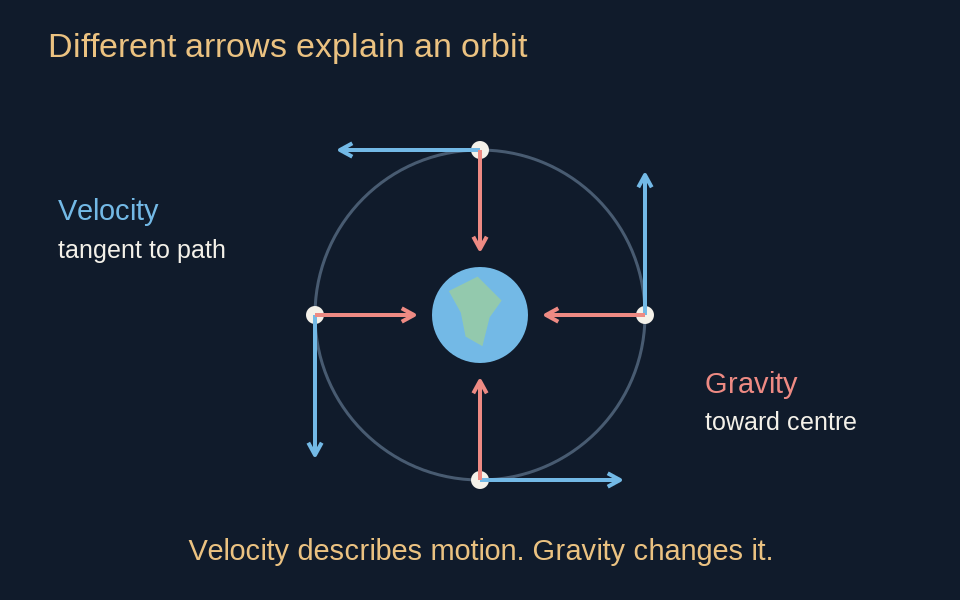
- Minutes 6-16: Draw a circular orbit with a tangent velocity arrow and a separate inward gravity arrow. Explain their different meanings.
- Minutes 16-27: Pairs complete both arrows at four orbital positions and predict the path if gravity ceased in the ideal model.
- Minutes 27-37: Present three incorrect diagrams for students to diagnose: radial velocity, outward gravity and equal opposite force arrows.
- Minutes 37-45: Students write a short explanation and respond to the exit task.
Student questions
- 1. Is the direction of travel the same as the direction of gravitational acceleration in a circular orbit?
- 2. Can an object accelerate while its speed remains constant?
- 3. What path would it follow if gravity vanished at one instant in the simplified model?
- 4. Why is a tangent velocity arrow not an outward force balancing gravity?
Answer guide
The travel direction is tangent while gravitational acceleration points toward the centre. Acceleration includes a change in direction, so constant speed does not imply constant velocity. Without gravity in the ideal model, the object continues along the tangent in a straight line. Velocity describes motion and is measured differently from force; it must not be added to gravity as if the two were opposing forces.
State the model’s assumptions: a small satellite around one dominant spherical body, treating that body as fixed and ignoring atmospheric drag or powered manoeuvres. In an ellipse extension, place the central body at one focus. Gravitational acceleration still points toward the body, but speed changes around the orbit.
Support and assessment
Use separate labels as well as colours so colour-vision differences do not affect the task. For learners needing support, trace the path with a finger before drawing the tangent. For extension, compare arrows at the near and far parts of an ellipse without requiring exact magnitudes. Assess whether the final response includes continuing gravity, sideways motion and inward acceleration. Do not award full understanding for the phrase gravity balances motion unless the learner can clarify the distinction between motion and force.
PAUSE AND THINK
What is wrong with saying a satellite stays up because there is no gravity in space?
Explore the answer
Gravity is what continually bends its path. An orbiting satellite has sideways motion while falling toward the gravitating body.
RECORD YOUR OWN EVIDENCE
Your activity sheet
You need: Paper, ruler and two pencil colours.
At each orbital position, distinguish a tangent velocity arrow from inward gravitational acceleration.
Name or group: Date:
| Orbit position | Velocity direction | Acceleration direction | Reason |
|---|---|---|---|
| Top | |||
| Right | |||
| Bottom | |||
| Left |
Could speed stay constant while velocity changes? Explain.
What path would follow if gravity vanished in this idealised model?
Record what happened, including uncertain results. Use the answer guidance in this resource to discuss your explanation.