
On this page
THE BIG IDEAS
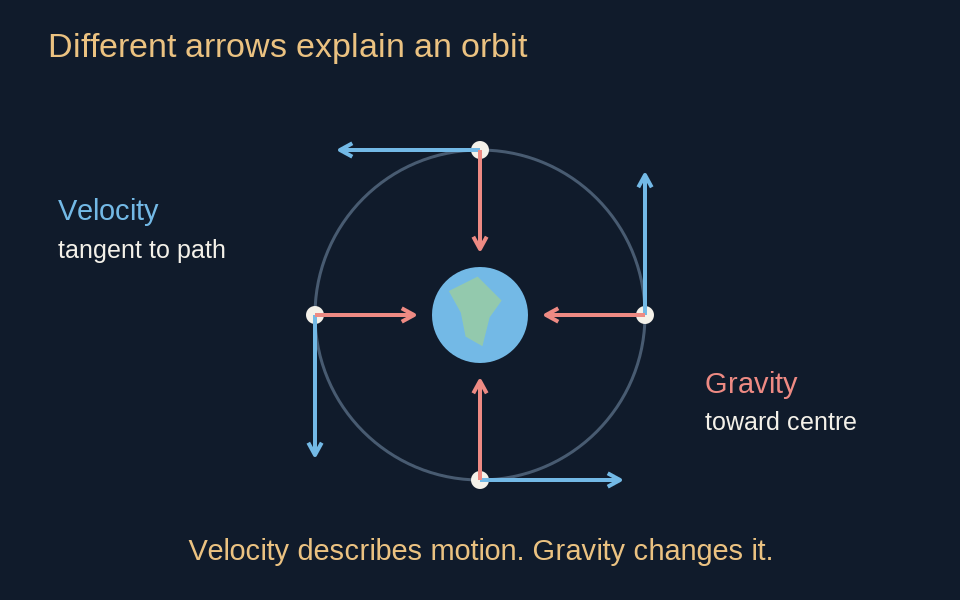
- Velocity is tangent to an ideal circular orbit.
- Gravitational acceleration points inward.
- A velocity arrow is not an outward force balancing gravity.
Two different arrows
An orbiting object is moving while gravity continually changes its motion. These are different ideas and a diagram becomes confusing when one arrow is used for both. This activity uses a circle as a deliberately simple orbit and asks you to draw separate arrows for velocity and gravitational acceleration. No objects need to be thrown or swung.
Prepare a diagram
Use paper, a cup to trace a circle, ruler and two colours of pencil. Label the centre Earth and place a small dot on the circular path. Make the circle large enough for arrows but note that neither Earth nor the orbit is drawn to scale. A circular orbit is a special case; many real orbital paths are elliptical.
Build the arrow pattern
- 1. Choose clockwise or anticlockwise travel and label that choice clearly.
- 2. At the dot, draw a short arrow tangent to the circle to represent instantaneous direction of travel. A tangent touches the circle without pointing toward its centre.
- 3. In a different colour, draw an arrow from the dot toward Earth’s centre. Label it gravity.
- 4. Repeat both arrows at three more positions around the circle.
- 5. At one position, draw a dotted straight path extending the tangent and label it the path if gravity suddenly ceased in this ideal model.
Explain the sideways fall
Gravity points inward while the object has sideways motion. In a circular orbit, that inward acceleration changes the velocity’s direction even when its speed stays constant. The object continually falls toward Earth while moving forward, so its path curves around Earth instead of simply dropping straight down.
The tangent arrow is not a second force balancing gravity. It describes velocity. Inward gravity is the unbalanced force responsible for acceleration. This distinction matters because a diagram with two equal force arrows pointing opposite ways would instead suggest no net acceleration.
Test and qualify the picture
Ask a partner to find a deliberately misplaced arrow and explain its correction. For an ellipse extension, place Earth at one focus rather than at the ellipse’s geometric centre. The speed changes around that orbit, so equal-length velocity arrows would be misleading. This exercise illustrates directions, not a numerical orbit calculation. It assumes Earth is the dominant gravitating body and its motion is neglected; other bodies and atmospheric drag can require more detail.
PAUSE AND THINK
If gravity vanished at one point in this ideal model, would the object fly radially outward?
Explore the answer
No. It would continue in a straight line along its instantaneous velocity, which is tangent to the circular path.
RECORD YOUR OWN EVIDENCE
Your activity sheet
You need: Paper, ruler and two pencil colours.
At each orbital position, distinguish a tangent velocity arrow from inward gravitational acceleration.
Name or group: Date:
| Orbit position | Velocity direction | Acceleration direction | Reason |
|---|---|---|---|
| Top | |||
| Right | |||
| Bottom | |||
| Left |
Could speed stay constant while velocity changes? Explain.
What path would follow if gravity vanished in this idealised model?
Record what happened, including uncertain results. Use the answer guidance in this resource to discuss your explanation.