
On this page
Falling while moving sideways
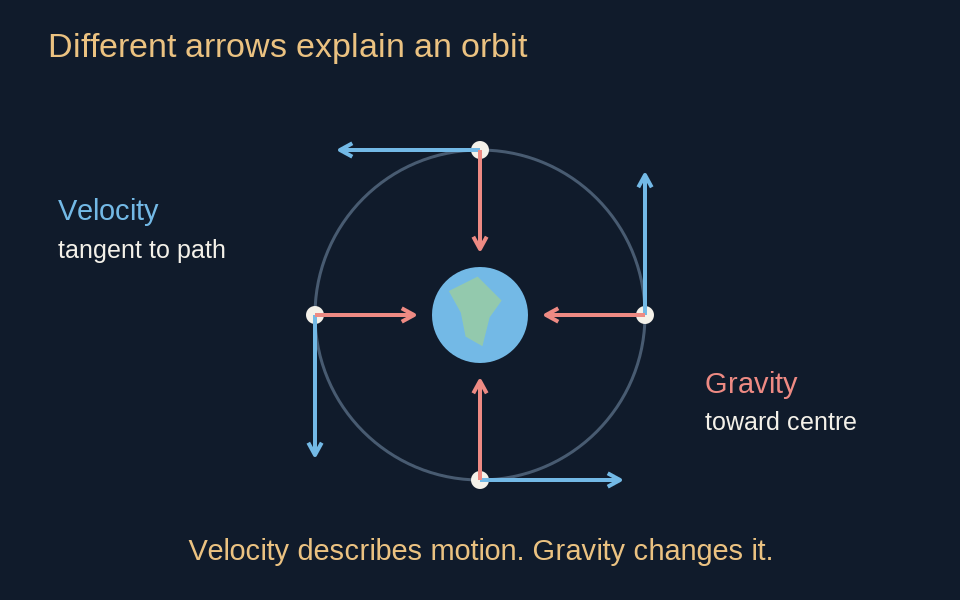
An orbit is a path produced by motion and gravity. Imagine an object moving sideways above Earth. Gravity continually changes its direction toward Earth’s centre. With an appropriate combination of height and speed, the surface curves away beneath the falling object and the object keeps circling. A satellite does not need a solid track in the sky. Its path is the continuing result of its velocity and gravitational acceleration.
THE BIG IDEAS
- An orbit combines motion with gravitational acceleration.
- Elliptical orbits are common.
- A spacecraft’s orbit is chosen to support its mission.
Circles are only one possibility
In an ideal Newtonian system of two bodies, their bound relative orbit is an ellipse. For a small satellite around a much more massive body, that body lies approximately at one focus rather than at the geometric centre. Other bodies and effects can perturb the path.
A circle is a special case of an ellipse. In a noticeably elongated orbit, an object moves faster when closer to the attracting body and slower when farther away. This relationship is useful for understanding comets and spacecraft transfers. A drawing with an exaggerated ellipse can misrepresent a nearly circular planetary orbit.
Changing an orbit
A spacecraft changes its orbit by changing its velocity, usually with a thruster. The result can feel surprising: increasing speed at one point can raise the opposite side of the orbit. An orbital manoeuvre affects the future path, not just the current location. Mission planners consider timing, fuel, atmospheric drag and the gravity of other bodies. A launch vehicle must supply sideways orbital motion as well as lift a spacecraft upward.
Different jobs need different paths
A low Earth orbit allows detailed observations and relatively short communication distances but moves rapidly across the sky. A geostationary satellite follows a circular equatorial orbit in the same direction and with the same period as Earth’s rotation, appearing near one fixed direction from the ground. Polar orbits pass over high latitudes and can help map the globe as Earth turns beneath them. Orbit choice is part of the instrument’s design because it controls what the spacecraft can see.
Read an orbital diagram carefully
Check whether an illustration is drawn to scale and whether it shows a view from above or from the side. Height above the surface is different from distance from Earth’s centre. An arrow may show direction rather than speed. The most useful questions are what body provides the main attraction, how the object is moving and what changed its motion. These questions work for natural moons as well as artificial satellites.
PAUSE AND THINK
Why is simply launching a spacecraft straight upward not enough to put it into a circular Earth orbit?
Explore the answer
It also needs sufficient sideways velocity. Without that motion, gravity brings it back down unless it follows an escaping trajectory.