On this page
THE BIG IDEAS
- Docking needs controlled relative motion and orientation.
- Rendezvous, mechanical connection, undocking and power transfer are distinct tests.
- SpaDeX demonstrated autonomous redocking and electrical transfer in April 2025.
Meeting in orbit takes more than matching a place
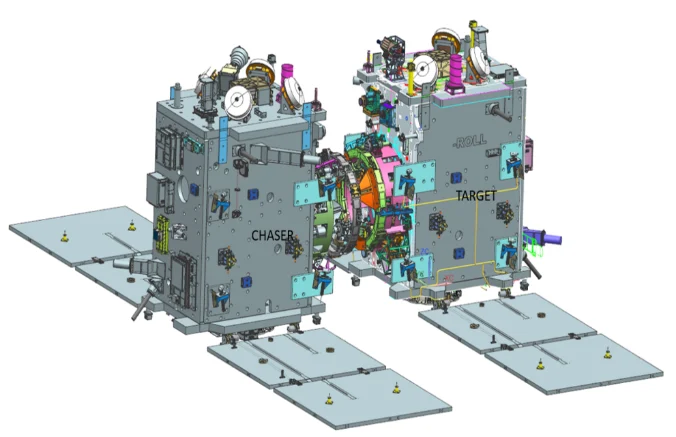
SpaDeX, the Space Docking Experiment, used two small spacecraft to demonstrate rendezvous, docking and related operations. They were launched together on PSLV-C60 on 30 December 2024. The engineering challenge was to bring them into a controlled relative position and orientation, then connect them.
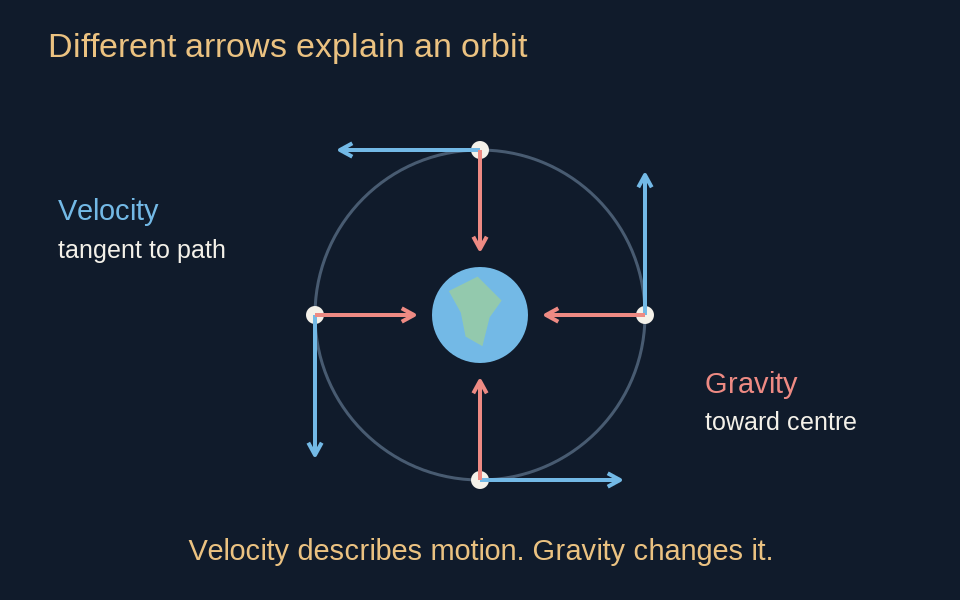
Two vehicles can be at nearly the same location and still be moving dangerously fast relative to one another. A docking plan must control relative velocity as well as separation. In orbit, changing a spacecraft’s velocity also changes its future path. It is not simply steering a car directly toward a parked target.
Rendezvous and docking are different tasks
Rendezvous establishes the required proximity and relative motion. Docking makes a mechanical connection between the spacecraft. Operating as a connected pair introduces further questions about control and resource transfer. Successful separation, or undocking, is another operation to demonstrate.
The SpaDeX design combined sensors, communication and control algorithms with a docking mechanism. Different measurements are useful at different ranges. A plan can include pauses to assess conditions before the next approach stage rather than treating every hesitation as a failure.
Read the verified sequence
The first docking took place on 16 January 2025. ISRO reported successful undocking on 13 March 2025. A second docking was completed on 20 April 2025, with an autonomous final approach from a separation of 15 metres. Electrical power transfer in both directions was demonstrated on 21 April.
These milestones answer different questions. A mechanically connected pair has not automatically proved that electricity can be transferred successfully. A successful one-time connection has not by itself demonstrated every future use of docking in a larger spacecraft programme.
Try a safe relative-motion model
Place two paper spacecraft on a table and draw an arrow beside each for its velocity. Start with parallel arrows of equal length. Their separation can remain unchanged even though both are moving. Then change one arrow slightly and describe how the relative position would change.
This is a first model of relative motion, not a simulator of orbital rendezvous. It leaves out gravity’s continuous effect on curved paths and the response of an actual control system. Add that limitation to the drawing rather than using straight tabletop tracks as a prediction of a real docking trajectory.
Measure a claim against its objective
Make a four-row record headed approach, connection, separation and power transfer. Beside each, write the observation that would count as evidence of success. Distinguish a planned action from a completed test and label any illustrative numbers as invented.
Then compare your record with the dated mission announcements. The lesson is how engineers break a demanding objective into checkable operations. Images of two spacecraft close together are useful context, but they cannot establish all the mechanical, electrical and control results without the accompanying measurements and reports.
PAUSE AND THINK
Would two spacecraft with the same speed necessarily be ready to dock?
Explore the answer
No. Their velocity directions, separation, orientation and control conditions also matter. Equal speed alone does not guarantee a small relative velocity or a safe alignment.