On this page
THE BIG IDEAS
- Mangalyaan entered Mars orbit in September 2014.
- Interplanetary navigation must account for moving targets.
- Instrument objectives should not be confused with confirmed results.
An interplanetary milestone
India’s Mars Orbiter Mission, popularly known as Mangalyaan, launched on 5 November 2013 and entered orbit around Mars on 24 September 2014. It was primarily a technology-demonstration mission with a compact scientific payload.
Communication was lost in April 2022 and ISRO subsequently declared the spacecraft unrecoverable after about eight years at Mars. Reaching another planet requires a sequence of precisely planned manoeuvres rather than simply pointing a rocket at a visible red dot. The planet and spacecraft both move throughout the journey.
Why timing and navigation matter
An interplanetary spacecraft must leave Earth on a suitable trajectory and arrive where Mars will be, not where it was at launch. Near arrival it must change velocity to become gravitationally bound to Mars rather than fly past. Communication delays mean many events cannot be controlled as an immediate remote-driving exercise. Navigation, onboard autonomy and carefully tested commands are therefore central parts of the scientific mission’s success.
An orbit with a wide perspective
Mangalyaan followed an elongated orbit around Mars. Different parts of that orbit offered different observing distances and perspectives. A close approach can provide more detail over a smaller area, while a distant view can show the planet’s whole disk and large weather patterns. Neither is inherently the better view. The useful choice depends on the question, the instrument and how observations at different distances are combined.
The scientific payload
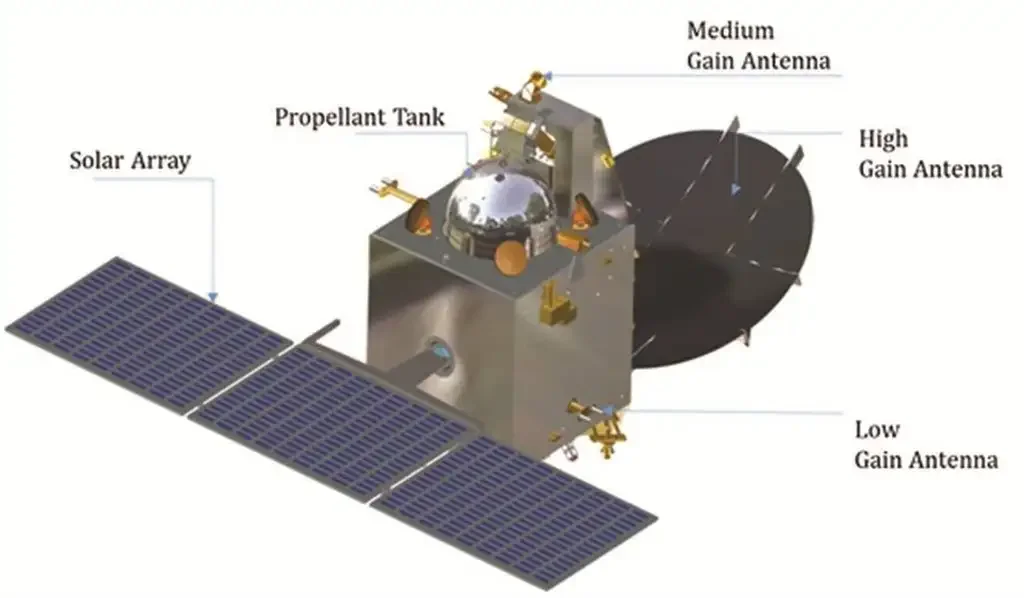
The spacecraft carried instruments including the Mars Colour Camera, a thermal infrared imaging spectrometer and instruments for studying atmospheric gases. Their purposes ranged from recording surface and atmospheric appearance to investigating the planet’s environment. An instrument’s stated objective is not the same as a confirmed discovery. For example, carrying a sensor intended to investigate a gas does not by itself establish that the gas was detected at a scientifically significant level.
What students can take from the mission
Mangalyaan is a useful case study in designing around constraints. Payload mass, power, communication and mission objectives all influence one another. A classroom team can practise this reasoning by choosing three measurements for a fictional Mars orbiter and explaining what must be sacrificed to fit a budget. The lesson is not that one mission answers every question about Mars, but that a focused design can create valuable capabilities and observations.
PAUSE AND THINK
Why might an orbiter take images from both near and far parts of an elongated orbit?
Explore the answer
Close views can reveal local detail while distant views show wider context and the planet’s whole disk. The two scales answer different questions.