On this page
Choose one scale first
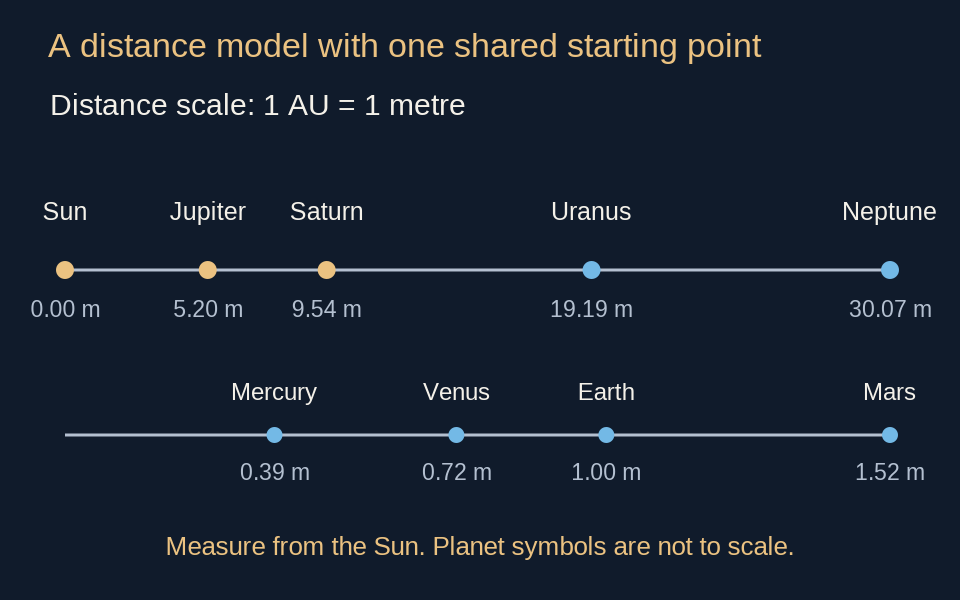
A scale model connects a measured distance to a smaller representation. If the Earth–Sun distance becomes one metre, every other orbital distance must use the same conversion. An astronomical unit, or AU, is a standard length based on the Earth–Sun distance, approximately 149.6 million kilometres. Using AU makes comparisons easier: it replaces long strings of kilometres with numbers that reveal the structure of the planetary system.
THE BIG IDEAS
- AU is a convenient unit for planetary distances.
- Planetary orbits are not evenly spaced.
- Size and distance often require separate classroom scales.
Distances are not evenly spaced
The inner planets cluster relatively close to the Sun. The giant planets occupy a much larger region, with Neptune about thirty AU from the Sun on average. A line of eight equally spaced dots may help remember names, but it hides this important pattern. Planetary orbits are not identical circles, so a single quoted distance is usually a representative value such as the semi-major axis rather than an unchanging separation.
Sizes cause a second problem
At a distance scale small enough to fit the planetary system on a playground, most planet models must be tiny. Enlarging them makes the display readable but introduces a second scale. That is acceptable if it is labelled clearly. A good exhibit might say that distances are to scale while planet sizes are enlarged. Without that explanation, viewers can leave with a false impression of planets nearly touching their neighbours.
Light offers another ruler
Light needs roughly eight minutes to travel from the Sun to Earth. Signals from distant spacecraft take much longer, so a command and reply cannot be instantaneous. Light-travel time is useful because it connects astronomical distance with an experience people understand: waiting. It does not mean the spacecraft itself moves at light speed. Radio signals are electromagnetic waves, while a spacecraft travels far more slowly through space.
Make your model communicate honestly
Choose a straight safe route and calculate positions before placing markers. State whether your model shows average orbital distances or a particular arrangement. Do not imply that all planets actually line up. Keep a second small diagram for planet sizes if necessary. After walking the model, ask which fact surprised you most: the crowded inner region, the gap to the outer giants or how small Earth becomes. The explanation is as valuable as the arithmetic.
PAUSE AND THINK
If one AU is represented by one metre, about how far from the Sun marker would Neptune go?
Explore the answer
About thirty metres. This represents its approximate average orbital distance rather than its distance on every date.