On this page
THE BIG IDEAS
- Jupiter’s visible bands are atmospheric features.
- The four bright moons are not always all visible.
- Timed sketches reveal orbital motion.
A bright point becomes a world
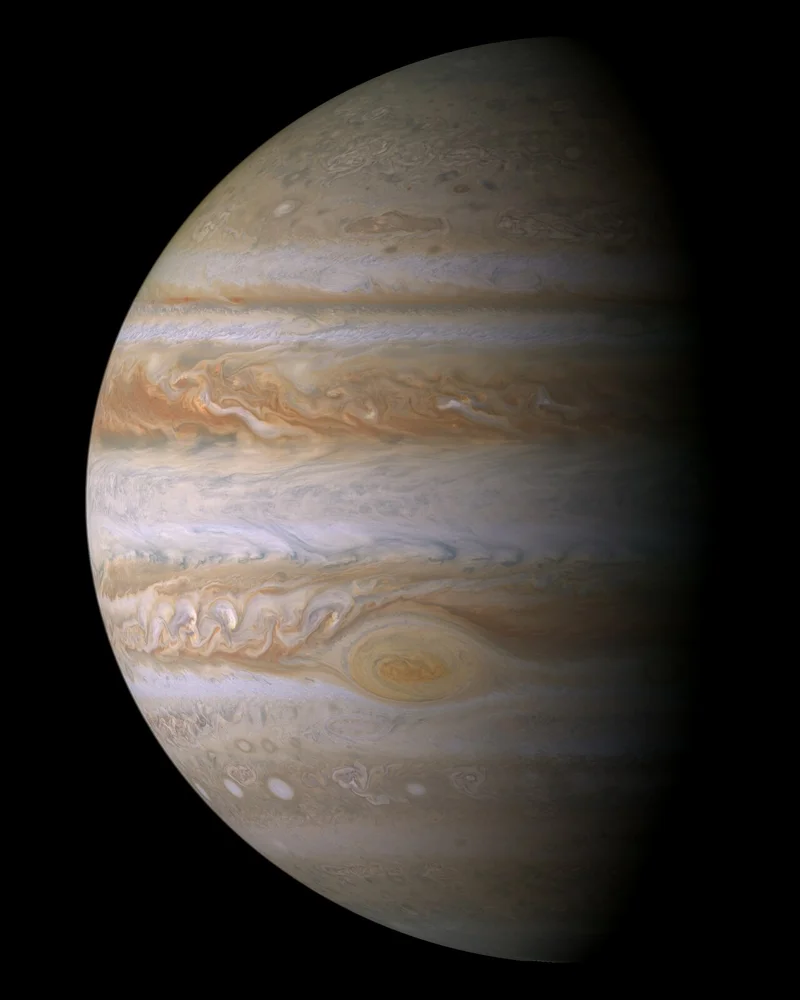
Jupiter often looks like a conspicuous point of light to the unaided eye. A telescope reveals a small disk rather than a point. The planet is a gas giant, so the visible bands are patterns in its atmosphere. You are not seeing a solid surface beneath the clouds.
Its four large Galilean moons are useful beginner targets. Their positions can change enough to notice within an evening. This makes Jupiter especially rewarding when you compare observations instead of treating the first glance as the whole experience.
Find the planet for this date
Jupiter changes position against the stars over time. Use a current planetarium view set to your observing location, date and local time. Confirm the direction and height above the horizon before pointing a telescope. A planet’s brightness is helpful but does not make identification certain.
Choose a time when Jupiter is reasonably high. Looking close to the horizon sends its light through more atmosphere and often produces a wavering image. Avoid aiming over a warm roof or road if another safe position offers a clearer path.
Begin with the moons
At low power, look for small points arranged roughly in a line on either side of the planet. You may see fewer than four because a moon is behind Jupiter, in its shadow or passing in front of the disk. Nearby background stars can also confuse the picture.
Sketch the planet as a circle and mark every nearby point. Record the time carefully. Identify the moons afterwards with a chart for that exact moment rather than guessing from which one seems closest.
Look patiently for cloud belts
Once the telescope is focused, try a moderate increase in magnification. Let the image settle after touching the focuser. Two broad belts are often the first atmospheric features noticed. Some moments may appear sharper than others because air turbulence is changing.
The Great Red Spot is not always facing Earth and is not guaranteed to be obvious in a small telescope. Avoid turning an expected feature into an imagined observation. A confident record of two belts is more useful than a detailed drawing copied from a photograph.
Return after a short interval
Make a second moon sketch later in the same session, keeping the orientation consistent. Note which points moved and which stayed in place. If conditions deteriorate, record that too. You are building a small time series, not competing for the largest number of features. Keep equipment away from the Sun and supervise young observers around cables and tripod legs.
PAUSE AND THINK
Does seeing only three points beside Jupiter mean one of its large moons has disappeared?
Explore the answer
No. A moon may be behind the planet, in its shadow or crossing the disk, where it is harder to distinguish.