On this page
What you see from Earth
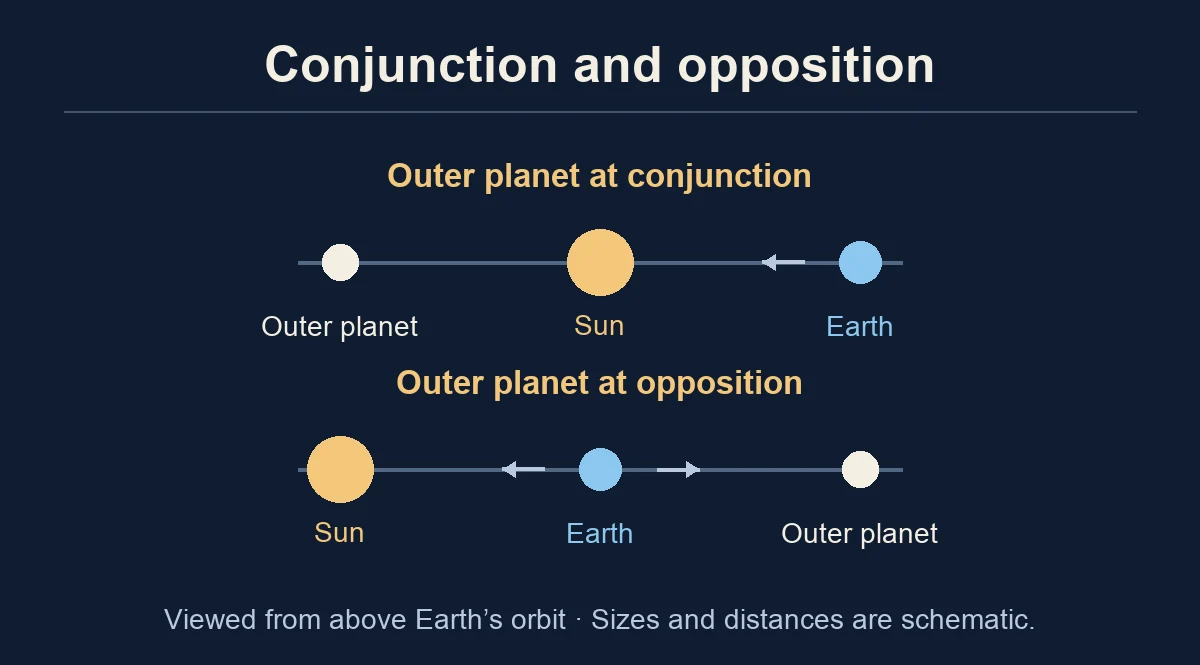
Planets outside Earth’s orbit, including Mars, can reach opposition. If Jupiter is near solar conjunction, it is in the bright sky close to the Sun. There is little or no dark-sky viewing time. At opposition Jupiter rises around sunset, crosses its highest point near the middle of the local night and sets around sunrise. This is a good period to look at its clouds or moons, especially when it is high enough to clear local haze.
An almanac usually gives one instant for an opposition or conjunction. The favourable viewing conditions around opposition typically last much longer than that instant. Weather, the length of the night and obstructions at the horizon affect the hours you can use.
| Event | Seen from Earth | Practical result |
|---|---|---|
| Solar conjunction | Planet near the direction of the Sun. | Wait for the planet to move into a safer and darker part of the sky. |
| Opposition | Outer planet near the direction opposite the Sun. | Often visible for much of the night. |
| Two planets in conjunction | The planets share nearly the same direction along one sky coordinate. | They may make a close-looking pair if the event is visible after dusk or before dawn. |
Why Mercury and Venus have two kinds of solar conjunction
Mercury and Venus orbit inside Earth’s orbit. At inferior conjunction the planet passes roughly between Earth and the Sun. At superior conjunction it passes roughly behind the Sun. Both events put the planet in the Sun’s direction from Earth, so neither planet reaches opposition.
If the inner planet crosses directly in front of the Sun’s visible disc at inferior conjunction, the event is a transit. Usually its tilted orbit carries it a little above or below the solar disc.
When two planets appear close together
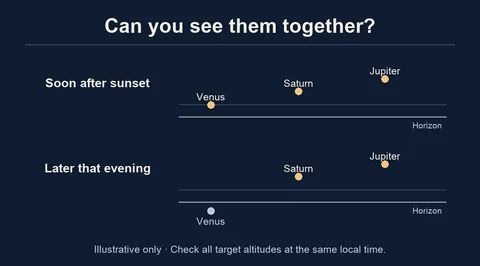
You may hear that Venus and Jupiter are in conjunction. That is a description of directions in the sky. The planets can be very far apart in space. A conjunction time and the minimum angular separation can differ because the planets can move across the sky at different angles.
Check the closest-looking evening or morning with a chart set to your location. If the objects are near the Sun, skip the attempt. Never sweep the sky near the Sun with binoculars or a telescope.