On this page
Why the shape changes
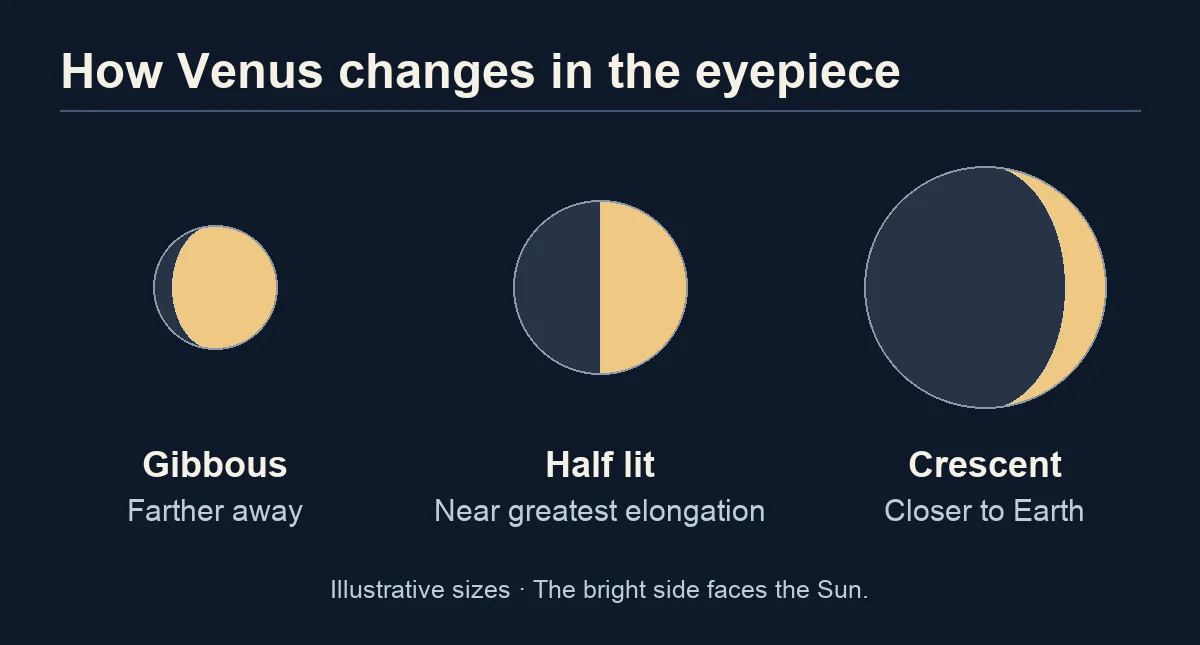
Sunlight illuminates half of Venus. From Earth we see different amounts of that lit half as Venus moves around the Sun inside Earth’s orbit. Near the far side of the Sun, much of the illuminated half faces Earth. When Venus is on the near side, most of the lit half faces away and we see a thin crescent if the planet is sufficiently separated from the Sun.
Near its greatest separation from the Sun in our sky, Venus often looks roughly half lit. Almost full and almost new phases happen close to the Sun in the sky, where they are difficult or unsafe to try to observe.
Why the thinner phase can look bigger
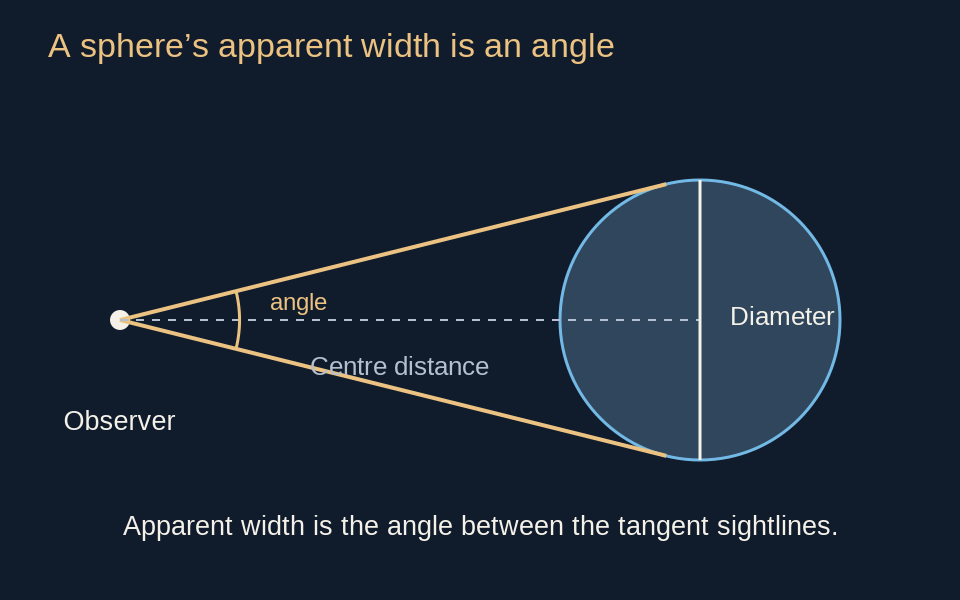
Two things are changing. The phase tells you what fraction of the disc is lit. Apparent diameter tells you how large the whole disc would look if you could see its edge all the way around. A nearby crescent can span more of the eyepiece than a farther gibbous Venus even though the lit fraction is smaller.
To compare sketches, keep the eyepiece the same. Draw a circle around each visible phase to estimate the full diameter. If you only draw the bright area, the change in apparent diameter is harder to see.
How to observe Venus safely
Pick an evening when a chart shows Venus well clear of the Sun and high enough after sunset to see above your local horizon. Wait until the Sun has set before pointing a telescope. For a morning session, pack the telescope away before sunrise. If Venus and the Sun are close together in the sky, wait for a safer date.
Centre Venus at low power before increasing magnification. On a night with unsteady air its shape can waver. Try another night during the same part of its visibility period and compare drawings a few weeks apart.