TRY IT YOURSELF
Angular size
Moon example: about 0.518° or 31.1 arcminutes
On this page
THE BIG IDEAS
- Angular size measures apparent width rather than physical size.
- The calculator assumes a sphere and a centre-to-observer distance.
- The example Moon distance is not a live measurement.
Size in the sky
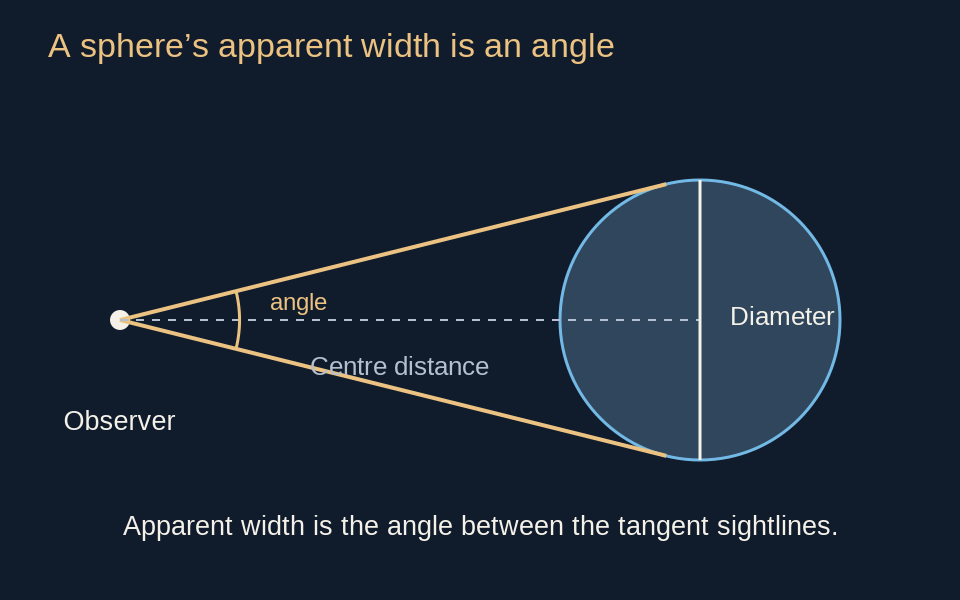
Astronomers describe apparent width using angles. A full circle contains 360 degrees. One degree contains 60 arcminutes and one arcminute contains 60 arcseconds. These units describe how much of your field of view an object occupies, not how wide it is in kilometres.
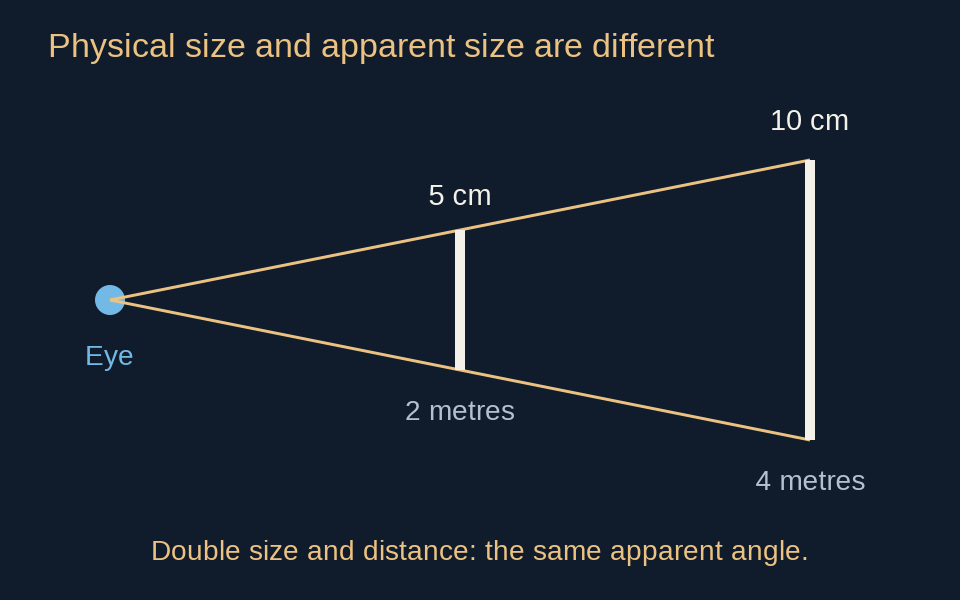
A nearby small object can look wider than a distant large one. Hold a coin at two different distances from your eye to see this relationship without any astronomical equipment.
The geometry used here
This calculator treats the target as a sphere. Enter its physical diameter and the distance from the observer to its centre in kilometres. It calculates 2 × arcsin(diameter ÷ twice the distance), then converts the result from radians to degrees. The observer must be outside the sphere.
For distant objects whose diameter is tiny compared with their distance, the angle in radians is approximately diameter divided by distance. This is the small-angle approximation. A flat disk at close range has different exact geometry, although the small-angle result is similar at large distances.
Try the Moon example
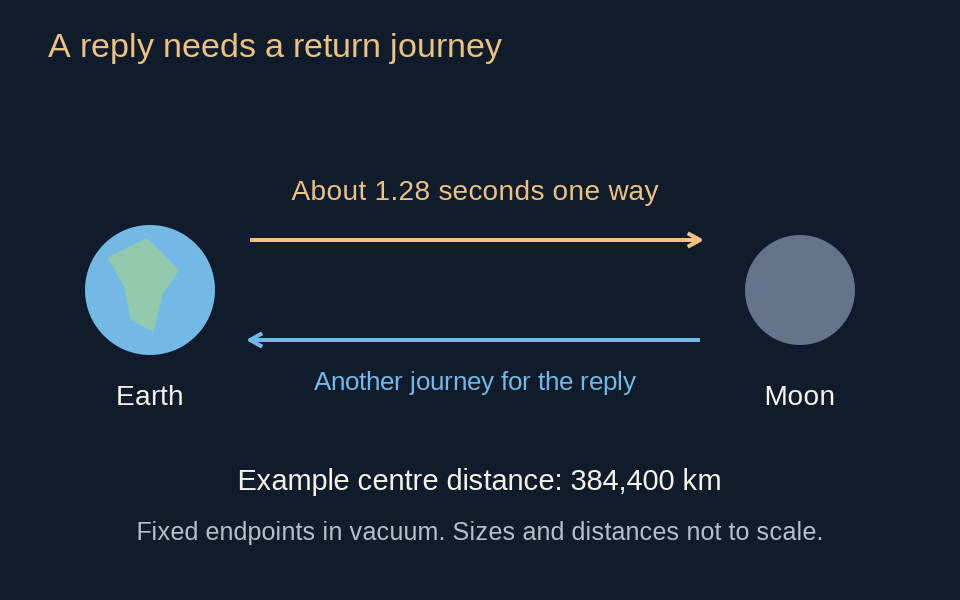
Using a rounded lunar diameter of 3,474.8 km and an illustrative centre distance of 384,400 km gives roughly 0.518 degrees, or about 31 arcminutes. These are example inputs. The Moon’s actual distance changes throughout its orbit, so its apparent diameter also changes.
Double the distance while leaving the diameter unchanged. The apparent size becomes approximately half as large. Then restore the distance and double the diameter. The apparent size becomes approximately twice as large.
Interpret the result carefully
The tool does not calculate tonight’s lunar distance or a planet’s location. It also leaves out atmospheric refraction and the effects of image processing. Use a current ephemeris if you need the angular diameter for a particular observing date.
The result can help compare a target with a telescope’s true field of view. A target may fit numerically but still be difficult to see because of low surface brightness, poor contrast or bright sky. Angular size is only one part of observing.
PAUSE AND THINK
Why can the Moon and Sun look similar in apparent size?
Explore the answer
A much larger object can have a similar angular size when it is much farther away. Similar apparent widths do not mean similar physical diameters.