On this page
A journey turns time into distance
A light-year is the distance light travels in vacuum during one year, about 9.46 trillion kilometres. Despite its name, it measures length rather than time. The idea is similar to saying a village is a two-hour walk away, except that the speed of light is precisely defined while walking speeds vary. Astronomers need large distance units because kilometres become cumbersome when describing the separation between stars.
THE BIG IDEAS
- A light-year measures distance.
- Distant light shows objects at an earlier time.
- Light-travel time is not a spacecraft journey estimate.
Seeing into the past
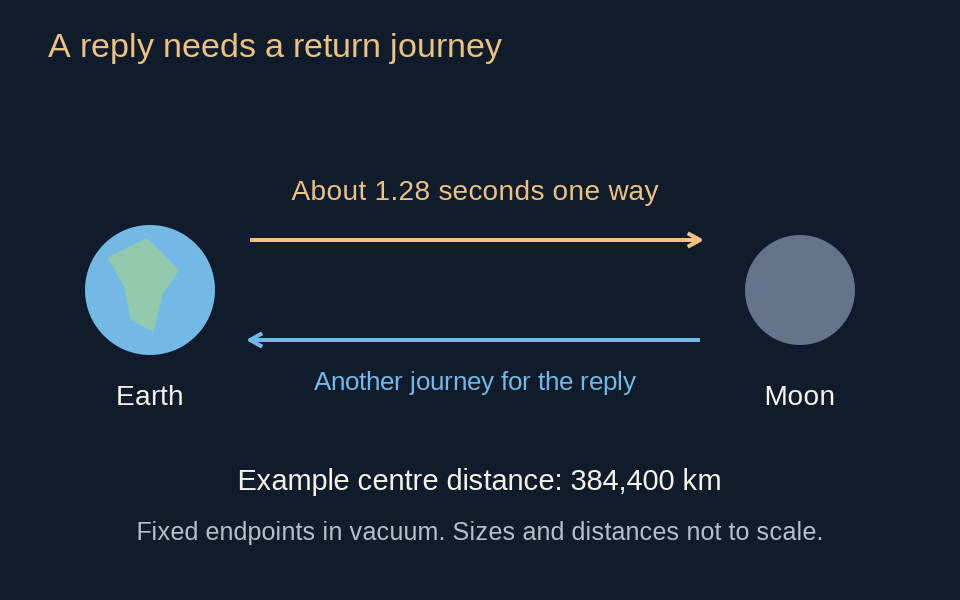
Light carries information and takes time to reach us. If a star is ten light-years away, the light entering our telescope left it about ten years earlier. We see that star as it was then. This does not make the image false: it is the physical information available at our location. Even the Moon and Sun are seen after a light-travel delay, although those delays are much shorter than for distant stars.
Distance does not reveal travel time for a spacecraft
A star four light-years away is not a four-year spacecraft journey with present technology. Four years would be the vacuum light-travel time in a simple stationary picture. Actual spacecraft move much more slowly. Interstellar travel also raises questions about acceleration, energy, navigation and protecting equipment. It is useful to keep a distance statement separate from any claim about how long a real mission would take.
Other astronomical units
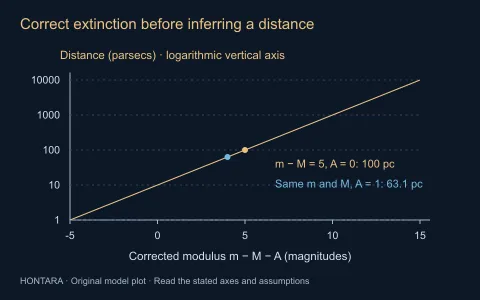
AU works well within planetary systems. Light-years are familiar in public explanations of stellar distances. Astronomers also use parsecs, a distance unit connected to the apparent shift of nearby stars as Earth moves around the Sun. One parsec is about 3.26 light-years. A unit change does not change the physical separation. It changes how conveniently the number relates to a measurement method or to the scale being discussed.
Do not confuse looking back with a map
For nearby stars, distance and light-travel time are closely connected in this simple way. At cosmological distances the expanding universe makes the relationship more complicated. The time light has travelled and the present separation of distant galaxies are not interchangeable numbers. Start by stating what a quoted distance means. This habit prevents a useful beginner explanation from being stretched beyond the situation in which it works.
PAUSE AND THINK
If two stars are five and fifty light-years away, which one are we seeing farther into the past?
Explore the answer
The star fifty light-years away, because its light has taken longer to reach us.