On this page
THE BIG IDEAS
- Keep kilometres and metres consistent.
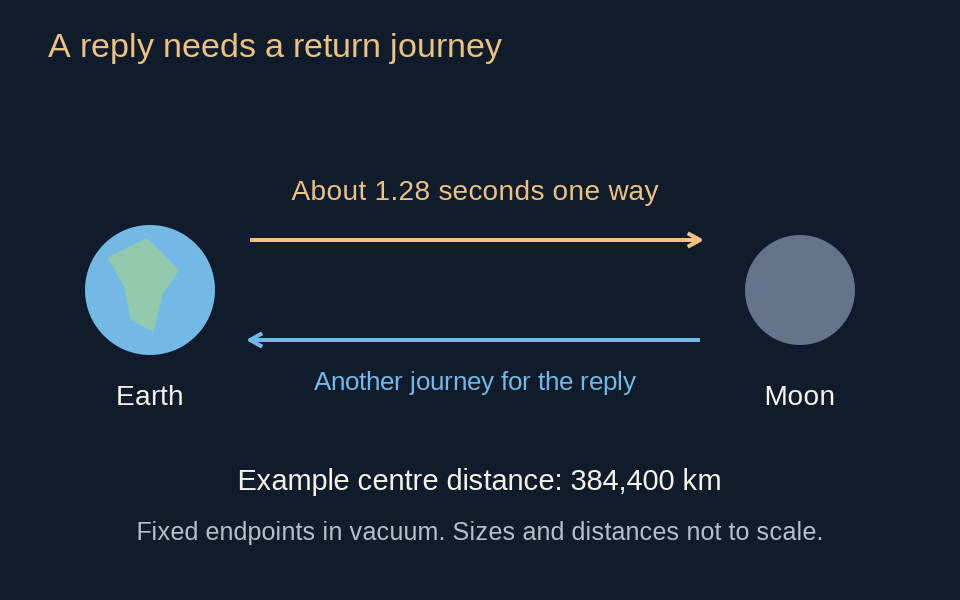
- A response contains two travel legs.
- Capacity improvements do not change vacuum c.
Preparation and success criteria
Learners should calculate one-way and round-trip propagation times then place a response on a timeline that includes processing. Supply calculators, paper message slips, a clock showing seconds and the paired worksheet. No network, phone call or live mission feed is required.
The invented fixed paths are exact multiples of c expressed as 299,792.458 km/s. They are not current distances to named worlds. Use A = 2,997,924.58 km, B = 17,987,547.48 km and C = 89,937,737.4 km. Identify this construction clearly on any board copy.
Minutes 0-10: diagnose instant-conversation thinking
Ask what must happen between sending a question and reading a reply. Elicit outbound travel, processing at the receiver and return travel. A learner who includes only the outward path has not yet modelled a complete exchange.
Introduce the exact vacuum speed 299,792,458 m/s and convert it to kilometres per second by dividing by 1000. Radio and laser signals share this speed. Distinguish sending more information each second from reducing the journey time of the first signal.
Minutes 10-25: calculate before acting
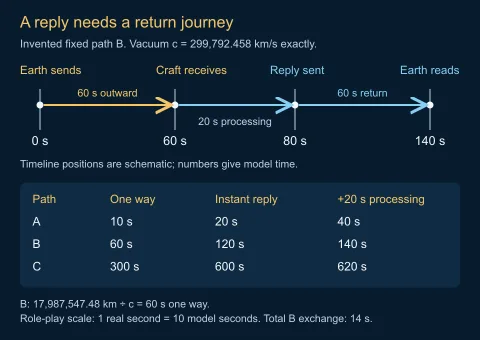
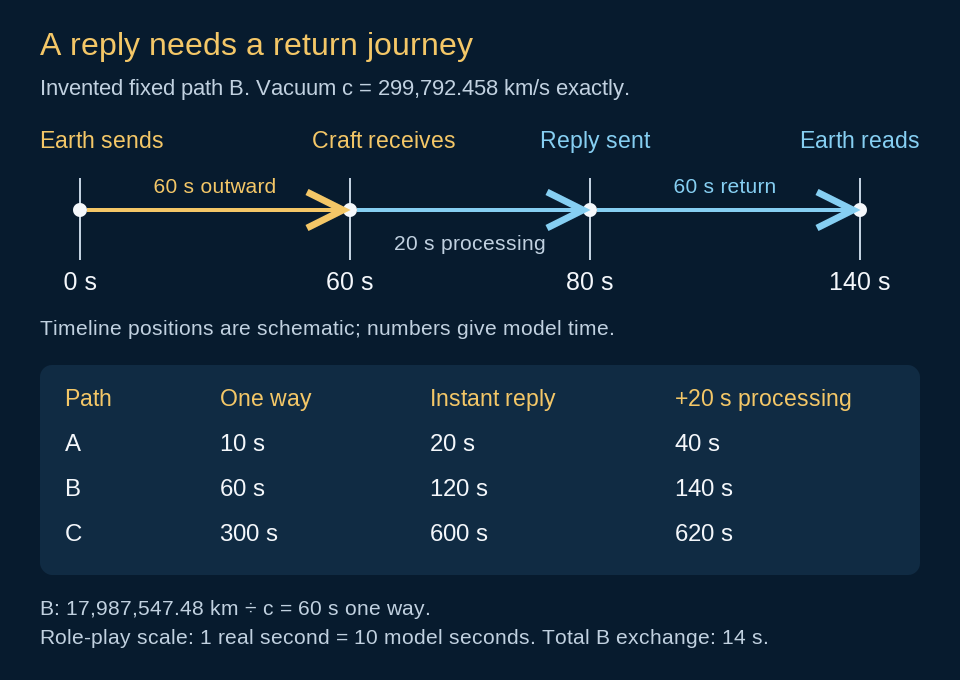
The table’s one-way answers are A = 10 s, B = 60 s and C = 300 s. Immediate round trips are 20 s, 120 s and 600 s. With one 20 s receiver-processing interval the exchanges become 40 s, 140 s and 620 s.
Check that units cancel in distance/speed and that learners have not divided kilometres by a value in metres per second. Ask one group to show the calculation for B while another verifies it by multiplying 60 s by 299,792.458 km/s.
Minutes 25-35: simulate path B
Allocate Earth, spacecraft and timekeeper roles. Use one real second for ten model seconds. The timekeeper releases the outbound slip after 6 seconds, allows 2 seconds for the receiver’s response and releases the reply after 6 more seconds. Learners can remain seated while the timekeeper carries slips.
On the model timeline, Earth sends at 0, spacecraft receives at 60, processing ends at 80 and Earth receives at 140 seconds. The classroom interval is 14 seconds. The time scale changes the role-play duration while the calculation retains the physical value of c.
Minutes 35-45: reason about operations
Ask learners to compare a command needing a new image before the next decision with a pre-planned sequence of safe actions. They should explain why delayed feedback changes planning. Avoid presenting the invented exchange as an actual mission procedure or a first-hand HONTARA classroom result.
Challenge “a laser makes the delay disappear”. NASA’s laser explanation distinguishes information capacity from propagation speed. A valid response notes that both links still have the same vacuum light time for a fixed path, even if their usable data rates differ.
Minutes 45-50: assess with boundaries
The worksheet answer for B with processing is 140 s. Award reasoning credit for a labelled four-event timeline even if a small arithmetic slip occurs. A correct round-trip number without an explanation of the return journey is incomplete evidence of understanding.
For extension, change processing alone from 20 s to 50 s: B becomes 170 s while its 60 s one-way propagation stays unchanged. Note that real changing geometry and additional system delays would need further information. This lesson intentionally isolates the simplest travel-time model.
PAUSE AND THINK
What must be added to twice the light time for a non-instant response?
Explore the answer
The receiver’s processing interval and any other stated system delays. In the supplied model only one 20 s processing interval is added.
RECORD YOUR OWN EVIDENCE
Your activity sheet
You need: Paper message slips, pencil, calculator and stopwatch or clock showing seconds.
Use invented fixed paths A = 2,997,924.58 km, B = 17,987,547.48 km and C = 89,937,737.4 km. Calculate one-way d/299,792.458 seconds and immediate round trip 2d/299,792.458. Role-play B at one real second per ten model seconds: outbound 6 s, processing 2 s and return 6 s.
Name or group: Date:
| Invented path | One-way / s | Immediate round trip / s | With 20 s processing / s |
|---|---|---|---|
| A: 2,997,924.58 km | |||
| B: 17,987,547.48 km | |||
| C: 89,937,737.4 km |
At B, when does Earth receive a reply to a command sent at model time 0 with 20 s processing?
Would more bits per second remove the propagation delay? Explain.
Record what happened, including uncertain results. Use the answer guidance in this resource to discuss your explanation.