TRY IT YOURSELF
Solar System scale
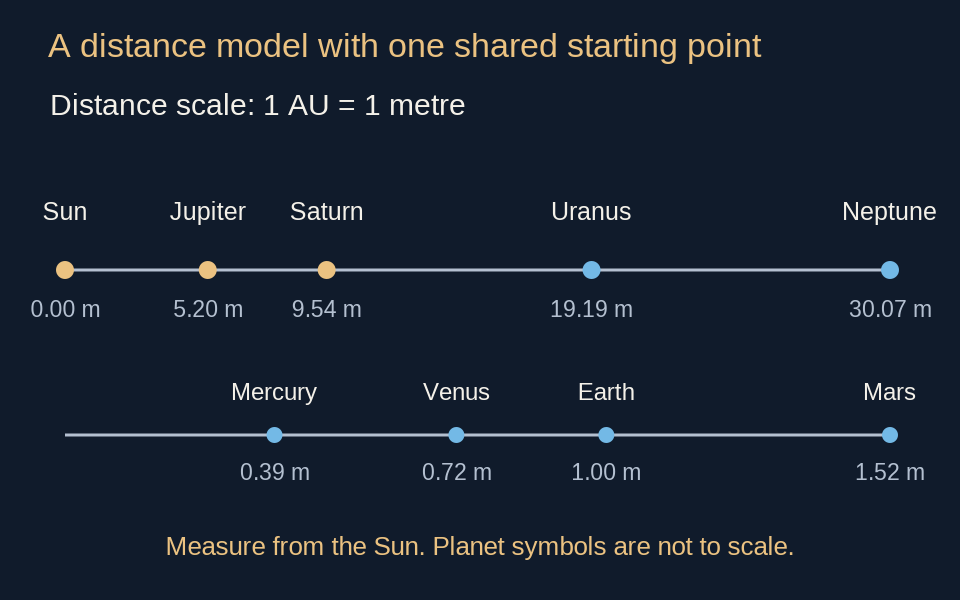
With Earth 1 metre from the model Sun, Earth is about 0.085 mm wide and Neptune is about 30.07 metres away.
On this page
THE BIG IDEAS
- Choose metres per AU to fit the available space.
- Measure each position from the model Sun.
- Use the diameter column to size the Sun and planets at that same scale.
Choose the scale before choosing the space
One astronomical unit (AU) is about 149.6 million kilometres. Enter how many metres in your model should represent 1 AU. The table gives approximate distances from the centre of the model Sun and diameters at the same scale.
At a scale of 1 metre per AU, Earth is 1 metre from the Sun and Neptune is about 30.07 metres away. Reduce the scale to 0.1 metre per AU to fit the same distance sequence into a little over 3 metres. For a longer corridor, 0.3 metre per AU puts Neptune about 9.02 metres from the model Sun.
Read the table as orbital size
The listed AU values are rounded from the J2000 reference entries in JPL’s approximate orbital-element table, with Earth set to 1 AU for the model. They describe semimajor axes, a measure of orbit size. Planetary orbits are ellipses and actual distances change. The planets also do not sit along one straight line. A classroom line model deliberately arranges the markers in a convenient way so distances can be compared.
Do not use this display to predict a conjunction, opposition or launch window. Those questions need orbital positions and time, not just orbital sizes.
Other teaching tables may use slightly different rounded values. Use one table consistently within an activity rather than mixing values from different sources. This calculator keeps its reference distances fixed when you change the model scale.
Build a safe model walk
Choose a clear indoor corridor or an approved outdoor space away from roads. Mark the Sun first. Measure every planet’s position from that same starting point rather than measuring each full table distance from the previous marker. Give each marker a name and its model distance.
Ask learners to predict the midpoint between the Sun and Neptune before measuring it. Many expect Earth or Mars to be near the middle because textbook diagrams often compress the outer planets. The measured layout makes that compression visible.
How big are the Sun and planets in the model?
At 1 metre per AU, the Sun is about 9.3 mm wide, Jupiter is about 0.956 mm wide and Earth is about 0.085 mm wide. At smaller scales, a printed dot can stand in for a planet. Label it as a marker if it is larger than the calculated diameter.
To calculate a model diameter in metres, divide the real diameter in kilometres by 149,597,870.7 and multiply by your model’s metres per AU. The planet sizes use diameters measured across the equator. Saturn’s diameter covers the planet itself.
PAUSE AND THINK
If Earth is placed 2 metres from the model Sun, about how far away is Neptune?
Explore the answer
About 60.14 metres using the rounded orbital value in this tool. A smaller scale may be needed for a classroom.