On this page
THE BIG IDEAS
- A scale statement and units belong beside every result.
- Every orbital distance uses the same origin.
- A useful model can deliberately exaggerate sizes if it says so.
Goals and resources
Students will apply one scale factor consistently, distinguish distance from diameter and explain a model’s limitations. Use rulers, paper, calculators if available and a measuring space. The lesson can remain on paper if there is no safe outdoor route. Prepare orbital-distance values in astronomical units: 0.39, 0.72, 1.00, 1.52, 5.20, 9.58, 19.2 and 30.1 for Mercury through Neptune.
Lesson outline
- Minutes 0-7: Draw eight equally spaced planets and ask what that picture communicates and what it hides.
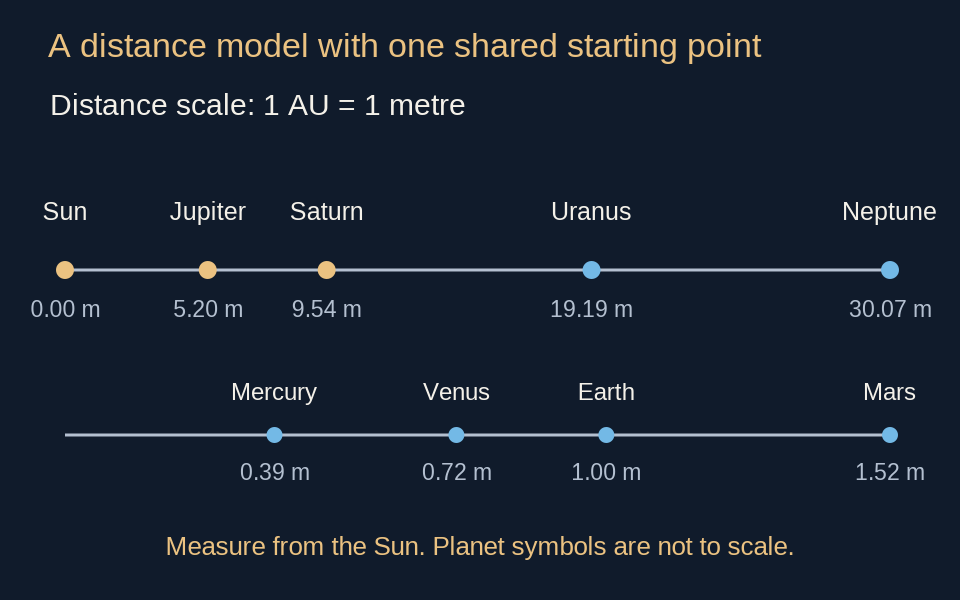
- Minutes 7-17: Establish the scale Earth equals one metre from the Sun. Calculate Mercury, Mars and Neptune together.
- Minutes 17-30: Groups create distance strips or a supervised model with at least 31 metres of clear route for Neptune at 30.1 metres. Allow any additional site clearance needed. Each group checks another group’s units.
- Minutes 30-40: Halve the available space and have students recalculate all distances.
- Minutes 40-50: Discuss planet sizes and complete an individual explanation of why the large paper markers are not scale-sized planets.
Student worksheet
Require a scale statement next to every answer. A correct number with no units is incomplete because readers cannot know what the number represents.
- 1. If Earth is 50 centimetres from the Sun, where should Jupiter and Neptune be placed?
- 2. A group measures Saturn’s distance from Jupiter’s card instead of the Sun. Explain the error.
- 3. Can one metre-wide planet cards accurately represent planet diameters in a thirty-metre model? Explain without calculating every planet size.
Answers and likely misconceptions
For question 1, Jupiter is 260 centimetres or 2.60 metres from the Sun; Neptune is 1,505 centimetres or 15.05 metres away. The listed distances use the Sun as their shared origin, so measuring each from the previous card adds an unintended offset. The large cards mark positions and would enormously exaggerate planetary diameters.
The model uses approximate orbital sizes. It is not a diagram of the planets’ actual arrangement on a particular date. Reinforce that the straight baseline is a measuring convenience rather than a predicted alignment.
Adapt and assess
Provide a conversion table for students who need help switching centimetres to metres. Let groups use repeated multiplication before introducing a general formula. For extension, ask students to choose a scale that fits a measured corridor and justify rounding. Assess consistent scale use, correct origin and clear acknowledgement of exaggerated sizes. Photographing a finished model can support discussion, but the written reasoning is what reveals whether learners understand the proportions.
PAUSE AND THINK
At a scale of Earth equals two metres, how far from the Sun is Mars?
Explore the answer
Mars is about 3.04 metres from the Sun because 1.52 astronomical units is multiplied by two metres per astronomical unit.
RECORD YOUR OWN EVIDENCE
Your activity sheet
You need: Tape measure, planet cards and a safe measured route or paper strip.
Use a scale of 1 AU = 1 metre. Measure every distance from the Sun.
Name or group: Date:
| Planet | Orbit scale (AU) | Model distance (m) | Position checked |
|---|---|---|---|
| Mercury | 0.39 | ||
| Venus | 0.72 | ||
| Earth | 1 | ||
| Mars | 1.52 | ||
| Jupiter | 5.2 | ||
| Saturn | 9.58 | ||
| Uranus | 19.2 | ||
| Neptune | 30.1 |
Why would measuring from the previous planet give a wrong layout?
Do your cards also show planetary diameters to this distance scale? Explain.
Record what happened, including uncertain results. Use the answer guidance in this resource to discuss your explanation.