TRY IT YOURSELF
Light travel time
At 1 AU, light takes about 8 minutes 19 seconds one way and 16 minutes 38 seconds for a round trip.
On this page
THE BIG IDEAS
- The speed used is 299,792.458 km/s in vacuum.
- The calculator shows one-way and round-trip times at the same distance.
- A light-year is a distance, not a duration.
Light has a finite speed
In vacuum, light travels at exactly 299,792.458 kilometres per second. Divide a distance in kilometres by that speed to find a travel time in seconds. The same calculation applies to radio signals in vacuum because radio waves and visible light are both electromagnetic radiation.
Enter a distance rather than a speed. The tool assumes a straight path through vacuum and a fixed distance between the endpoints.
Light time to the Moon, Sun and Mars
One astronomical unit is exactly 149,597,870.7 km. At that distance, light takes about 499 seconds to travel one way, which is approximately 8 minutes 19 seconds. The Earth–Sun separation varies during the year, so a specific day’s travel time can differ from this reference calculation.
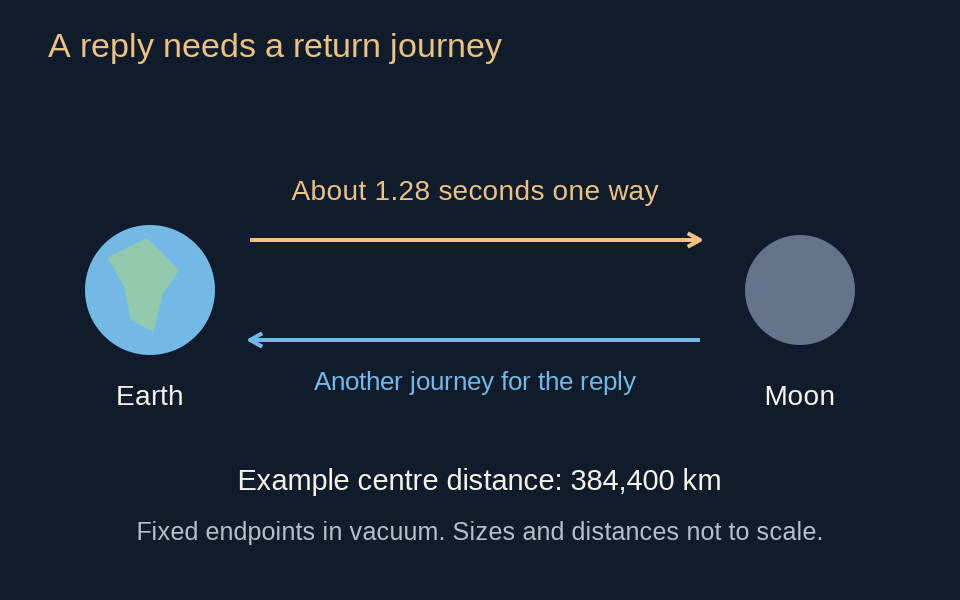
Try 384,400 km for an illustrative Earth–Moon centre distance. The result is about 1.28 seconds. That number explains why even nearby space communication cannot be instantaneous, though actual surface-to-spacecraft distances are different.
The Mars distances are examples from opposite ends of the usual range. The actual separation changes along both orbits.
| Example | Distance | One way |
|---|---|---|
| Earth to Moon | 384,400 km | About 1.28 seconds |
| Sun to Earth | 1 AU | About 8 minutes 19 seconds |
| Nearby Mars | 55 million km | About 3 minutes 3 seconds |
| Distant Mars | 400 million km | About 22 minutes 14 seconds |
| One light-day | 25.902 billion km | 24 hours |
One way is not a conversation
A command sent to a spacecraft takes time to arrive. A response then needs another journey back. With stationary endpoints at the same separation, the minimum round-trip light time is twice the one-way result. Processing, scheduling and communication systems add further delays.
For interplanetary missions the distance keeps changing as planets and spacecraft move. Do not treat a single calculated delay as a permanent property of a mission. Mission teams use precise trajectories and timing systems.
A light-year is a distance
A light-year is the distance light travels in one Julian year of 365.25 days. It is not a unit of time. This calculator sometimes expresses long travel times in Julian years to keep the output readable. That does not turn your input into a light-year measurement.
For very distant galaxies, a simple distance divided by light speed is not enough to describe cosmological distances. The expansion of the universe changes the relationship between different distance definitions. Use this tool for straightforward vacuum travel-time exercises and nearby-scale examples.
PAUSE AND THINK
If a one-way signal takes 10 minutes, can a reply arrive 10 minutes after sending the question?
Explore the answer
No. Even an immediate reply would need another 10 minutes to return, giving a minimum round trip of 20 minutes at fixed separation.