On this page
Why there are antennas on three continents
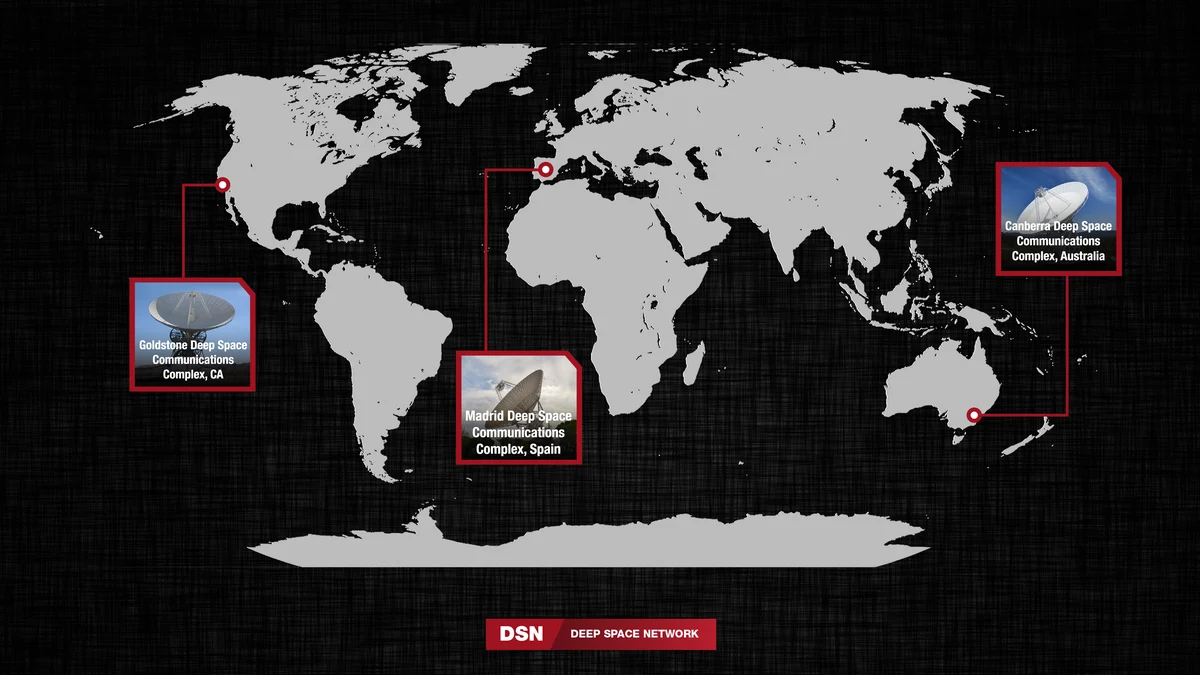
The complexes are near Goldstone in California, Madrid in Spain and Canberra in Australia. Their longitudes are spaced roughly 120° apart. As Earth turns and a spacecraft drops below one site’s horizon, a different site can often take over. Which antenna is available depends on the direction of the spacecraft and the observing schedule.
Large dishes collect weak radio signals and concentrate them onto sensitive receivers. A steerable dish follows the spacecraft’s predicted direction as it moves. Observing teams may schedule more than one antenna when a weak signal requires additional sensitivity.
What goes up and what comes back
The uplink carries instructions from Earth. The downlink carries science observations and spacecraft health readings. Engineers also measure the radio signal to help determine the spacecraft’s trajectory. Tracking can use signal travel time and shifts in its frequency.
A carrier signal tells a station that it has received radio energy at the spacecraft’s frequency. Recovering science or engineering data is another step. The receiver has to distinguish changes encoded in the signal from noise.
Why commands are planned ahead
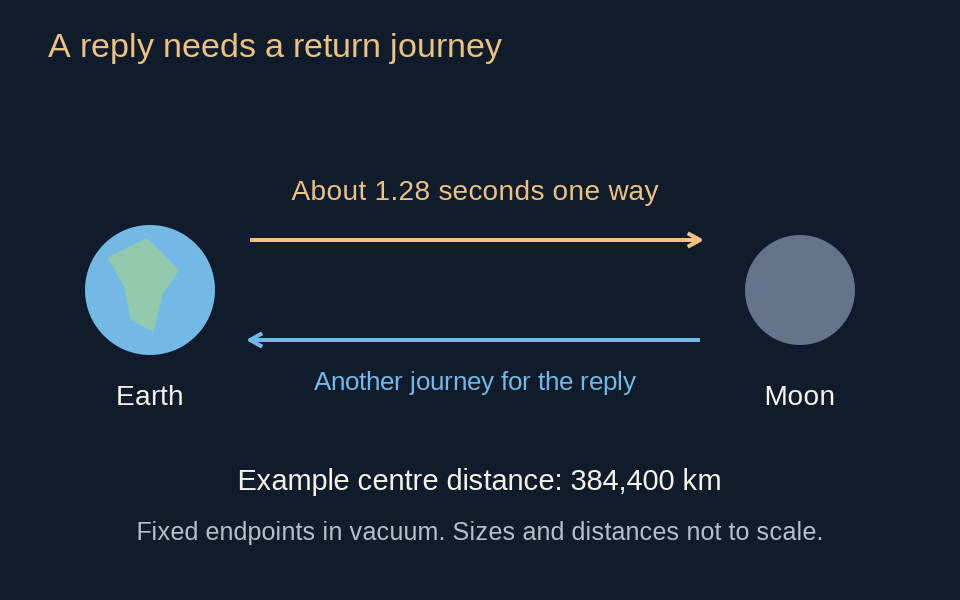
For a Mars spacecraft 55 million kilometres away, the signal takes about three minutes to arrive. At 400 million kilometres the same trip takes about 22 minutes. A reply takes roughly as long again. Mission teams send commands in sequences and design spacecraft to handle some situations on their own.
Distance also weakens the signal. A mission may use a slower transmission rate to give the receiver more time to distinguish the bits. Extra time collecting those bits improves reception. The delay while the radio waves cross space is set by the separation and the speed of light.