On this page
THE BIG IDEAS
- Voyager used flybys and gravity assists to explore the giant planets.
- Voyager 2 visited all four giant planets.
- The heliopause is a particle-environment boundary rather than the end of all solar influence.
Two spacecraft and a changing journey
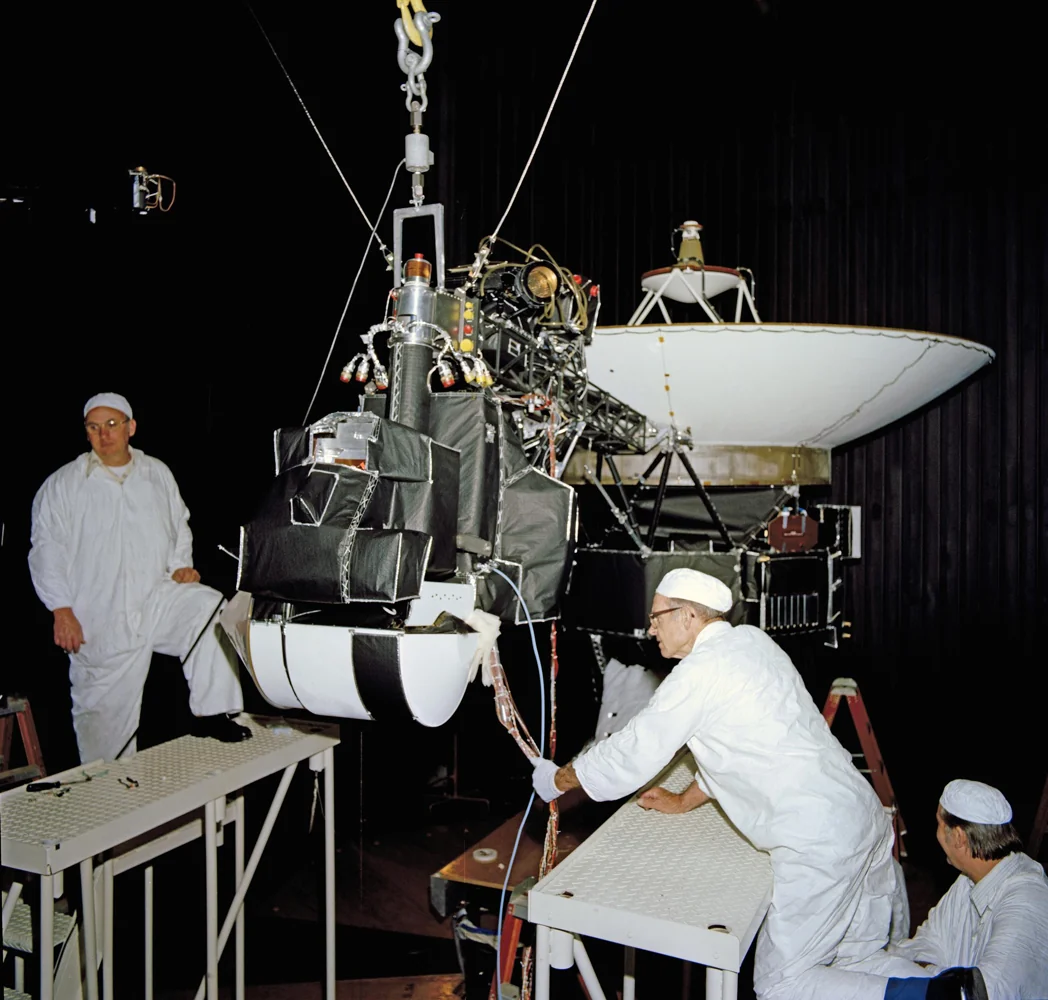
Voyager 1 and Voyager 2 launched in 1977 to explore the outer Solar System. Both encountered Jupiter and Saturn, while Voyager 2 went on to Uranus and Neptune. These were flybys rather than missions that settled into orbit around each planet. A flyby provides a relatively short close encounter, so observations must be planned carefully. The spacecraft’s path and available communication time determine which measurements can be made.
Using planetary motion
Gravity assists helped reshape the spacecraft trajectories. During a close encounter, a planet’s gravity changes a spacecraft’s motion relative to the Sun by exchanging a tiny amount of energy and momentum with the planet. This does not create energy from nothing. It uses the moving planet as part of the navigation problem. The favourable arrangement of the giant planets made an extended sequence of encounters possible for Voyager 2.
Worlds became places
The encounters revealed detailed environments around the giant planets and their moons. Images and other instruments transformed distant points into worlds with geology, atmospheres, rings and magnetic interactions. Jupiter’s moon Io, for example, showed active volcanism. The scientific lesson is that moons are not necessarily inactive copies of Earth’s Moon. Their composition, internal energy and interactions with their parent planets can create very different physical histories.
Crossing the heliopause
Voyager 1 crossed the heliopause in 2012 and Voyager 2 in 2018. This boundary separates the Sun-dominated solar-wind environment from the surrounding interstellar medium. Crossing it is not the same as leaving all of the Sun’s gravitational influence or passing every distant Solar System object. The phrase interstellar space needs that context. Different definitions of the Solar System’s edge answer different questions about particles, magnetic fields and orbital populations.
A lesson in distant communication
At great distances, radio signals take many hours to travel between Earth and a spacecraft. Available power and communication capacity also constrain operations. Voyager is therefore a case study in patient measurement and long-term engineering rather than instant remote control. When reading a mission update, distinguish a spacecraft’s distance from its signal travel time and from the time needed to analyse its data. Those related quantities describe different parts of the story.
PAUSE AND THINK
Did crossing the heliopause mean that Voyager had passed every object orbiting the Sun?
Explore the answer
No. Very distant bodies can still orbit the Sun beyond that boundary. The heliopause describes the solar-wind environment.