TRY IT YOURSELF
Distance from same-band magnitudes
m = 10, M = 5 and A = 0 give 100 parsecs. All three magnitude values must refer to the same band.
On this page
THE BIG IDEAS
- All three magnitude inputs must use the same band.
- Positive extinction is subtracted in the corrected modulus.
- The tool does not determine an object’s absolute magnitude or dust correction.
Keep three magnitude quantities in one band
Enter apparent magnitude m, absolute magnitude M and extinction A for the same photometric band. Absolute magnitude describes the brightness a source would have at the standard distance of 10 parsecs without intervening extinction. The calibration of M must be appropriate for the object being studied.
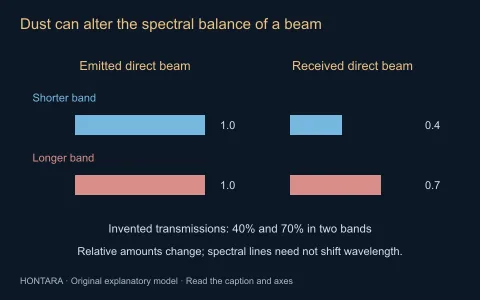
For example, a visual apparent magnitude cannot be combined casually with an infrared absolute magnitude. A numerical calculation would still run, but the quantities would not describe the intended physical comparison. Extinction is also wavelength dependent and must refer to that chosen band.
Follow the corrected modulus
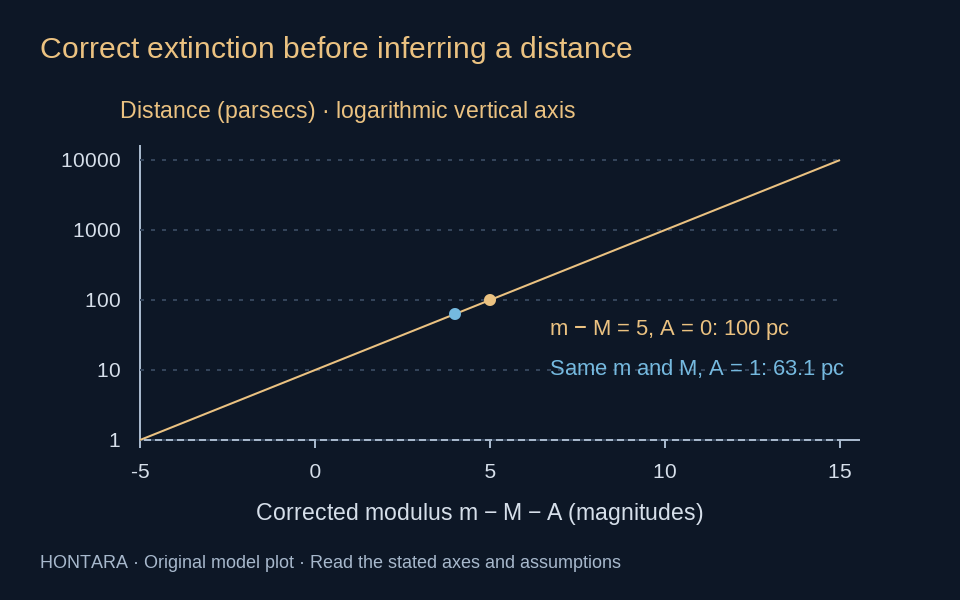
The model uses m − M − A = 5 log₁₀(d/10 pc). Rearranging gives d in parsecs as 10 raised to the power (m − M − A + 5)/5. Extinction is subtracted because some apparent faintness came from intervening material rather than distance alone.
An input of zero for A is an assumption of no correction, not a measurement proving the absence of dust. This tool does not infer extinction, classify the source or determine its absolute magnitude from a spectrum. Those are separate observational and modelling tasks.
Work through a transparent example
For invented same-band inputs m = 10, M = 5 and A = 0, the corrected modulus is five and the distance is 100 parsecs, approximately 326 light-years. Increasing m to 15 with the other values fixed gives 1,000 parsecs.
Now return to m = 10 and include A = 1 magnitude. The corrected modulus becomes four and the inferred distance is about 63.096 parsecs. It decreases because part of the observed dimming is now attributed to extinction. Reversing that sign would make an already uncertain inference worse.
When m equals M and extinction is zero, the calculation returns 10 parsecs. This is a useful check against the definition of absolute magnitude rather than an independent measurement of a source.
Read a ratio before trusting digits
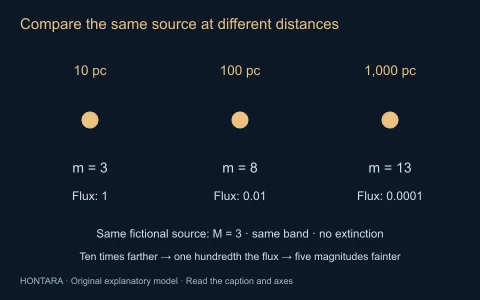
At fixed absolute magnitude and extinction, a five-magnitude increase in apparent magnitude corresponds to ten times the distance in this inverse-square framework. A one-magnitude change corresponds to a factor of about 1.585 in distance, not a factor of one or five.
The worked values are teaching inputs rather than measurements of a named star. Displayed decimal places describe arithmetic, not the accuracy of an absolute-magnitude calibration or extinction estimate. Preserve their uncertainties and model assumptions in any scientific application.
Know when the simple inference is insufficient
Variable stars, unresolved companions, incorrect band conversions and uncertain calibration can affect an inferred distance. Cosmological applications also require appropriate corrections and a clear definition of distance; this is not a redshift-to-distance solver.
Use the tool to explore a same-band relation and its sensitivity to assumptions. For catalogue or research work, follow the relevant data release and published distance method rather than treating a plausible-looking number as confirmation that the inputs were physically compatible.
PAUSE AND THINK
Why does a positive extinction correction reduce distance for fixed m and M?
Explore the answer
Some apparent faintness is assigned to intervening extinction, so less distance-related dimming is required. The corrected modulus m − M − A becomes smaller.