On this page
Follow what leaves the light beam
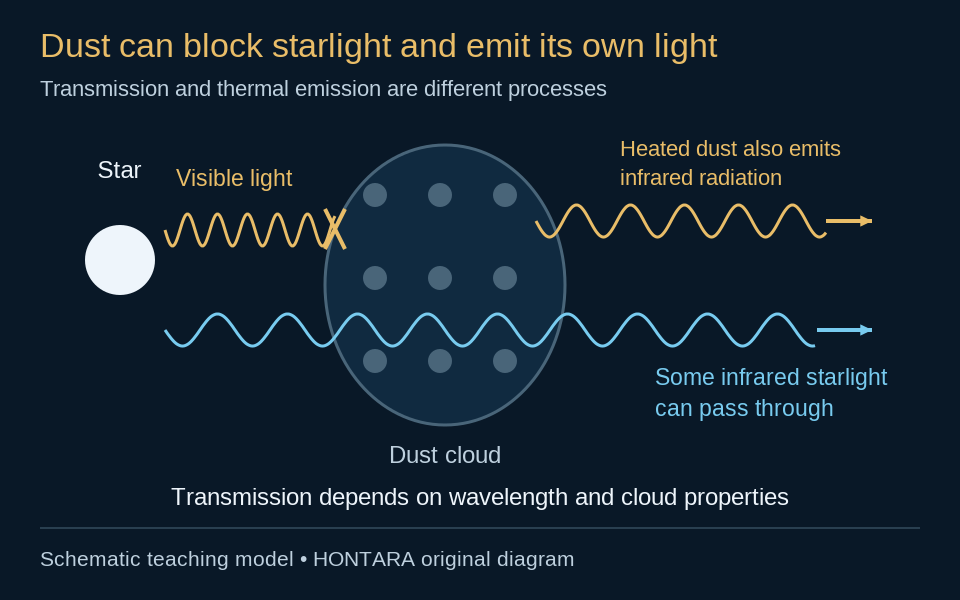
Interstellar dust can absorb light and scatter it out of a line of sight. Both processes reduce the direct light reaching an observer and contribute to extinction. The dust grains are mixed with gas, but the obscuring effect is not identical at every wavelength.
A foreground cloud may hide some stars strongly while leaving others less affected because they lie in front of it or along different paths. A dark patch in an image is therefore not necessarily an empty region with no stars behind it.
THE BIG IDEAS
- Extinction removes direct light through absorption and scattering.
- Reddening changes spectral balance rather than shifting every line.
- A full line-of-sight dust column may exceed the foreground to a nearby star.
Separate reddening from redshift
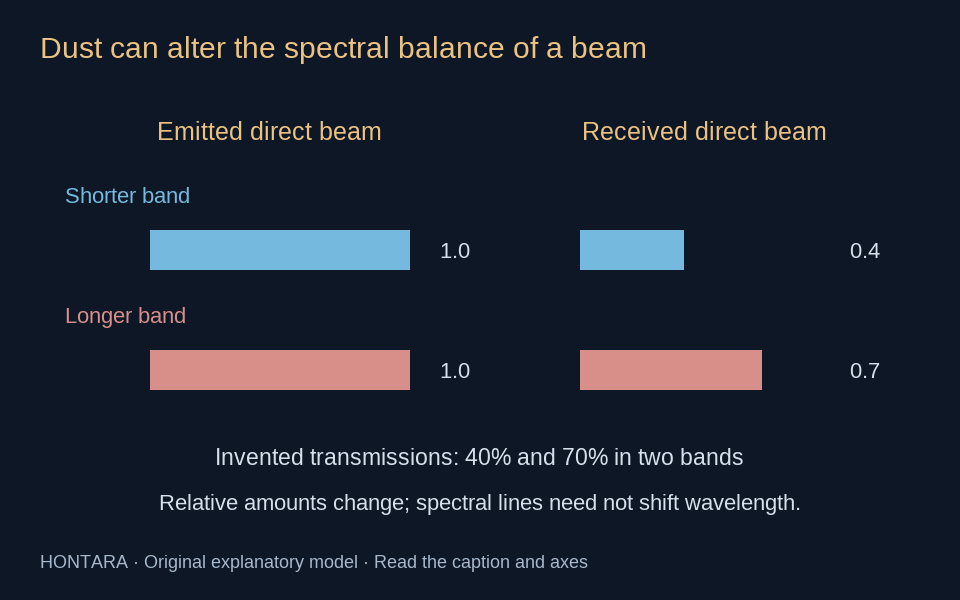
In many optical situations shorter-wavelength blue light is extinguished more strongly than longer-wavelength red light. The transmitted spectrum becomes relatively redder. This changes the balance of received light across bands; it does not shift every spectral line to a new wavelength.
Doppler or cosmological redshift concerns the wavelengths of spectral features. Reddening concerns their continuum balance after wavelength-dependent attenuation. A source can experience both effects, so the presence of red colours alone does not identify one mechanism.
Use a two-band numerical comparison
Colour excess can be written E(B−V) = (B−V)observed − (B−V)intrinsic. In an invented example, an intrinsic B−V of 0.0 becomes an observed 0.5, giving E(B−V)=0.5 magnitude. The intrinsic colour needs independent justification rather than a guess from the image’s assigned RGB hue.
Extinction is logarithmic. One magnitude of extinction in a particular band transmits about 39.8% of the flux that would otherwise arrive in that band. The calculation says how much is lost from the direct beam; it does not specify a cloud’s complete grain-size distribution.
Inspect the assumptions of a dust map
A Galactic dust map often describes material integrated along a line of sight. A nearby star may lie in front of part of that column, so the full map value is not automatically the extinction to that star. Three-dimensional context can be important.
Extinction laws also vary between environments. A commonly adopted relation between colour excess and visual extinction is a model choice with a stated parameter, not a universal constant applying identically to every cloud or galaxy. Read the service’s limitations before applying a correction.
Build a better interpretation
Compare optical and infrared views using their documented passbands. Infrared observations can penetrate some dusty regions more effectively, but they do not make all dust effects disappear. Warm dust can also emit strongly, adding another physical contribution to an infrared image.
A useful conclusion names the bands, distinguishes obscuration from intrinsic colour and lists the assumed foreground geometry. Combine spectra, distances and appropriate maps when possible. Avoid turning a reddish patch into a precise stellar temperature without considering the material between source and observer.
A useful comparison record has separate columns for measured B, measured V, estimated intrinsic colour and the resulting colour excess. That structure makes the inferred correction auditable. It also prevents a catalogue’s uncertain intrinsic colour from being silently presented as a directly measured foreground-dust property.
PAUSE AND THINK
Does a redder observed colour prove that a star’s surface temperature has decreased?
Explore the answer
No. Foreground dust can alter the received colour even if the star is unchanged. Temperature inference needs extinction and measurement-band context.