On this page
One waveband answers several questions
Infrared radiation lies beyond the red end of visible light. It is electromagnetic radiation rather than a separate substance called heat. Many objects emit infrared, including cool material that gives little visible light. Detectors sensitive to these wavelengths can therefore study dusty disks, young planets and regions hidden in ordinary optical images.
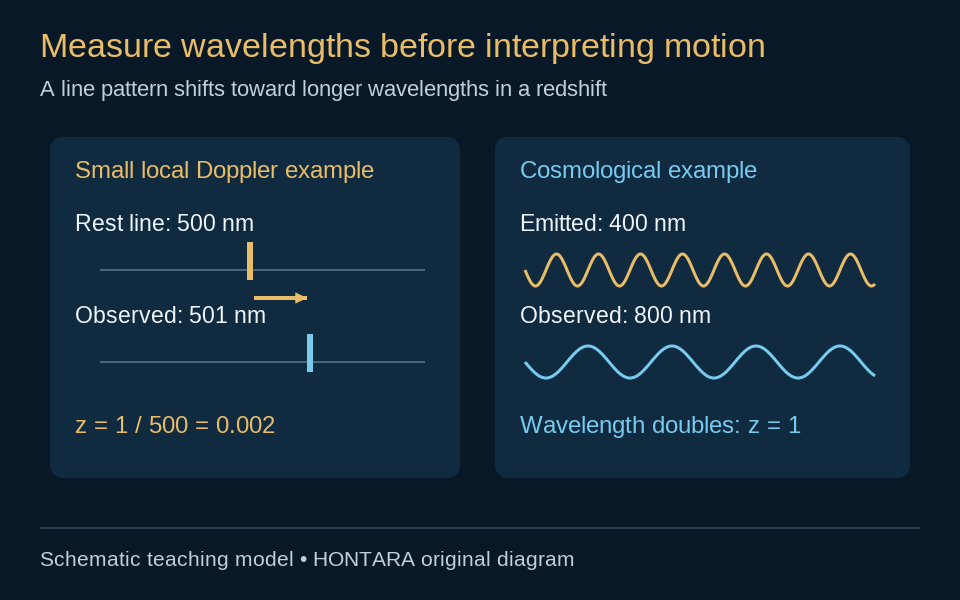
Infrared astronomy has several distinct uses. It can measure thermal emission from warm dust. At suitable wavelengths it can reveal stars behind obscuring dust. It can also detect light emitted at shorter wavelengths by very distant galaxies and stretched during cosmic expansion. These explanations should not be combined into a claim that every infrared source is nearby and cool.
THE BIG IDEAS
- Infrared reveals thermal emission as well as transmitted or redshifted light.
- Dust is not equally transparent at every infrared wavelength.
- Cold instruments help reduce the observatory’s own background.
Dust can hide and glow
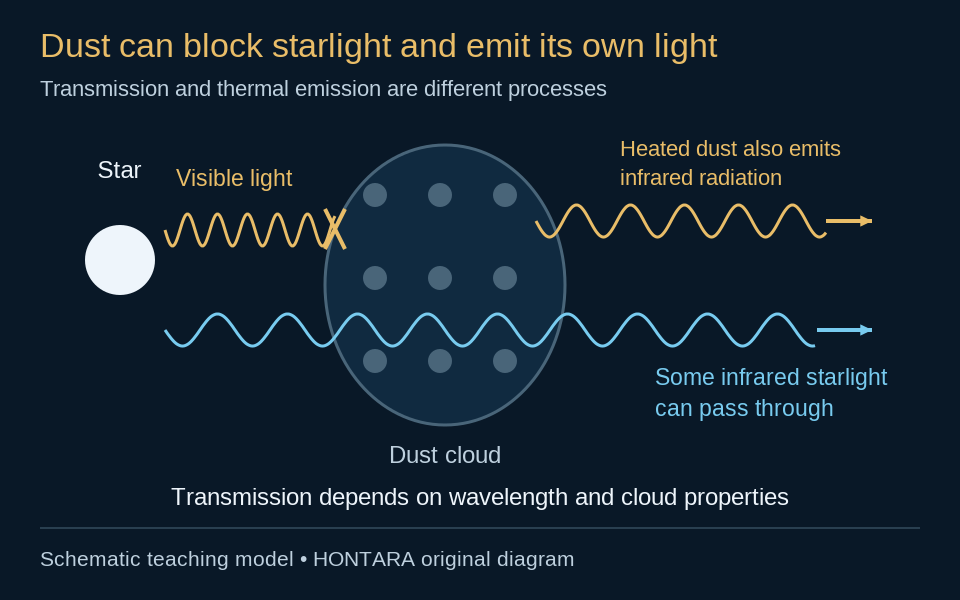
Dust interacts differently with different wavelengths. It generally blocks visible light more strongly than many infrared wavelengths, although the densest clouds can remain opaque. At the same time dust absorbs energy and radiates at longer wavelengths. Thus a cloud that looks dark in an optical image can be conspicuous in an infrared image for a different reason.
To interpret a paired image, ask whether bright infrared structure is a newly revealed star or emission from the dust itself. Instruments observing different infrared bands may emphasise different components. The simple ray diagram separates transmitted starlight from emission by a heated cloud. Real clouds have varied grain sizes, temperatures and compositions, so there is no universal transparent infrared window through everything.
Calculate which detector is needed
Suppose a distant source emits a spectral feature at 0.5 micrometres and its cosmological redshift is 3. The observed wavelength is the emitted wavelength multiplied by 1 plus z: 0.5 times 4 equals 2 micrometres. A visible-light-only detector would miss that feature. A suitable near-infrared instrument might measure it if the source is sufficiently bright.
This is a wavelength calculation rather than a prediction of exposure time or distance. Sensitivity, collecting area, background and spectral resolution still matter. A detector covering 2 micrometres is not automatically capable of measuring a faint feature clearly. The example explains why distant-galaxy research requires suitable wavebands as well as large telescopes.
The telescope glows too
Warm observatory hardware emits infrared radiation that can obscure a weak astronomical signal. Cooling detectors and controlling the telescope’s temperature reduce this unwanted background. Webb uses a large sunshield and thermal design while its mid-infrared instrument also needs active cooling. The engineering requirements depend on the wavelength range and intended measurements.
Earth’s atmosphere absorbs much infrared radiation and also contributes background. Some bands remain accessible from dry high-altitude observatories while others are better studied from space. In published images visible display colours are assigned to infrared measurements. Always read the band labels and processing notes before comparing colour with temperature. A blue patch in the displayed picture does not mean that infrared radiation became blue light in space.
PAUSE AND THINK
Where does a 0.5-micrometre feature appear at redshift 3?
Explore the answer
At 2 micrometres because the wavelength is multiplied by 1 plus 3.