On this page
Radio is light beyond our eyesight
Radio astronomy studies naturally emitted electromagnetic waves at wavelengths longer than visible light. A radio telescope is a detector of radiation rather than a microphone collecting sound through space. The same broad family of waves includes visible light, infrared and X-rays. Radio observations reveal physical conditions that an optical photograph alone cannot fully describe.
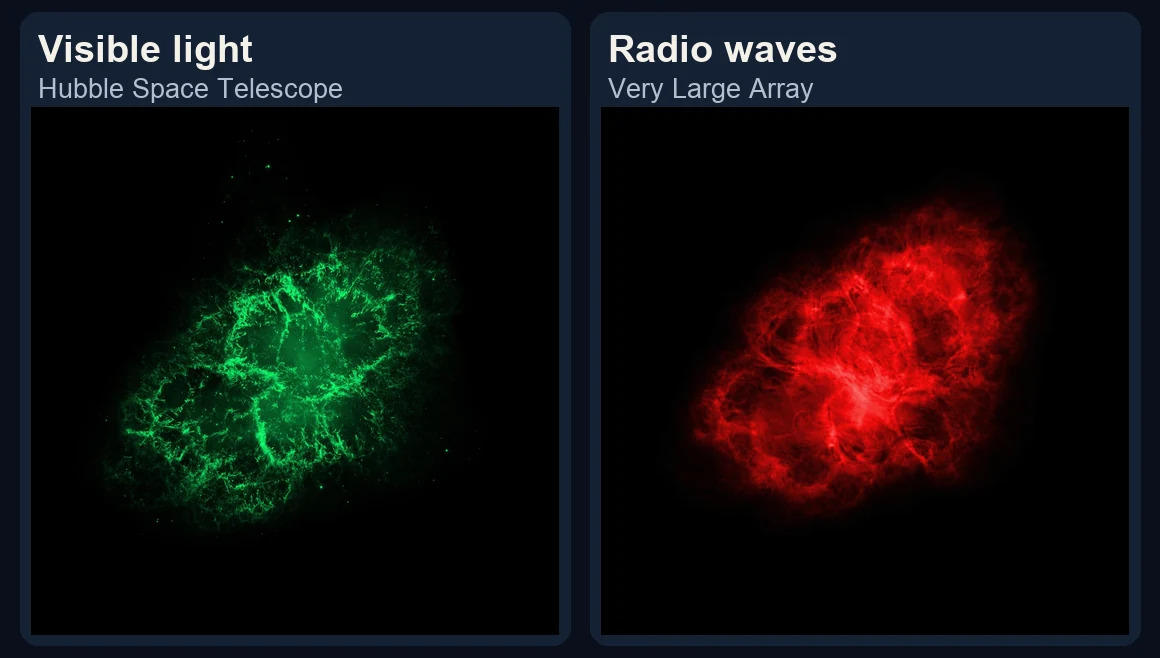
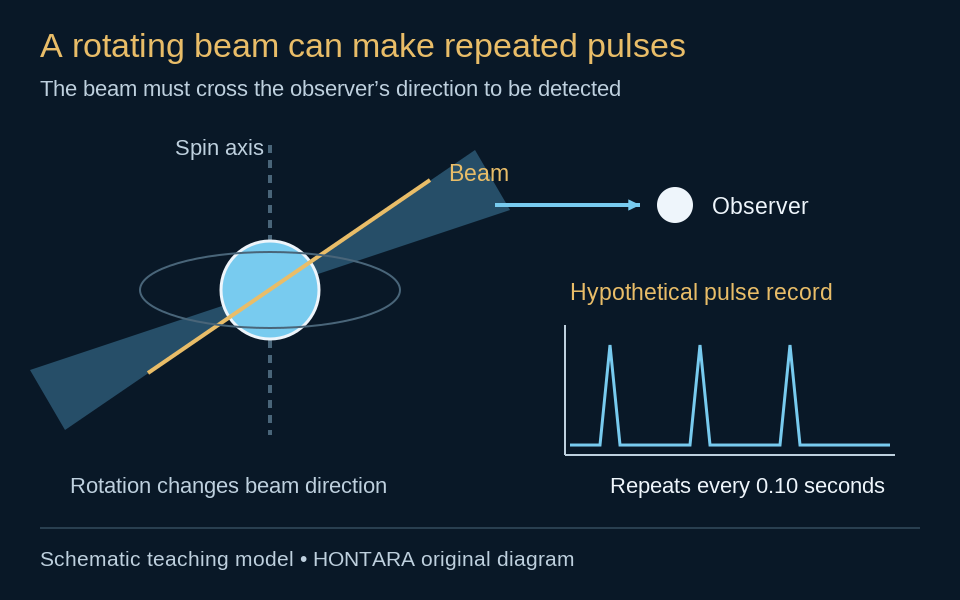
Astronomers may study emission from cold gas, fast electrons moving in magnetic fields or a pulsar’s changing signal. These mechanisms do not all trace the same material or temperature. A bright radio feature need not be a visibly bright star. Combining wavebands helps distinguish an interpretation based on one detector from a consistent explanation of the source.
THE BIG IDEAS
- Radio telescopes detect electromagnetic radiation rather than sound.
- Hydrogen’s 21-centimetre line traces gas and radial motion.
- Antenna separation and collecting area have different roles.
A dish gathers a signal
A reflecting dish directs arriving waves toward a receiver. Electronics measure and amplify the very weak signal. Instruments record quantities such as intensity, frequency, polarisation and time. A familiar broadcast receiver is a useful comparison for selecting a frequency but cosmic observations demand careful calibration and rejection of local interference.
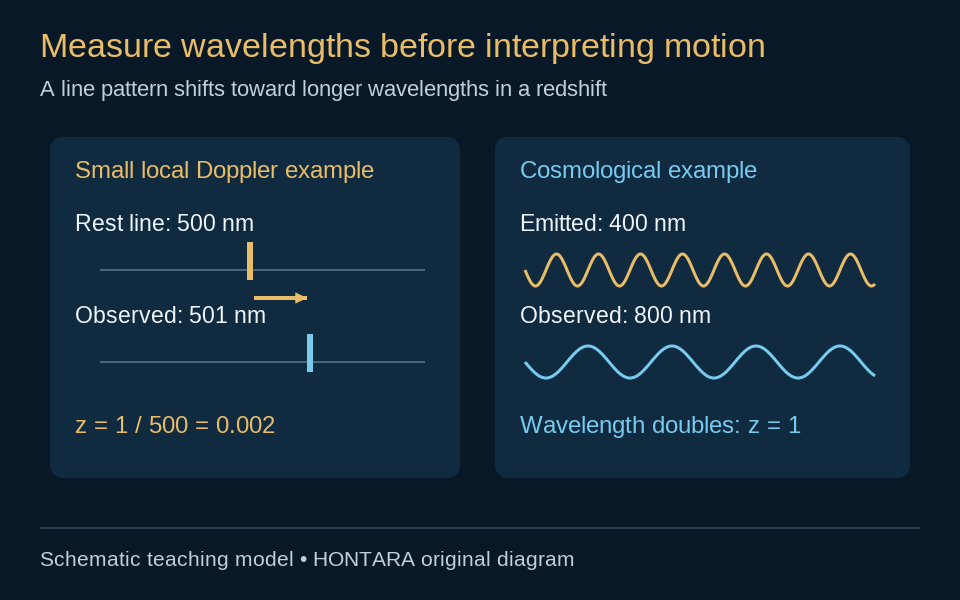
Neutral atomic hydrogen produces an important spectral line near a wavelength of 21 centimetres. Its strength and frequency help trace gas and its line-of-sight motion. The signal is not a spoken message and it need not come from stars. Maps of this emission can trace hydrogen across regions that are difficult to study through interstellar dust in visible light.
Resolution depends on wavelength and size
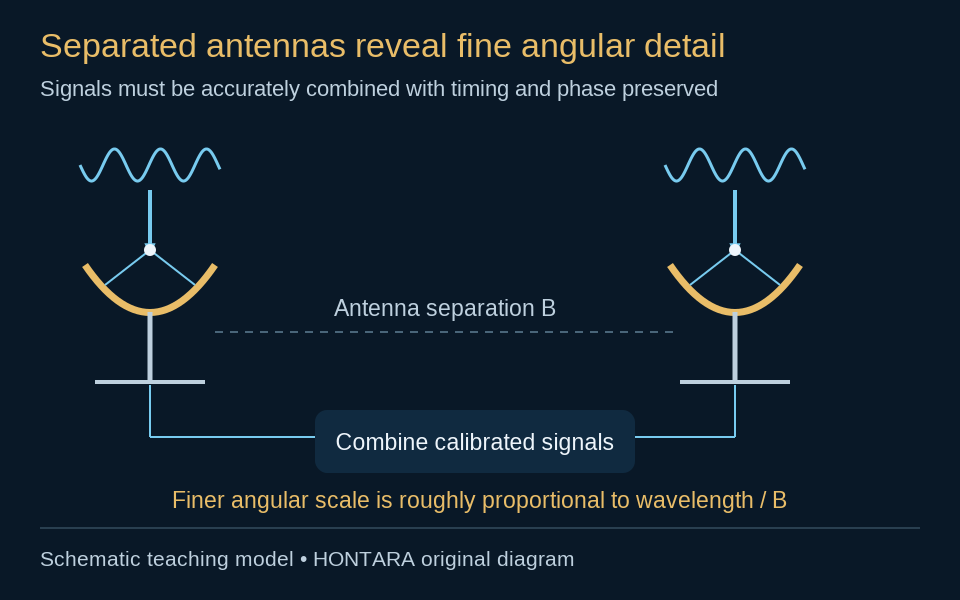
The angular scale a single aperture can distinguish is roughly proportional to wavelength divided by aperture diameter. In an illustrative calculation, a 0.21-metre wavelength observed with a 100-metre dish gives 0.0021 radians, about 7 arcminutes. The numerical factor depends on aperture illumination and the definition of resolution, so this is an order-of-magnitude estimate.
A long wavelength therefore needs a large aperture for fine detail. Interferometry combines signals from separated antennas while preserving timing and phase information. The largest separation helps set the finest angular detail. This does not magically turn the array into a filled dish with the same collecting area: sensitivity to different structures also depends on antenna number and arrangement.
A map is a measured reconstruction
An interferometer samples particular spatial information about the sky. Astronomers calibrate the measurements and reconstruct an image. Missing antenna separations can leave some broad structures poorly measured. Images can contain both real features and processing artefacts, which is why observing configuration and calibration belong in the scientific description of a map.
For an image-reading task compare an optical and a radio map of the same region. First check their field sizes, coordinate orientation and resolution. Describe where emission overlaps before proposing why. The colours in a radio map usually encode measured intensity or another selected quantity. They are a display choice rather than colours an unaided observer could see at the telescope.
PAUSE AND THINK
Why can a radio array show finer detail than one of its dishes?
Explore the answer
Combining signals across long separations provides information on smaller angular scales, provided the measurements are accurately timed and calibrated.