On this page
Compare a pattern with a reference
Redshift means that a recognisable spectral feature arrives at a longer wavelength than its reference wavelength. Blueshift means a shorter wavelength. Astronomers identify patterns of lines rather than deciding that any red-looking object must be receding. A cool nearby star and a dust-reddened source can look red without that colour alone measuring a redshift.
The dimensionless quantity z is the observed wavelength minus the rest wavelength, divided by the rest wavelength. Reference wavelengths come from laboratory measurements and atomic physics. Matching several lines makes an identification more reliable than using one ambiguous bump. Calibration of the spectrograph matters because a small instrumental shift can imitate motion.
THE BIG IDEAS
- Redshift compares observed and reference wavelengths.
- The small-speed Doppler approximation measures radial motion.
- Cosmological distance needs a model as well as redshift.
A worked Doppler example
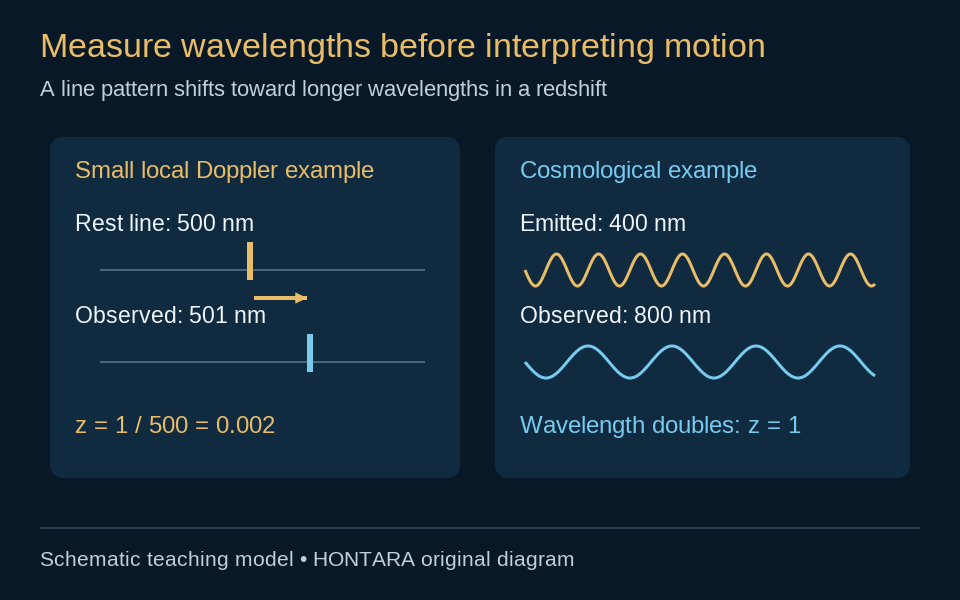
Consider a hypothetical line with a rest wavelength of 500 nanometres measured at 501 nanometres. Its redshift is (501 minus 500) divided by 500, which equals 0.002. For small speeds compared with light in a local Doppler example, radial speed is approximately cz. Taking c as 300,000 kilometres per second gives 600 kilometres per second away.
This calculation estimates the component of motion along the line of sight. It does not reveal a sideways velocity. If the line appeared at 499 nanometres the same approximation would give 600 kilometres per second toward us. For speeds approaching light speed the relativistic Doppler relation must replace the small-speed approximation.
Expansion requires a different interpretation
Cosmological redshift describes light travelling through an expanding universe. In a standard expanding-universe model, 1 plus z equals the ratio of the cosmic scale factor at reception to its value at emission. A galaxy at z equal to 1 therefore has wavelengths stretched by a factor of two. This statement does not assign it a simple local speed of light.
Distant galaxies can also have local motions relative to the average expansion. Converting cosmological redshift to distance or lookback time requires an expansion model and its parameters. The familiar nearby linear Hubble relation is an approximation over a limited range. Multiplying a large redshift by c is not a general method for recovering a distant galaxy’s physical recession speed.
Ask what caused the shift
Gravity can also shift light: radiation escaping from a stronger gravitational potential can arrive redshifted. Consequently a measured shift needs physical context. Astronomers combine the object’s identity, environment and other measurements to interpret it. Several effects may contribute to the same spectrum rather than appearing as neatly separated labels on the detector.
Try a second example using a 400-nanometre feature observed at 800 nanometres. Its redshift is 1, not 400 or 2. The wavelength ratio is 2 while z is that ratio minus 1. Write both values beside the diagram. This small distinction prevents confusion when connecting spectral measurements with the expansion factor and with infrared observations of distant galaxies.
PAUSE AND THINK
If a line’s wavelength doubles, what is its redshift?
Explore the answer
The ratio of observed to rest wavelength is 2, so z equals 2 minus 1, or 1.