On this page
A star has an evolving structure
Stars form as gravity gathers material in a cloud of gas and dust. When the core becomes hot and dense enough for sustained hydrogen fusion, a star enters its main-sequence phase. It can remain in this phase for a large fraction of its lifetime. That does not mean every region of the star is unchanged.
Fusion changes composition, energy moves outward and the structure responds. A useful life-cycle diagram connects physical stages rather than implying that a star simply switches from one painted ball to another. Its size and surface temperature can change independently of the amount of matter it contains.
THE BIG IDEAS
- Main-sequence stars sustain hydrogen fusion in their cores.
- Higher-mass main-sequence stars generally use fuel faster and live shorter lives.
- A Sun-like star and a much more massive star can leave different remnants.
Starting mass changes the timetable
More massive main-sequence stars contain more fuel, but use it at a much faster rate. Their main-sequence lives are therefore generally shorter than those of lower-mass stars. A larger fuel supply does not automatically give a longer lifetime when the rate of use also changes.
Try an explicitly invented comparison of two lamps powered by batteries. One has twice the available energy but consumes it ten times as fast, so its running time is one fifth as long. This analogy demonstrates the rate-versus-supply reasoning only. Stars regulate their own structure and are not battery-powered lamps.
The Sun’s broad pathway
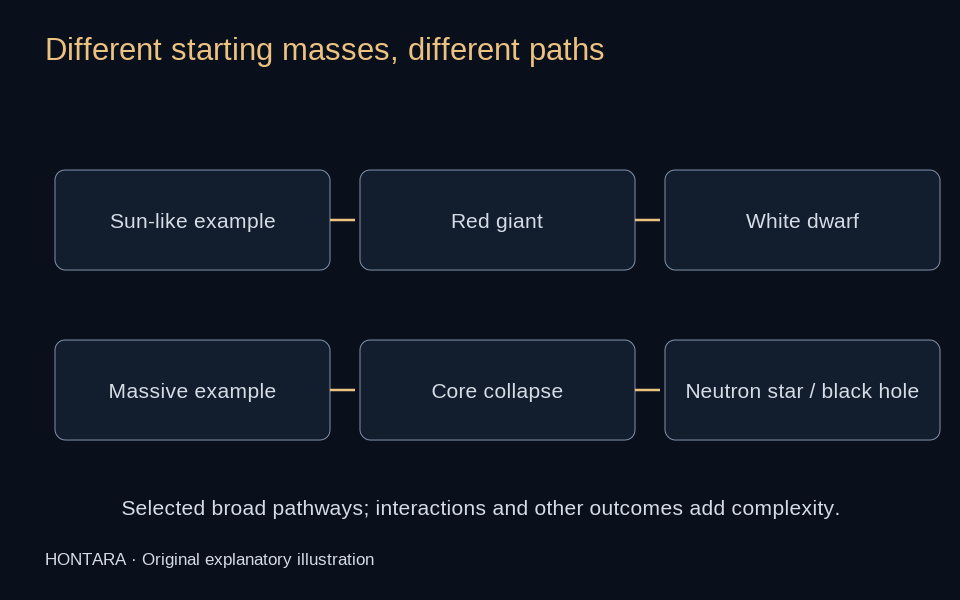
A Sun-like star eventually exhausts the hydrogen available for fusion in its core and develops a changed internal structure. Later stages include a red-giant phase. Its outer material can be expelled, leaving a white dwarf: a dense remnant that then cools. The Sun is not expected to end in a core-collapse supernova.
A white dwarf can still shine even though it is no longer a main-sequence hydrogen-fusing star. Light from a hot remnant should not be taken as proof of the same ongoing energy source. Ask what physical process supports the brightness before assigning a stage.
More massive stars take other paths
Sufficiently massive stars can pass through additional fusion stages and undergo core collapse. An explosion may leave a neutron star or black hole. The outcome depends on more than one simple mass boundary: mass loss, composition, rotation and interactions with a companion can matter.
These are broad pathways rather than a prediction for an unidentified bright star. A star’s apparent brightness does not reveal its mass by itself and a star that looks red in one photograph is not automatically a red giant. Measurements and modelling are needed to place an object within an evolutionary interpretation.
Build two sequences and test them
Make separate paper sequences for a Sun-like example and a much more massive example. Label where core hydrogen fusion occurs, where the star changes greatly in size and what remains at the end of each chosen pathway. Use dashed connections where the outcome depends on additional conditions.
Now challenge three claims: all stars become black holes; every red-looking star is old; all light comes from current core hydrogen fusion. Explain why each is too broad. Keep observations, model predictions and artist’s illustrations distinct when using images. A meaningful sequence teaches the differences rather than forcing all stars into the same ending.
PAUSE AND THINK
Why does having more hydrogen not automatically give a massive star a longer life?
Explore the answer
Lifetime depends on both the available fuel and the rate of use. More massive main-sequence stars consume their usable fuel much faster, usually giving them shorter main-sequence lifetimes.