On this page
A useful first clue
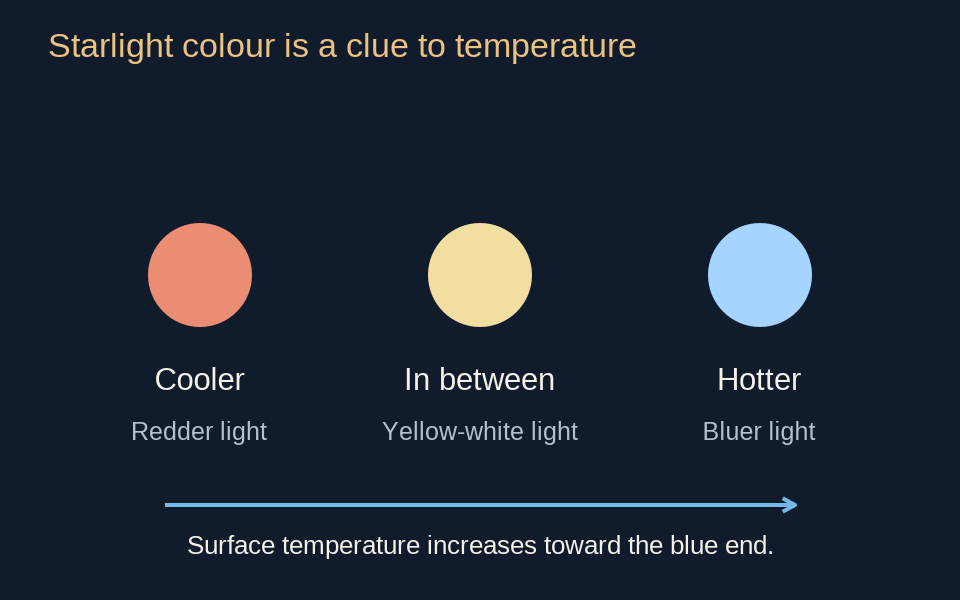
Stars do not all emit the same mixture of wavelengths. Their surface temperatures influence the distribution of light they produce, giving some a reddish appearance and others a blue-white appearance. In broad terms, a blue star has a hotter surface than a red star. This may feel opposite to familiar blue-and-red water taps, but it follows the physics of thermal radiation rather than everyday colour conventions.
THE BIG IDEAS
- Blue stellar surfaces are generally hotter than red ones.
- Stars emit a spectrum rather than a single wavelength.
- Size and dust matter when interpreting colour and brightness.
A spectrum rather than one colour
A star usually emits light over a wide range of wavelengths. Calling it red does not mean it produces only red photons. Its temperature shifts the balance of its output. The Sun emits strongly across the visible range and is often described as a white star when viewed from space. Earth’s atmosphere changes its appearance near the horizon. Never look directly at the Sun to investigate its colour.
Why eyes can be misleading
At low light levels human colour perception becomes weak. Many faint stars look almost colourless even when measurements show a clear temperature difference. Camera settings can also alter colour and images may use filters to highlight particular physical processes. A photograph’s vivid palette is not automatically the naked-eye view. A useful observing note distinguishes what you directly saw from the colour measured by an instrument or displayed in an illustration.
Colour is not the whole identity
Two stars with similar surface temperatures can have very different sizes and total luminosities. A cool giant can emit more total energy than a much smaller hotter object because it has a far larger radiating surface. Astronomers therefore combine temperature with luminosity to place stars on a Hertzsprung–Russell diagram. This reveals populations and evolutionary stages that a simple red-to-blue colour line cannot show.
Other influences need checking
Interstellar dust can scatter and absorb light in ways that make distant stars appear redder. Earth’s atmosphere and the star’s low altitude can also affect the view. To infer temperature reliably, astronomers use calibrated measurements and account for these effects. For a beginner, comparing a bright reddish star with a bright blue-white one is a starting observation, not a precision thermometer. Record the conditions and avoid turning subtle visual impressions into exact temperature claims.
PAUSE AND THINK
Can a red giant be more luminous than a small blue-white star?
Explore the answer
Yes. Total luminosity depends on radiating area as well as temperature, so a very large cooler star can outshine a smaller hotter one.