On this page
THE BIG IDEAS
- A disc can separate reflected light by wavelength.
- Different white lights need not contain identical mixtures of wavelengths.
- An uncalibrated disc is not a precision spectrometer.
A spectrum on an everyday object
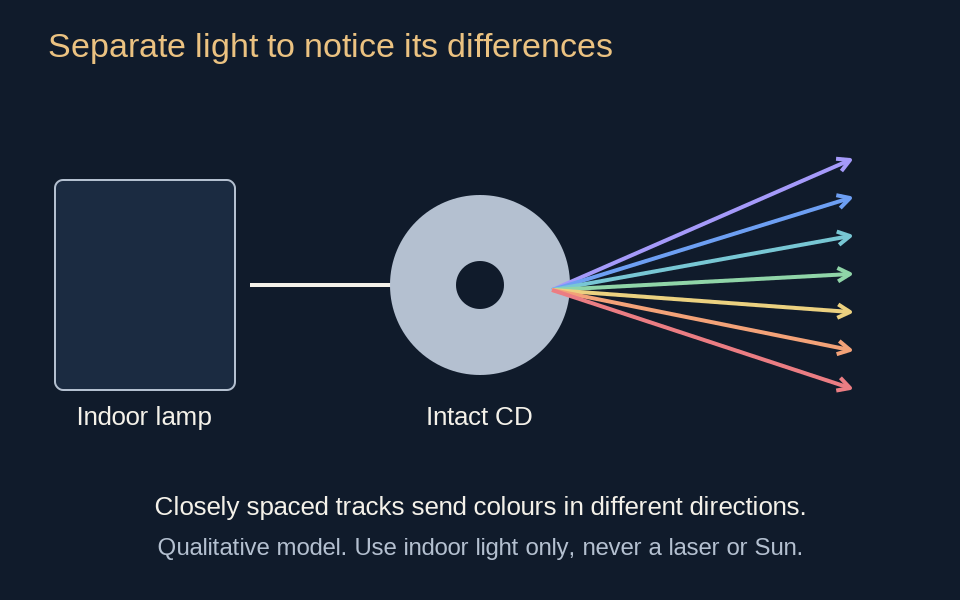
The recorded surface of a compact disc has many closely spaced tracks. Those repeated structures can separate reflected light into different directions according to wavelength. You can use that effect to compare indoor light sources. The disc does not manufacture a rainbow from nothing; it redirects components already present in the incoming light.
Choose safe materials
Use an unwanted but intact CD or DVD, plain paper and two ordinary low-brightness indoor lamps if available. An adult should handle electrical equipment. Do not break, cut or scrape the disc. Hold it by the edge and avoid directing a bright reflection into anyone’s eyes. Never use sunlight or a laser for this activity.
Compare two sources
- 1. Hold the disc below eye level with its shiny surface facing an indoor lamp. Gently tilt it until coloured bands become visible.
- 2. Sketch the order and width of the colours you see. Write down the lamp type if its label is known.
- 3. Repeat under another indoor lamp while keeping your viewing distance and disc similar.
- 4. Move the disc slightly and notice how the band position changes. Distinguish movement of the spectrum from a change in the source.
- 5. Compare sketches with a partner before discussing the labels on the lamps.
Interpret carefully
Different lamps can distribute their visible light differently even when both look white. Some show a broad blend of colours while others have stronger bands. Your eye combines the incoming wavelengths into an overall colour sensation; the disc spreads them so differences may become easier to notice.
Astronomical spectrometers perform a more precise version of separating and recording light. Scientists use measured patterns to investigate composition and other properties. A handheld disc has no calibrated wavelength scale and does not let you identify a star’s elements or measure a reliable temperature.
Record uncertainty
The room’s other lamps, reflections and your viewing angle can affect the result. Do not label a faint band missing simply because you failed to see it. Record where the observation was difficult and repeat with one lamp switched off by an adult. Finish by explaining why two sources that look similar to an unaided eye can still have distinguishable spectra. Your result is a qualitative comparison, not a laboratory chemical test.
PAUSE AND THINK
Does the disc change white light into newly created colours?
Explore the answer
No. Its closely spaced tracks redirect different wavelength components into different directions, making parts of the existing mixture easier to distinguish.
RECORD YOUR OWN EVIDENCE
Your activity sheet
You need: Intact CD, two ordinary indoor lamp types, paper and pencil. Adult supervision.
Compare indoor light sources under similar viewing conditions. Use colour names or band labels.
Name or group: Date:
| Source | Viewing conditions | Bands or colours | Uncertainty |
|---|---|---|---|
What observation suggests the two sources distribute light differently?
Why is a rainbow-like band insufficient to identify an element in a star?
Record what happened, including uncertain results. Use the answer guidance in this resource to discuss your explanation.