On this page
THE BIG IDEAS
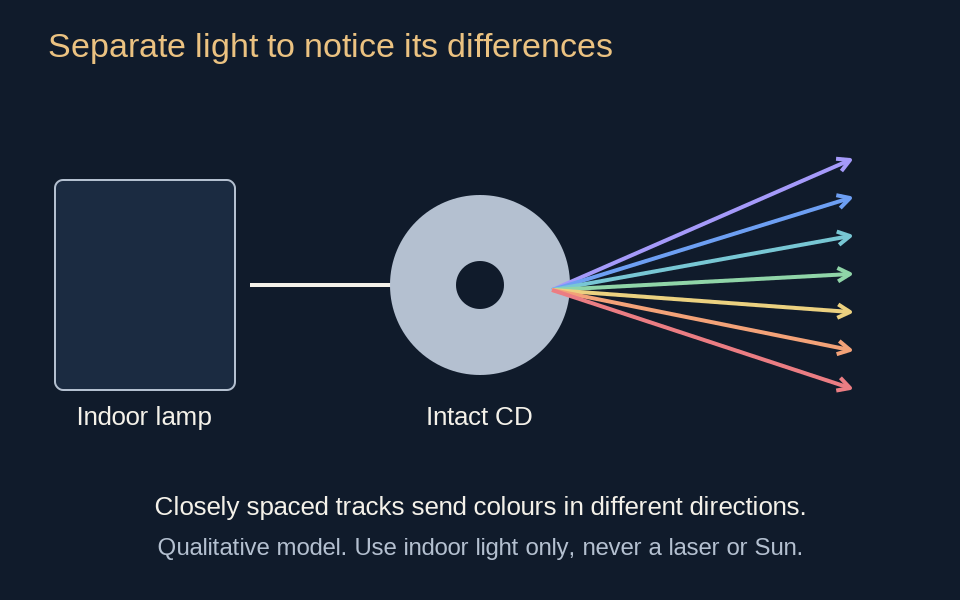
- The separator and the source have different roles.
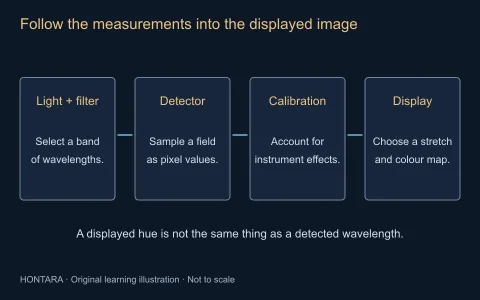
- Scientific interpretation needs calibrated measurements.
- Offer descriptions that do not depend only on colour naming.
Learning focus
Students will distinguish a light source from a device that separates light and explain why spectra provide additional information. Prepare an intact CD, two ordinary indoor lamp types if available and paper for sketches. Use cool lamps supervised by an adult. Never use sunlight, lasers or broken discs. If a demonstration is impractical, use labelled reference spectra from the source links and discuss their captions.
Lesson sequence
- Minutes 0-5: Ask whether two lights that look white must contain the same mixture of colours. Collect reasons without voting on a correct answer yet.
- Minutes 5-15: Demonstrate the disc under one indoor lamp, then another. Students sketch only what they can actually distinguish.
- Minutes 15-25: Compare observations in groups and separate claims about the source from effects of viewing angle or room lighting.
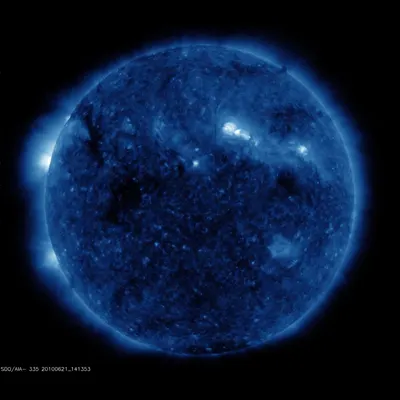
- Minutes 25-35: Introduce the idea of a calibrated astronomical spectrometer and examine one labelled scientific example.
- Minutes 35-45: Complete the task prompts and revise the initial white-light claim.
Student prompts
- 1. Does the disc create the colour components or redirect incoming light?
- 2. Name two conditions that could make the classroom comparison unreliable.
- 3. Explain why observing a rainbow-like band is not enough to identify an element in a star.
- 4. Write one question that a carefully calibrated spectrum could help scientists investigate.
Answer guide
The disc’s repeated tracks separate incoming wavelengths into different directions. Lamp mixing, reflections, viewing angle and uncertain visual judgement can affect the demonstration. Chemical identification requires measured wavelength patterns and comparison with reference information, not merely the presence of several colours.
Composition is an appropriate example for the final question. Temperature and motion can also be investigated with suitable spectra and interpretation. Avoid implying that one measurement automatically answers every question about a distant object. The classroom disc is qualitative and does not reproduce the precision of a research instrument.
Support and challenge
Supply colour names or allow ordered labels such as band A and band B so colour-vision differences do not exclude learners. Use brightness patterns and written descriptions as additional evidence. Ask advanced students why a detector sensitive beyond visible light reveals information their eyes cannot see. Assess whether students distinguish observation, calibration and inference. Their final explanation should contain a claim and a limitation, showing why spectra are useful without overstating what the demonstration proves.
PAUSE AND THINK
What would strengthen a claim that two sources have different spectra?
Explore the answer
Repeat their measurements under controlled conditions with a calibrated instrument, then compare identifiable features rather than relying on one handheld view.
RECORD YOUR OWN EVIDENCE
Your activity sheet
You need: Intact CD, two ordinary indoor lamp types, paper and pencil. Adult supervision.
Compare indoor light sources under similar viewing conditions. Use colour names or band labels.
Name or group: Date:
| Source | Viewing conditions | Bands or colours | Uncertainty |
|---|---|---|---|
What observation suggests the two sources distribute light differently?
Why is a rainbow-like band insufficient to identify an element in a star?
Record what happened, including uncertain results. Use the answer guidance in this resource to discuss your explanation.