On this page
THE BIG IDEAS
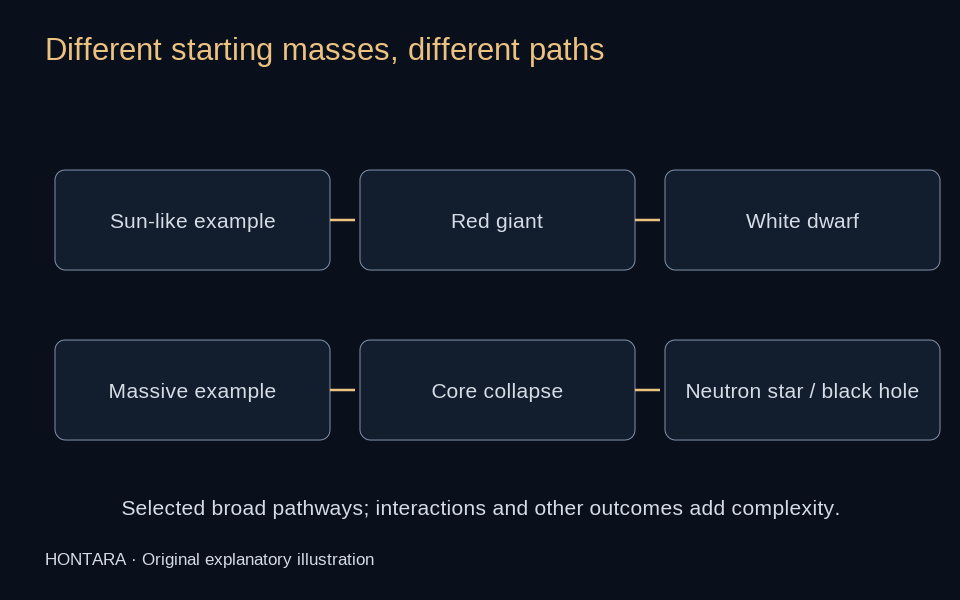
- Starting mass strongly influences a star’s path.
- A Sun-like model leaves a white dwarf.
- The massive-star remnant remains conditional here.
Start with two cases
Stars do not all pass through the same ending. This activity contrasts a Sun-like case with an initially much more massive case. Your task is to organise a supplied set of teaching cards and justify links using the physical descriptions on them.
The two cases are simplified models of single stars, not observations of two named objects. Initial masses of 1 and 20 solar masses were selected for contrast. Composition, mass loss, rotation and interactions can complicate real evolution. A card sequence cannot fix every possible outcome from initial mass alone.
Make the complete card set
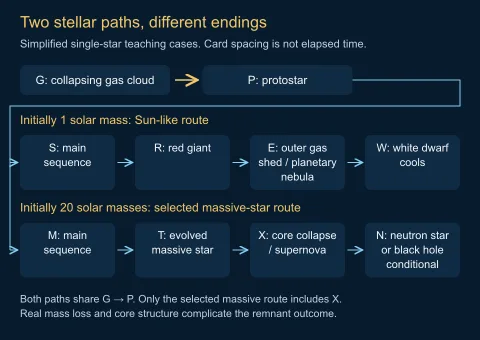
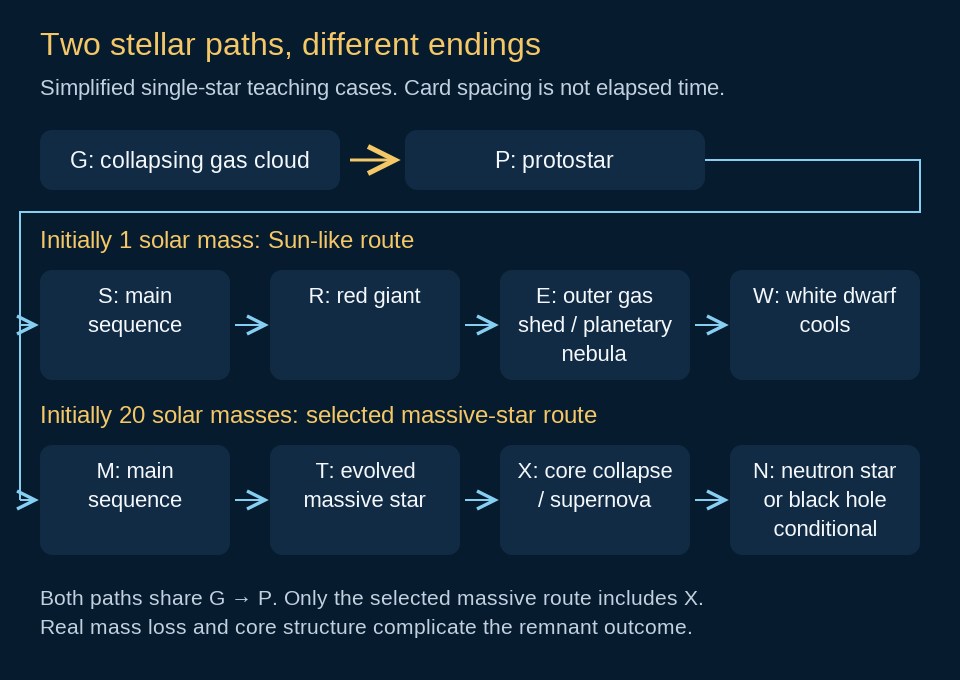
Use paper or index cards and pencil. Write G: collapsing gas cloud and P: protostar. For the Sun-like branch write S: main-sequence star, initially 1 solar mass; R: red giant; E: shed outer layers forming a planetary nebula; W: cooling white dwarf.
For the massive branch write M: main-sequence star, initially 20 solar masses; T: evolved massive star with layered burning; X: core collapse with a supernova in this simplified case; N: neutron star or black hole, outcome conditional. Copy all these descriptions so the letters alone do not become a memory puzzle.
Build and defend the paths
Arrange cards into two paths sharing G and P. If cutting is inconvenient, copy the letter sequences into the worksheet instead. Put the two initial-mass labels beside the correct main-sequence cards. Do not use size of handwriting or card colour as evidence for an order.
For every arrow write a short reason. Contraction precedes the start of sustained core hydrogen fusion. A main-sequence star later changes as its core fuel and structure change. Distinguish an envelope shed into space from the compact remnant left behind.
Check the evidence
The supplied Sun-like route is G → P → S → R → E → W. Its endpoint is a white dwarf that cools rather than a core-collapse supernova. “Planetary nebula” names expelled glowing gas and does not mean the star has turned into a planet.
The selected massive route is G → P → M → T → X → N. N deliberately keeps alternatives. The initial 20-solar-mass label alone is insufficient to decide the exact remnant in a real case. Some massive-star collapses also differ from the bright explosion represented by X.
Find what the cards cannot tell you
Add a question mark beside any arrow that hides several processes. The cards do not provide stage durations, temperatures or a numerical mass-loss history. Card spacing is not elapsed time. Do not assign equal lifetimes simply because the rectangles are equally wide.
Write a comparison using one shared feature and two differences. Then consider a very low-mass red dwarf: its predicted lifetime can exceed the universe’s current age. That is a reason not to treat an unseen complete red-dwarf history as a directly watched sequence.
Finish with an evidence claim
Choose the incorrect sequence S → X → W and explain why it does not follow the stated Sun-like model. Keep “all stars eventually explode” out of your conclusion. State that astronomers combine physical models with observations of different stars and remnants to infer these histories.
PAUSE AND THINK
Why is a single line ending in a supernova misleading?
Explore the answer
It incorrectly assigns the massive-star ending to Sun-like stars and hides the different possible outcomes of stellar evolution.
RECORD YOUR OWN EVIDENCE
Your activity sheet
You need: Paper or index cards, pencil and optional scissors used with supervision.
Copy these supplied cards: G = collapsing gas cloud; P = protostar; S = Sun-like main-sequence star, 1 solar mass initially; R = red giant; E = shed outer layers / planetary nebula; W = cooling white dwarf; M = massive main-sequence star, 20 solar masses initially; T = evolved massive star with layered burning; X = core collapse / supernova in this simplified case; N = neutron star or black hole, outcome conditional. Build two paths sharing G and P.
Name or group: Date:
| Path | Ordered card letters | Evidence for one link | Limit of the path |
|---|---|---|---|
| Sun-like, initially 1 solar mass | |||
| Massive, initially 20 solar masses |
Why does the Sun-like path end at W rather than X?
Does card N let you choose a definite remnant for every 20-solar-mass star? Explain.
Record what happened, including uncertain results. Use the answer guidance in this resource to discuss your explanation.