On this page
A core left after a larger star
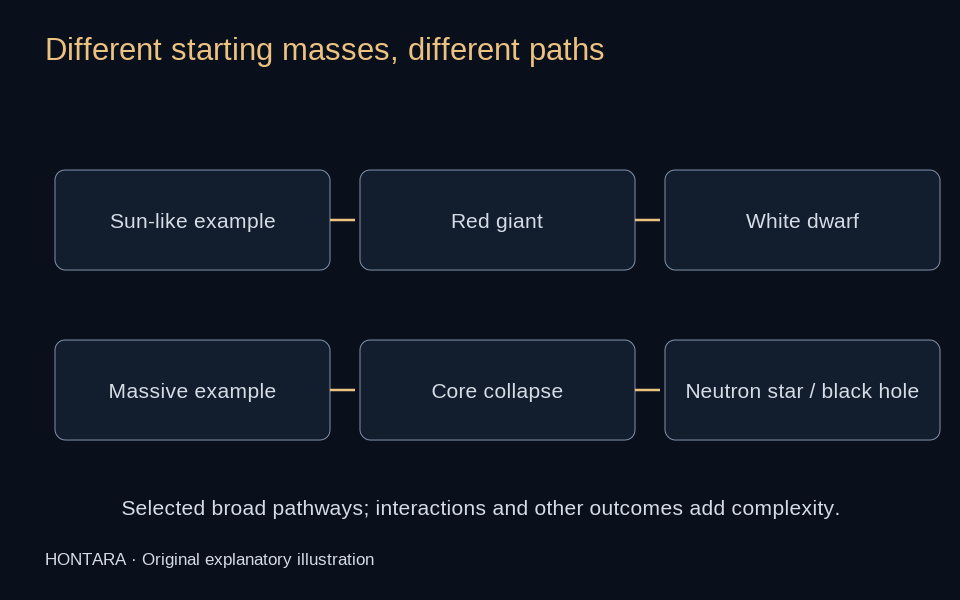
A white dwarf is a compact stellar remnant. A star similar to the Sun can shed its outer layers after a giant phase and leave a hot dense core. The core gradually cools as it radiates stored energy. It no longer maintains the main-sequence process of steadily fusing hydrogen into helium at its centre.
The surrounding expelled gas can form a planetary nebula. Despite that historical name the gas cloud is not a collection of planets. The nebula and the white dwarf are distinct parts of the system. The cloud spreads and fades while the compact core can remain for billions of years. Not every white dwarf still has an obvious surrounding nebula.
THE BIG IDEAS
- White dwarfs are exposed compact cores rather than miniature ordinary stars.
- Electron degeneracy pressure can support a cooling remnant.
- Small emitting area can keep a hot object relatively faint.
Earth-sized does not mean Earth-like
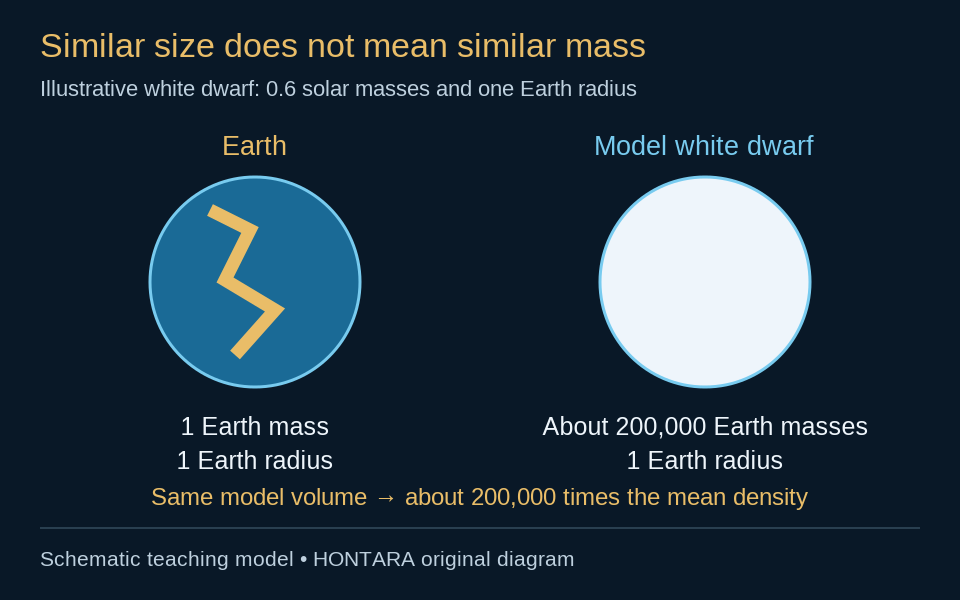
A typical white dwarf contains a substantial fraction of the Sun’s mass in a sphere comparable in size to Earth. Its density is therefore enormous. The size comparison in the illustration shows approximate diameters only. It is not a claim that white dwarfs have rocky continents or conditions resembling those on our planet.
For a scale calculation suppose a remnant has 0.6 solar masses and one Earth radius. Using a solar mass of about 333,000 Earth masses gives about 200,000 Earth masses within approximately Earth’s volume. Its mean density is then about 200,000 times Earth’s. This is an illustrative model; actual masses and radii vary and should be measured for a named object.
What stops further collapse?
Electron degeneracy pressure supplies much of the support. Electrons obey quantum rules that prevent identical particles from occupying the same quantum state. Compressing this dense material forces electrons into higher momentum states and raises pressure. This support does not require ongoing central fusion. A white dwarf can stay supported while losing thermal energy.
The support has limits. For an idealised cold nonrotating white dwarf the limiting mass is about 1.4 solar masses, called the Chandrasekhar limit. Composition and other details matter. Adding mass does not simply make the object larger: the white-dwarf mass-radius relation generally makes a more massive remnant smaller. Avoid interpreting degeneracy as particles becoming completely motionless or incompressible.
Read brightness with care
A recently formed white dwarf can have a very hot surface yet a modest total luminosity because its emitting surface is small. Surface temperature and total energy output are different measurements. Imagine two surfaces at the same temperature: the one with ten times the area radiates ten times the total power under the same idealised assumptions.
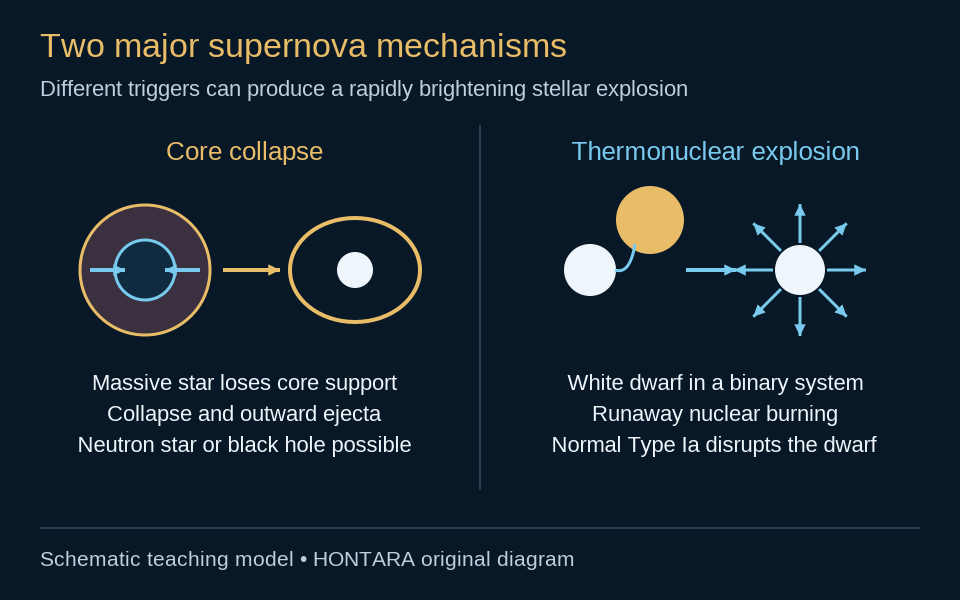
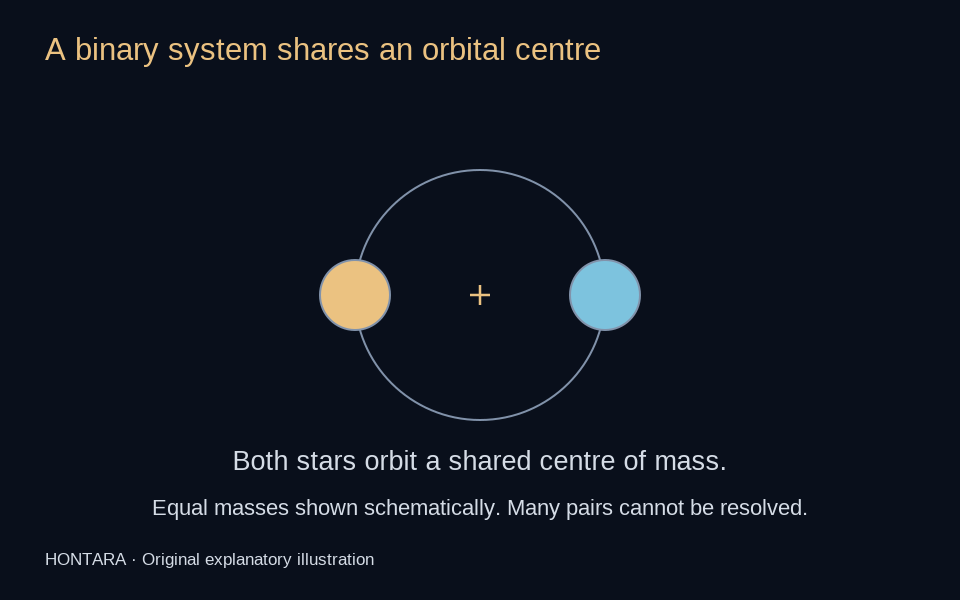
In a close binary, falling material can heat the surroundings and produce bright high-energy emission. Surface eruptions called novae and some thermonuclear supernova pathways involve white dwarfs but are not the inevitable fate of every isolated remnant. When reading an image caption, distinguish the remnant’s own cooling light from emission generated by matter interacting with it.
PAUSE AND THINK
How can a white dwarf shine after central fusion has ended?
Explore the answer
It radiates energy stored in its hot interior as it cools. In interacting systems falling matter can provide an additional energy source.