On this page
What remains when a star changes
A star like the Sun can shed its outer layers and leave a white dwarf. Some much more massive stars experience core collapse. Their dense cores can leave neutron stars or black holes. The outcome depends on how massive the remaining core is and how the star evolves. In a binary, interaction with the companion can also change that outcome.
| Remnant | Typical scale | Observation clue |
|---|---|---|
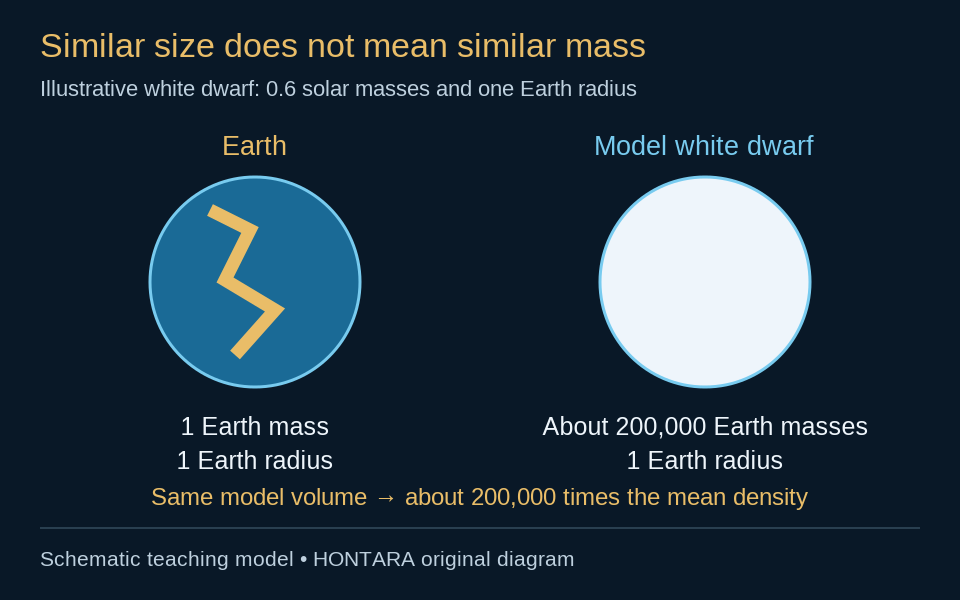
| White dwarf | Roughly Earth-sized. | A small hot object that cools and fades over time. |
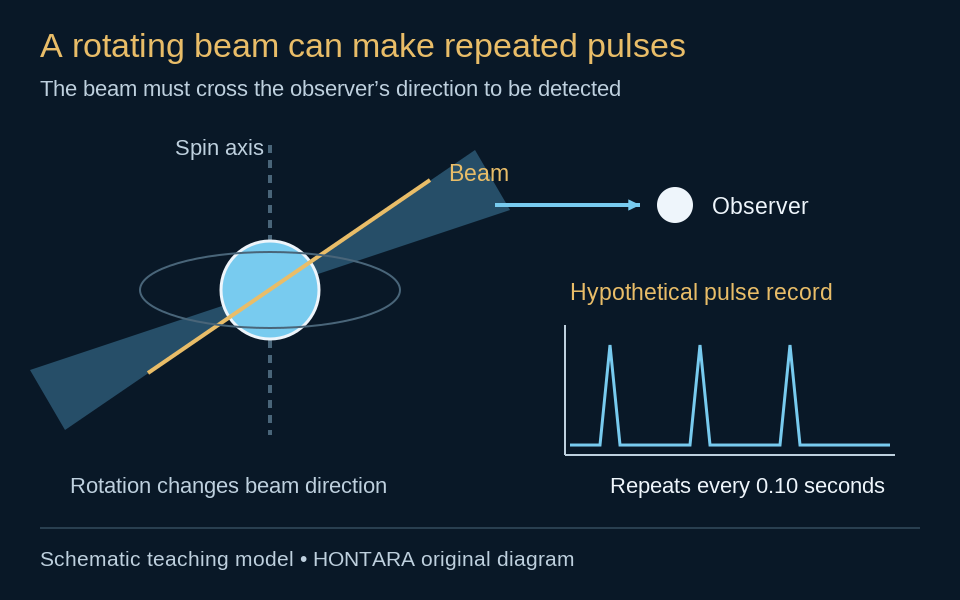
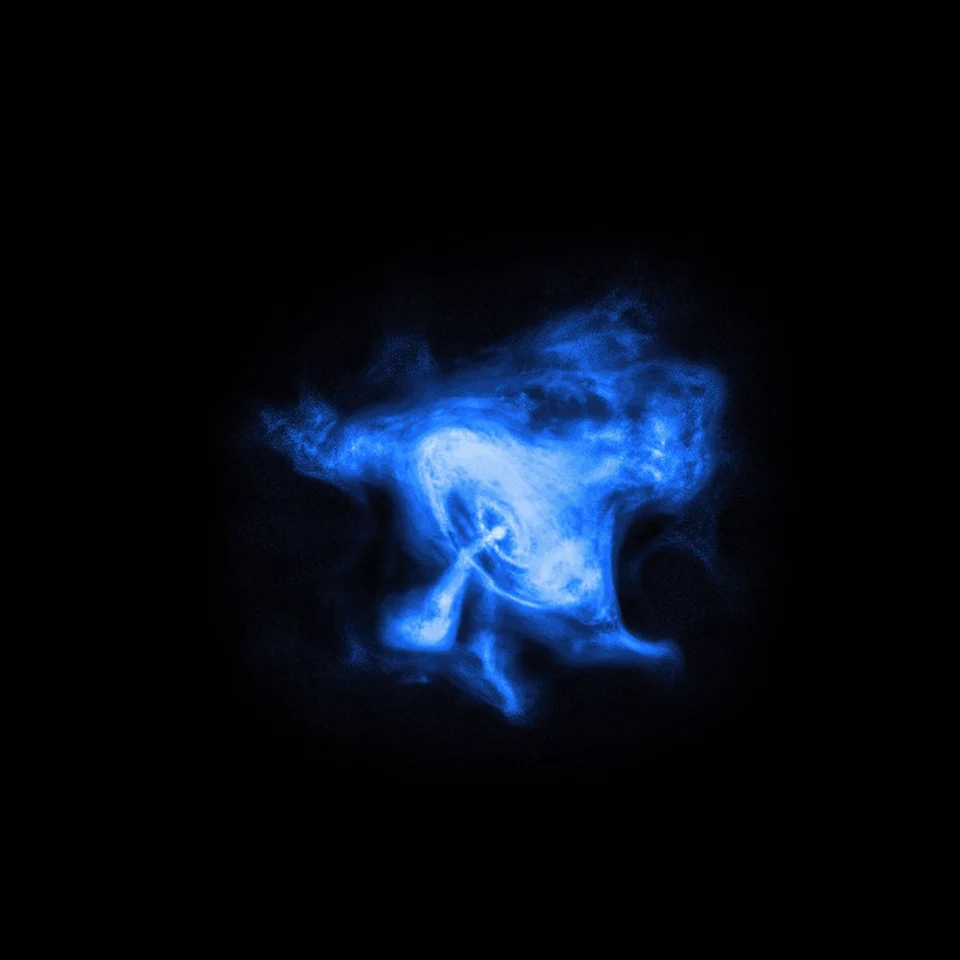
| Neutron star | Usually a few tens of kilometres across. | Some produce repeating pulses. Hot surface regions can emit X-rays. |
| Black hole | Horizon size grows with mass. | Companion orbits, hot nearby gas or gravitational waves can reveal it. |
Why similar masses can have very different sizes
Electrons resist being squeezed together in a white dwarf. A neutron star is denser. The behaviour of tightly packed neutrons and other matter helps support it. If a collapsing remnant becomes a black hole, an event horizon separates the region light can escape from the region where light cannot escape.
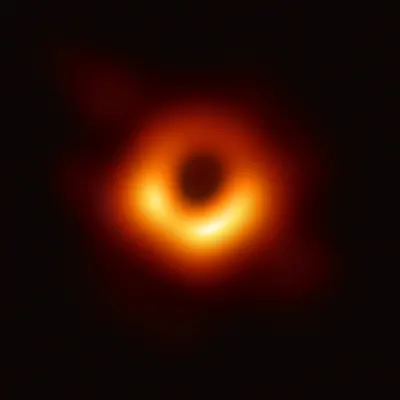
A ten-solar-mass black hole would have an event horizon about 59 kilometres across in a non-rotating model. The apparent bright ring seen in some telescope images comes from light emitted outside the horizon and bent by gravity.
What would tell you which remnant you found?
A regular pulse can be evidence for a rotating neutron star when its frequency, spectrum and behaviour match that explanation. A binary orbit can reveal the mass of an unseen companion. Astronomers compare several lines of evidence because a single bright spot or a single X-ray measurement can come from more than one kind of object.