On this page
What is the event horizon?
The event horizon is the boundary around a black hole. From inside it, every possible path that light can take stays inside. Outside it, some light can still travel far enough to reach a telescope.
THE BIG IDEAS
- An event horizon is a causal boundary rather than a solid surface.
- Black holes influence distant objects according to their mass.
- Astronomers infer black holes through measurable effects.
Mass matters at a distance
A black hole does not reach across space and pull in everything without limit. Far from it, the gravitational influence depends on its mass and distance just as it does for other objects. Replacing the Sun with a black hole of the same mass would not make Earth suddenly spiral inward, although losing sunlight would transform conditions here. This thought experiment is about gravity, not a prediction that the Sun can become a black hole.
How do black holes form?
When a massive star runs out of fuel in its core, the core can collapse under its own gravity. If the remnant is massive enough, it forms a black hole. Black holes can grow by absorbing surrounding matter and by merging with other black holes. How the first supermassive black holes formed is still an open question.
What is a black hole made of?
A black hole formed by stellar collapse starts with matter from the star. Once an event horizon forms, light from inside it cannot reach an outside observer. Astronomers can estimate the black hole’s mass and spin from their effects on nearby light and matter. The glowing gas seen in telescope images lies outside the horizon.
General relativity predicts a singularity inside a black hole, where the theory reaches a limit. Astronomers have no direct observations of the interior. Understanding what happens there may require a theory that combines gravity and quantum physics.
How astronomers find black holes
Astronomers look for measurable effects near a black hole or during a merger. A companion star’s motion can reveal an unseen mass. Hot gas outside the event horizon can emit light that reaches us.
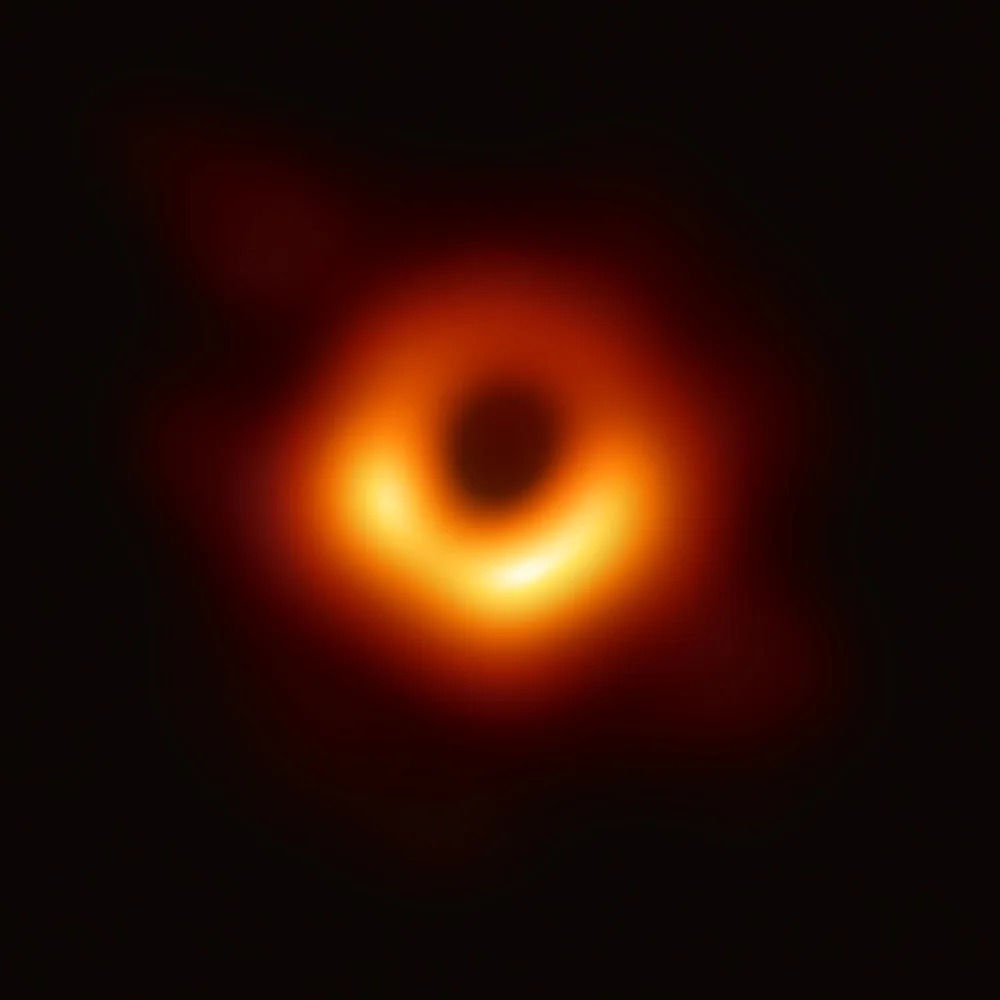
In 2019, the Event Horizon Telescope team released the image of M87* shown here. The ring shows radio emission from hot material near the black hole. Strong gravity bends the light and creates a larger dark shadow around the event horizon.
In 2015, the two LIGO detectors measured ripples in spacetime from a pair of merging black holes. Researchers identified the merger by comparing the signal with predicted waveforms.
Questions worth asking
When reading a black-hole headline, ask what was actually measured. It could be light from hot gas, the motion of nearby stars or gravitational waves from a merger. Each tells you about a different part of the system.
PAUSE AND THINK
Why can gas near a black hole shine brightly if the black hole itself is dark?
Explore the answer
The gas can heat and emit light before it crosses the event horizon. Light from outside that boundary can still reach us.