On this page
Follow an orbit to infer the central mass
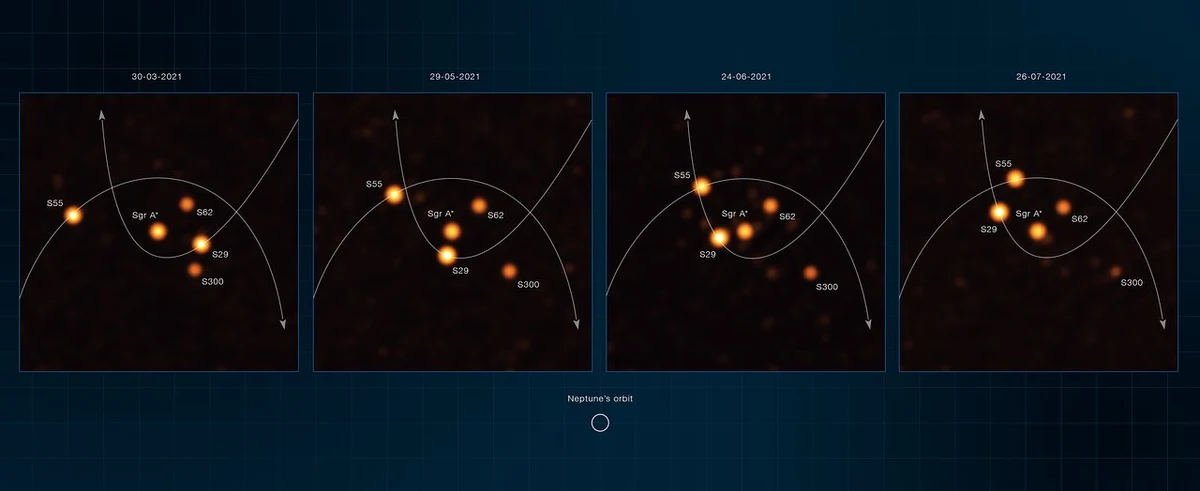
A stronger gravitational pull can make an orbit faster for a given orbit size. To measure the mass, astronomers track an orbiting star over time. They measure its position in the sky and can use changes in its spectrum to find motion along the line of sight. A model then connects both kinds of motion to an orbit and a mass.
The distance to the system matters because an angular size on the sky has to be converted to a physical size. Measuring more than one star gives additional checks on the same central mass.
A worked example from the Milky Way
The star S2 completes an orbit in about 16 years. Use a rounded semimajor axis of about 1,000 AU to see the scale of the result. If the central object dominates the system, the simplified Kepler relation divides the cube of the semimajor axis in AU by the square of the period in years.
The result is 1,000 cubed divided by 16 squared, or about 3.9 million solar masses. Professional fits use many measurements and include corrections from general relativity. The worked number helps explain why the observed motions point to a mass of about four million Suns.
What else can be measured?
Outside the Milky Way, astronomers can use the motion of gas or stars close to a galaxy’s centre. In a binary system, the orbit of a visible star can reveal the mass of a compact companion. Gravitational waves from a merger give another route because the shape of the signal depends on the masses of the objects.
An orbit measures the enclosed gravitating mass. Further evidence about how tightly that mass is confined and what the system emits helps astronomers identify a black hole.