On this page
Locate the focus, not the centre
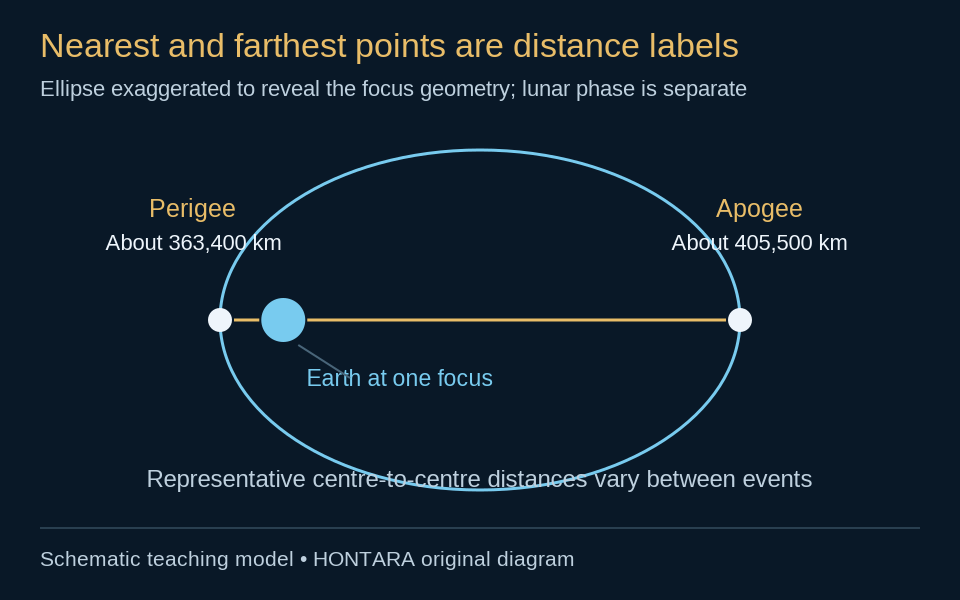
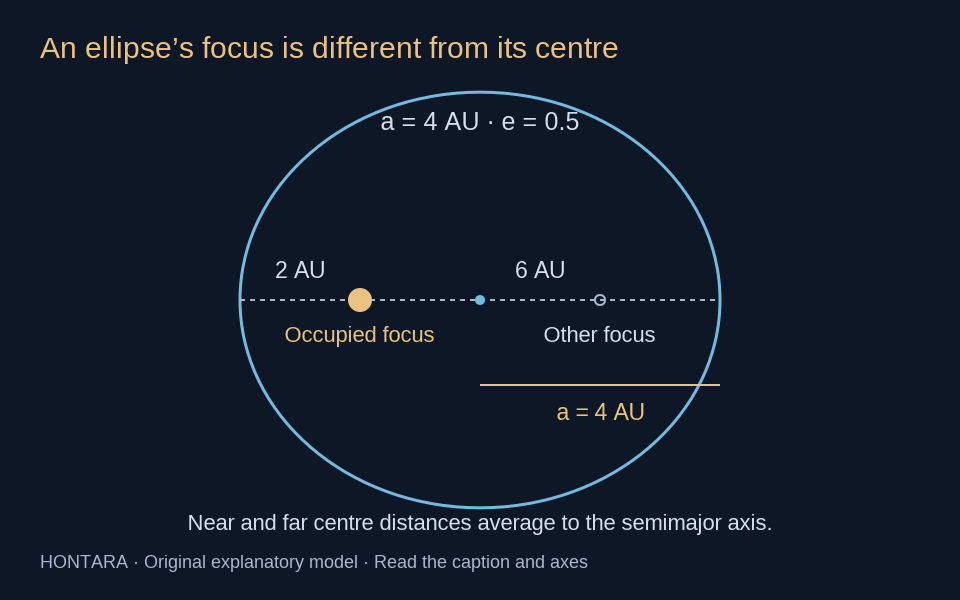
An ideal bound two-body orbit is an ellipse, with the attracting body at one focus when its motion is treated as negligible. The two foci are geometrical points; the second focus is not occupied by another hidden star. A circle is the special case in which the foci coincide.
The semimajor axis a is half the ellipse’s longest diameter. In an eccentric orbit it is not equal to every instantaneous distance from the focus. Near and far distances are a(1−e) and a(1+e), where e is eccentricity. Their average equals a.
THE BIG IDEAS
- An ellipse’s focus and centre are different points.
- Equal swept areas correspond to equal times.
- Period depends on semimajor axis and total mass.
Compare equal times through swept area
The line joining an orbiting body to its focus sweeps equal areas in equal times. Near the attracting body the line is shorter, so the body traverses a larger angle and moves faster while sweeping the same area. Farther away it moves more slowly.
Equal time therefore does not imply equal arc length or equal angle. For a simple drawing, compare one short time interval near periapsis with another near apoapsis. Label the equal areas first; arbitrary equal-angle wedges would represent different time intervals.
Use the mass appropriate to the system
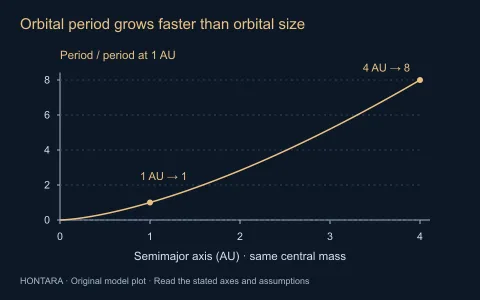
Newton’s generalisation is P² = 4π²a³/[G(M+m)] for the relative two-body orbit. It includes the total mass and applies beyond the Solar System. For a negligible planet mass around a one-solar-mass star, P in years is approximately a in AU raised to the power 3/2.
A model orbit with a=4 AU then has P≈8 years. A second with a=9 AU has P≈27 years. These are illustrative mass-normalised calculations, not dated predictions of where either fictional planet appears in the sky.
Keep shape and period separate
At fixed semimajor axis and total mass, changing eccentricity changes the speed pattern and near/far distances but not the ideal two-body period. Two very differently shaped ellipses can therefore share a period. A near-distance alone does not determine the full orbit.
For example, a=4 AU and e=0.5 gives periapsis 2 AU and apoapsis 6 AU. The normalised period remains about eight years. Using the periapsis distance as a would produce the wrong period even though the units look reasonable.
Know what the approximation leaves out
Additional planets perturb one another, extended bodies need more detailed gravity models and relativity matters in sufficiently demanding settings. Keplerian elements can still provide a useful description, but their values and the relevant epoch must be specified for precision work.
Use the three laws to explain a model and to check an answer’s direction: larger a should lengthen the period at fixed mass. Use an ephemeris or a suitable dynamical calculation when you need a real object’s position at a particular observing time.
A second mass check helps isolate the relationship: at the same semimajor axis, quadrupling total mass halves the ideal period. That comparison requires matching units and the relative two-body semimajor axis. It does not assume the star remains perfectly motionless when the companion has substantial mass.
PAUSE AND THINK
Do two ellipses with the same semimajor axis and total system mass need different periods because their eccentricities differ?
Explore the answer
No. They have the same ideal two-body period. Their instantaneous distances and speed patterns can still differ.