On this page
THE BIG IDEAS
- A swept sector includes the curved orbital boundary.
- Equal time and area can accompany different arc lengths.
- The model’s reference timing is supplied rather than measured.
Define the comparison before drawing
Kepler’s second law relates the area swept by a line from the Sun to an orbiting body to elapsed time. Equal times give equal swept areas in the ideal two-body model. The boundary follows the curved orbit, so a finite sector is not generally the same shape or area as the triangle joining its endpoints.
You will compare two equal-time reference sectors of one invented elliptical orbit. One lies near closest approach and the other near greatest distance. These are model regions with their timing already specified, not observed positions from which you will discover the law independently.
Build one shared coordinate drawing
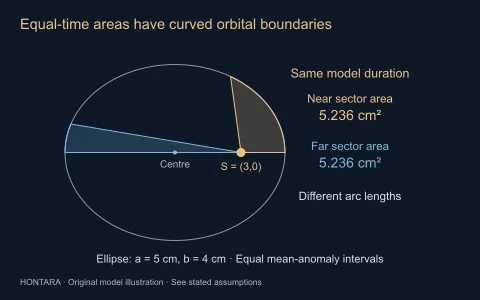
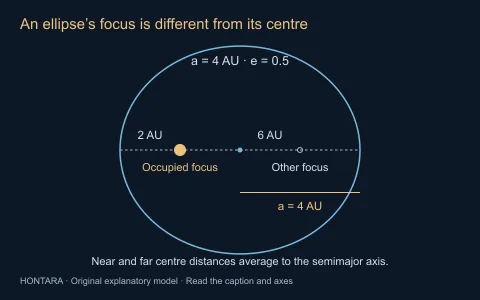
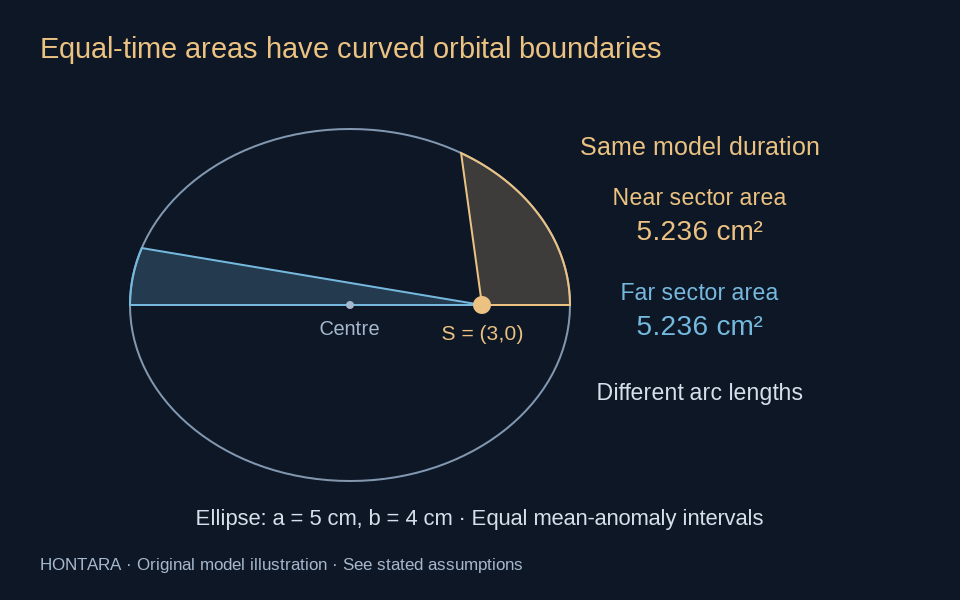
Use centimetre squared paper, ruler and pencil. Draw perpendicular axes and an ellipse centred at (0,0), with horizontal semiaxis 5 cm and vertical semiaxis 4 cm. Its right-hand focus is S=(3,0). Put the model Sun at that focus rather than at the ellipse centre.
The worksheet supplies six rounded coordinate points on each selected arc. Plot the near and far sets on the same axes, then trace a smooth ellipse boundary through them. Join both endpoints of each arc to S. Shade the enclosed curved sectors in distinguishable ways or label them without relying on colour.
Use a reproducible grid estimate
Count complete grid squares inside each sector and estimate the boundary pieces with one consistent rule. A smaller square grid or a transparent overlay can improve the estimate. Record the grid spacing and treatment of partial squares rather than altering the outline until two answers match.
The exact reference area for each model sector is 5π/3, approximately 5.236 cm². Your traced areas will differ because points are rounded and drawing or counting is imperfect. Report the two estimates separately before comparing their difference with the reference value.
Compare length as well as area
Trace the two orbital arcs with a paper strip or short straight segments and compare their lengths using the same method. The near-focus region has a longer orbital arc even though the two regions have the same model duration and swept area.
Explain why the body must travel faster through that selected near region. Equal swept areas do not mean equal angles measured at the focus, equal arc lengths or constant orbital speed. Name which quantity the law holds fixed for equal elapsed times.
State what the drawing establishes
Write a conclusion linking equal time, approximately equal traced area and different arc lengths. Include one source of uncertainty in your drawing and one property imposed by the reference model.
The supplied coordinates were calculated from an ideal orbit. Agreement with them checks your construction and interpretation, not the accuracy of a real planet prediction. A physical test would require independently timed position measurements and a justified treatment of observational uncertainty.
PAUSE AND THINK
Why is replacing a finite orbital arc by a straight chord not an exact area test?
Explore the answer
The chord omits or changes the region between the straight line and the curved orbit. A triangle can approximate a sufficiently small sector but is not generally the exact finite swept area.
RECORD YOUR OWN EVIDENCE
Your activity sheet
You need: Squared paper marked in centimetres, ruler, pencil, transparent paper if useful and the supplied coordinate table.
Draw an ellipse centred at (0,0), with semiaxes 5 and 4 cm. Mark the focus S=(3,0). Plot the two six-point arcs from this table, trace smooth curves through each set and close each sector back to S. Estimate their areas using the same grid rule.
Name or group: Date:
| Point | x (cm) | y (cm) |
|---|---|---|
| Near1 | 5.000 | 0.000 |
| Near2 | 4.892 | 0.827 |
| Near3 | 4.572 | 1.619 |
| Near4 | 4.055 | 2.340 |
| Near5 | 3.363 | 2.960 |
| Near6 | 2.525 | 3.453 |
| Far1 | -4.731 | 1.294 |
| Far2 | -4.827 | 1.042 |
| Far3 | -4.903 | 0.786 |
| Far4 | -4.957 | 0.526 |
| Far5 | -4.989 | 0.263 |
| Far6 | -5.000 | 0.000 |
Why must each measured region include the curved orbit boundary rather than only its endpoint chord?
Compare the near and far arc lengths over the stated equal time intervals.
How close are your grid areas to the model reference 5.236 cm² and what limits the comparison?
Ideal Kepler-model coordinates rounded to 0.001 cm. Equal time is imposed by the model; the classroom estimate illustrates the area relation rather than independently testing a real orbit.