TRY IT YOURSELF
Ideal orbital period
At 1 AU around one nominal solar mass parameter: about 365.257 days. The orbiting mass is neglected.
On this page
THE BIG IDEAS
- Semimajor axis is the relevant size of an ideal ellipse.
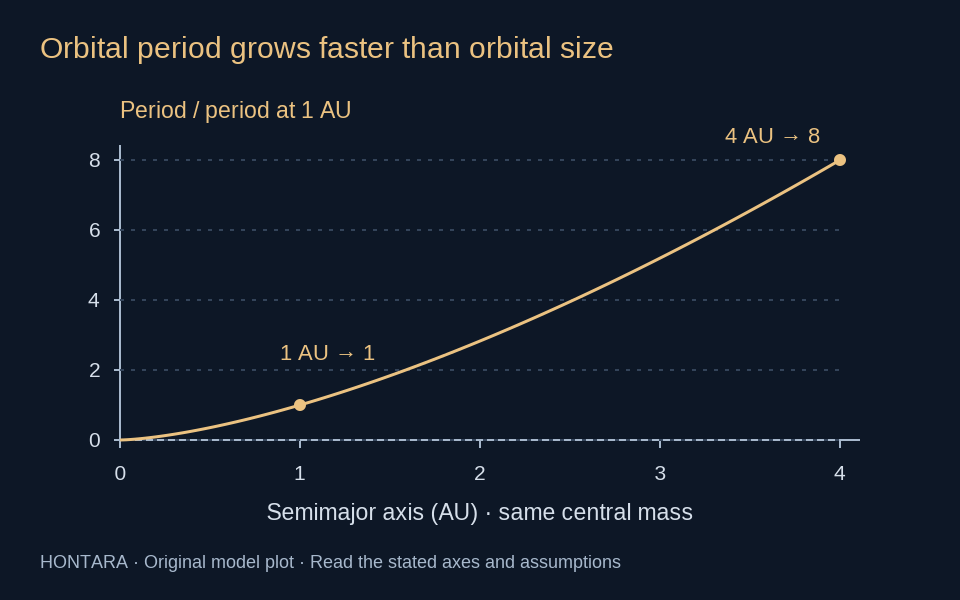
- Period scales as a³ᐟ² and central mass⁻¹ᐟ².
- A Julian-year unit is not an exact promise of a one-AU orbital period.
Use the semimajor axis, not a snapshot distance
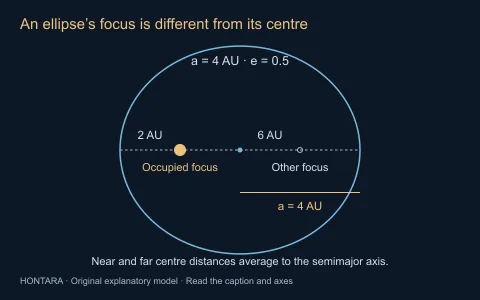
Enter the orbital semimajor axis in astronomical units and the central mass in nominal solar units. The semimajor axis is half the long diameter of an elliptical orbit. It is not necessarily the body’s current distance from the central focus, nor is it the nearest or farthest distance alone.
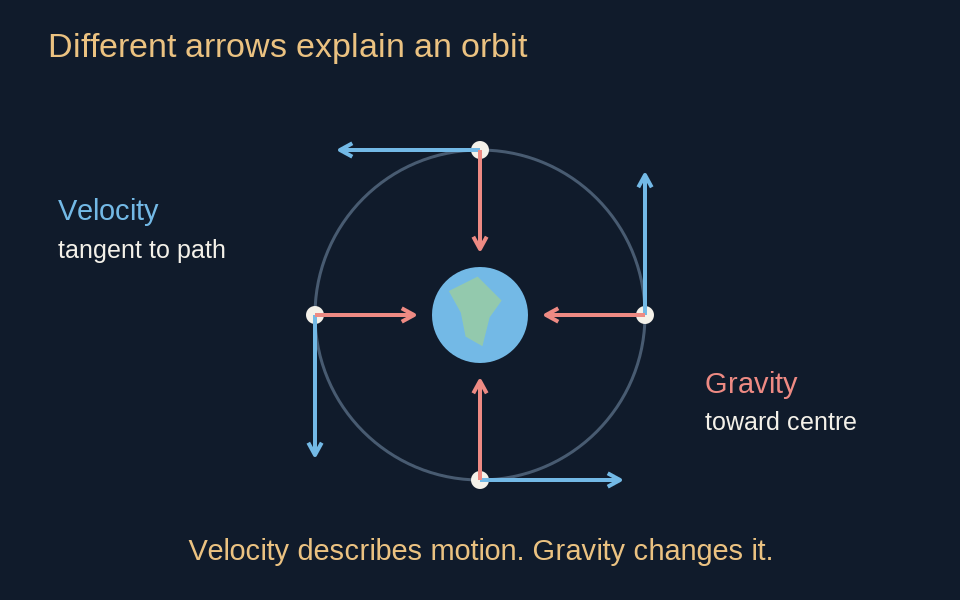
The model assumes a bound Newtonian two-body orbit with the orbiting body’s mass negligible compared with the central mass. It does not describe a trajectory receiving continuous thrust or an orbit strongly perturbed by additional bodies. For an appreciable companion mass the combined mass belongs in the full two-body relation.
Follow the mass parameter and unit conversion
The calculation uses P = 2π√(a³/μ), where a is converted to metres and μ is the central gravitational mass parameter. One AU is 149,597,870,700 metres. A central input of one uses the IAU nominal solar mass parameter, 1.3271244 × 10²⁰ m³/s².
This nominal parameter is a conversion convention rather than a claim that the Sun’s true properties are known with no uncertainty. Scaling it by the mass input gives the model’s central μ. The output is converted to days of 86,400 seconds and Julian years of exactly 365.25 days.
Check one reference and two ratios
At a = 1 AU and a central input of one, the model gives approximately 365.257 days. Expressing that result in Julian years gives about 1.00002, not exactly one. The unit definition of a Julian year and the model orbital period are different concepts.
Keeping central mass fixed while increasing a from 1 AU to 4 AU multiplies period by 4 to the power 3/2, which is eight. Keeping a fixed while increasing central mass fourfold halves the period. Check those ratios before interpreting an unfamiliar numerical result.
Remember what eccentricity changes
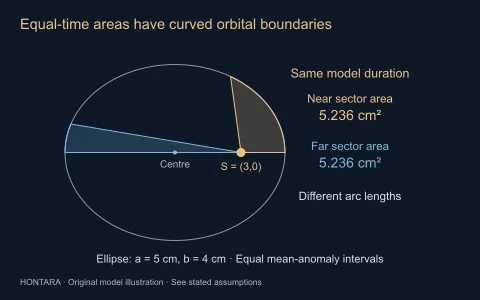
Within this ideal relation, elliptical orbits with the same semimajor axis and central mass have the same period even if their eccentricities differ. Their speeds and distances at particular positions can still be very different. Period alone does not specify the whole trajectory.
A drawing of an eccentric orbit can therefore help identify the correct a input, but measuring one radius in the drawing is insufficient. If nearest and farthest distances are reliably supplied for an ideal ellipse, their arithmetic mean gives the semimajor axis.
Keep precision appropriate to the question
This calculator is useful for exploring scaling and checking a classroom orbital example. Perturbations, relativistic corrections, uncertain input parameters and the neglected companion mass limit its use for precise ephemerides or mission navigation.
For a dated sky position or an actual spacecraft trajectory, use an appropriate ephemeris or mission analysis. Record which quantities came from observations and which were selected as teaching assumptions. Extra digits in a calculated period are not additional evidence about a real system.
PAUSE AND THINK
Would doubling semimajor axis double the ideal orbital period at fixed central mass?
Explore the answer
No. The factor is 2³ᐟ², approximately 2.828. Period does not scale linearly with semimajor axis.