On this page
THE BIG IDEAS
- Assess the curved boundary before assessing a final number.
- Separate grid approximation from the exact reference model.
- Do not mistake model-generated equality for an independent physical test.
Choose an outcome beyond repeating the law
Learners should construct two equal-time orbital sectors and explain how equal area can coexist with unequal travel distances. Assess the explanation and the chosen boundary, not just whether a numerical area happens to match an answer key.
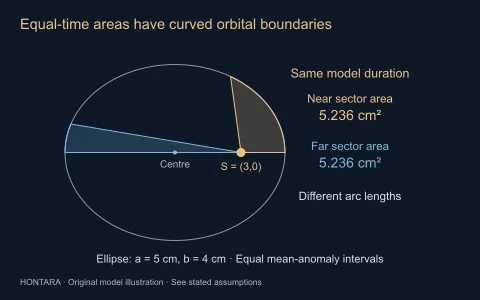
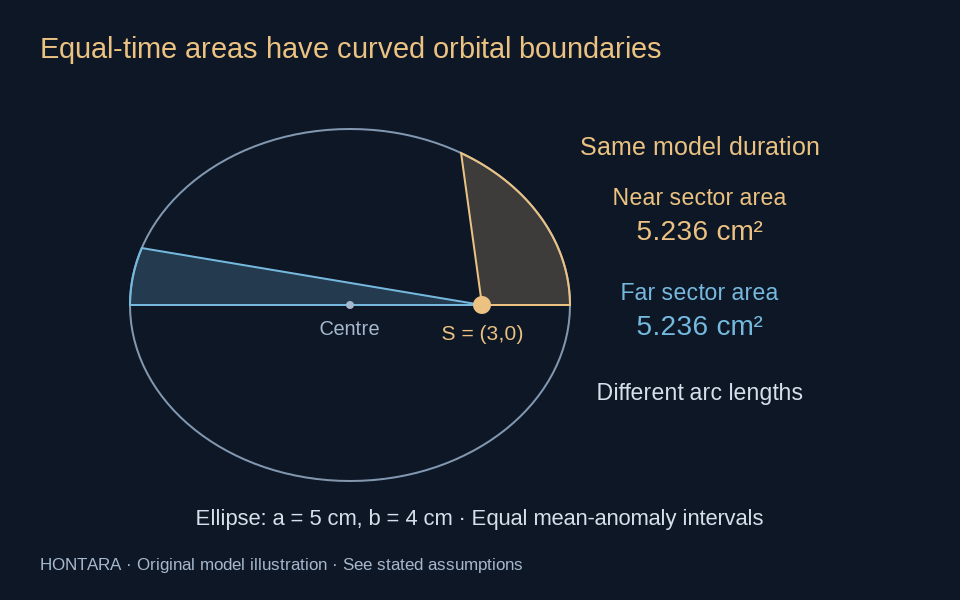
Prepare the paired coordinate table, centimetre squared paper and rulers. The reference ellipse has semiaxes 5 and 4 cm with focus S=(3,0). Its timing is generated by an ideal Kepler model. Keep that model status visible so a construction exercise is not described as an independent astronomical measurement.
Organise a 50-minute sequence
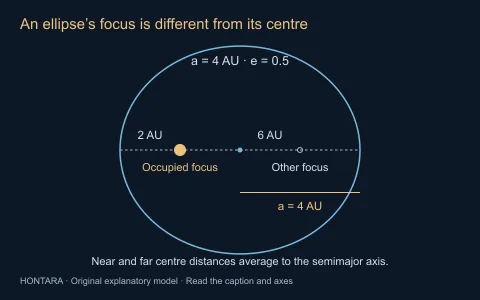
Use five minutes to distinguish the focus from the centre, ten to plot and trace the ellipse, fifteen to estimate areas, ten to compare arc lengths and ten for an explanation and exit case. Ask learners to label their axes and focus before measuring any shaded region.
Offer an enlarged prepared outline or a partner’s spoken point-reading role where plotting is a barrier. Keep the requirement to identify the curved boundary and both focus-to-endpoint lines. A learner can demonstrate the geometry without producing an especially neat drawing.
Use the exact reference appropriately
Each model sector has area 5π/3, approximately 5.236 cm². The coordinate list is rounded and learners interpolate the curve, so two grid estimates need not be identical. Ask whether the disagreement is plausible given grid size and boundary judgement.
The near sector runs from the closest point toward the upper-right part of the ellipse; the far sector ends at the most distant point on the left. They are selected to have equal mean-anomaly intervals and therefore equal ideal swept area. Learners need not solve Kepler’s equation to use the supplied coordinates.
Challenge the triangle shortcut
Ask a group that used endpoint triangles to show which curved part it omitted. A finite chord triangle is not the exact swept sector. For a very small interval the approximation may be useful, but calling it exact confuses a convenient construction with the area law itself.
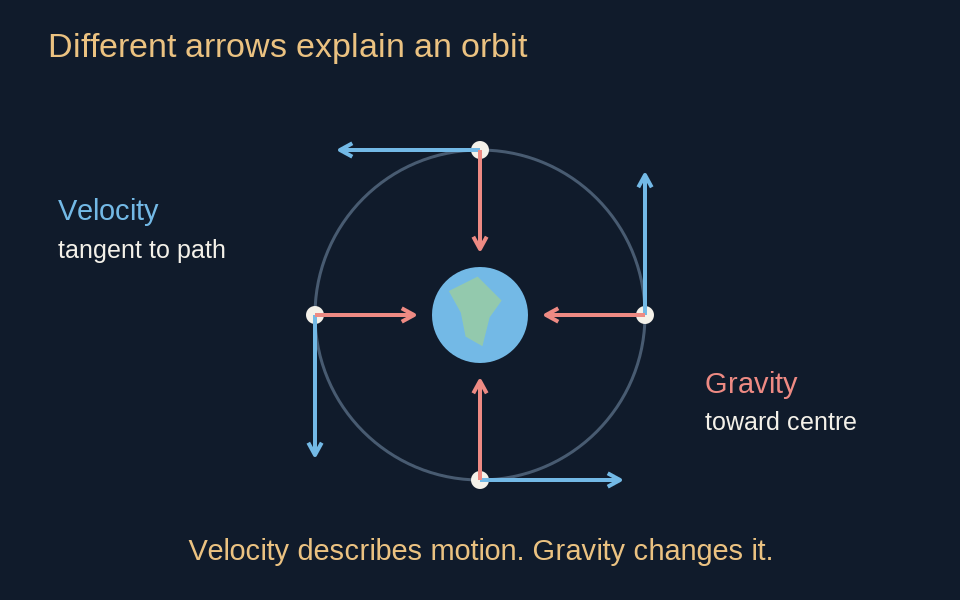
Also check claims of equal angles or constant speed. The nearer arc is longer in the same model time, so the average orbital speed over that interval is greater. Equal area is the relationship to defend; equal angle and equal distance are different statements.
Assess a transferred explanation
For the exit task describe a new pair of equal-time sectors at different orbital distances. Ask whether their arc lengths must match and what boundary would be measured to compare areas. Expect equal areas within the ideal model but no general equality of arc length.
For extension discuss what a physical test would require: independent timestamps, positional measurements and uncertainty estimates. The classroom reference data already encode the law. Recognising that limitation is part of understanding how a model illustration differs from new evidence about nature.
PAUSE AND THINK
A learner reports equal endpoint-triangle areas. Has that established exact equal swept sectors?
Explore the answer
No. The curved orbit boundary must be included. The learner should identify the omitted curved portions or explicitly state a small-interval approximation.
RECORD YOUR OWN EVIDENCE
Your activity sheet
You need: Squared paper marked in centimetres, ruler, pencil, transparent paper if useful and the supplied coordinate table.
Construct the two reference sectors and record area estimates, boundary conventions and evidence for different arc lengths.
Name or group: Date:
| Point | x (cm) | y (cm) |
|---|---|---|
| Near1 | 5.000 | 0.000 |
| Near2 | 4.892 | 0.827 |
| Near3 | 4.572 | 1.619 |
| Near4 | 4.055 | 2.340 |
| Near5 | 3.363 | 2.960 |
| Near6 | 2.525 | 3.453 |
| Far1 | -4.731 | 1.294 |
| Far2 | -4.827 | 1.042 |
| Far3 | -4.903 | 0.786 |
| Far4 | -4.957 | 0.526 |
| Far5 | -4.989 | 0.263 |
| Far6 | -5.000 | 0.000 |
Identify the ellipse centre and focus separately.
Explain why 5.236 cm² is a reference imposed by this model rather than an observed discovery.
Write the boundary and reasoning needed for the exit case.
Ideal Kepler-model coordinates rounded to 0.001 cm. Equal time is imposed by the model; the classroom estimate illustrates the area relation rather than independently testing a real orbit.