On this page
An orbit with a changing distance
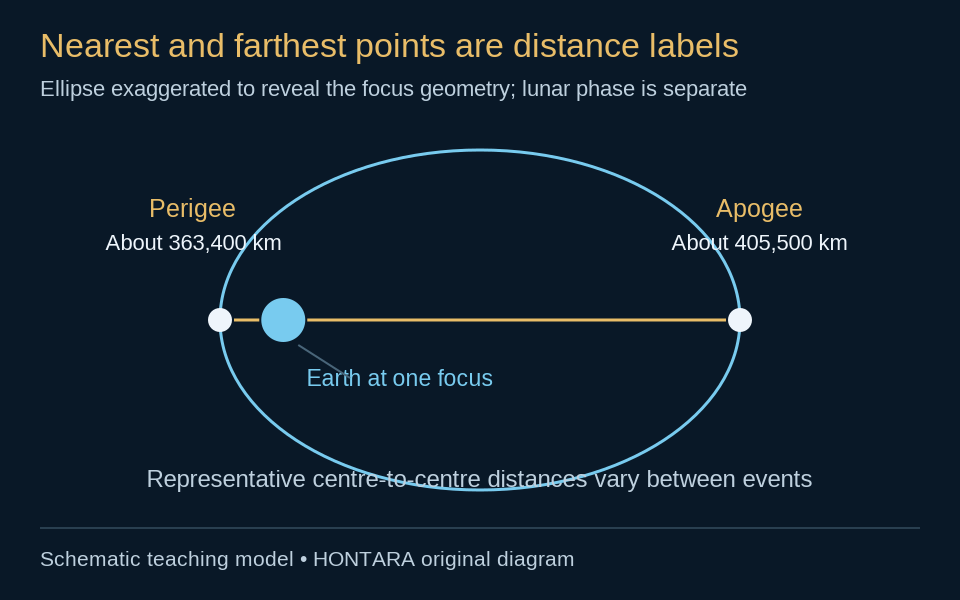
The Moon does not follow a perfect circle around Earth. In a simple elliptical model Earth lies at one focus rather than at the centre. The nearest point is perigee and the farthest point is apogee. Distances quoted for these positions normally refer to the centres of Earth and the Moon rather than the gap between their surfaces.
Useful representative values are about 363,400 kilometres at perigee and 405,500 kilometres at apogee. They are not fixed distances for every month. Solar gravity and other effects perturb the lunar orbit, so a specific event needs a calculated ephemeris. The enlarged ellipse in the diagram helps show the focus geometry and exaggerates the shape for clarity.
THE BIG IDEAS
- Perigee and apogee are orbital-distance extrema.
- Distance and phase cycles have different periods.
- Angular diameter and apparent disk area have different ratios.
Distance is not phase
Phase describes how much of the Moon’s Earth-facing hemisphere is illuminated by the Sun. Perigee and apogee describe orbital distance. The two cycles have different periods. The interval from one perigee to the next averages about 27.55 days while the cycle from one new Moon to the next averages about 29.53 days.
Subtracting those periods gives nearly two days. That difference means successive perigees do not stay attached to the same phase. A close Moon can be crescent, quarter, gibbous or full. A full Moon near perigee is commonly called a supermoon, a popular term with varying definitions rather than a new physical class of Moon.
Estimate a size difference
The Moon’s physical diameter changes negligibly on these timescales but its apparent angular diameter grows when it is closer. For a small angular size, apparent diameter is approximately proportional to physical diameter divided by distance. Using the representative distances, the near-to-far angular-size ratio is 405,500 divided by 363,400, about 1.12.
This means a roughly 12 percent larger angular diameter for that illustrative pair. Area changes as the square of diameter, so the apparent disk area differs by roughly 25 percent. Do not call this a 25 percent change in diameter. More extreme event pairs can yield other percentages and atmospheric conditions complicate casual visual comparisons.
Plan a comparison that tests distance
Use lunar images made with the same camera, lens and image scale on identified dates. Compare measured disk diameters in pixels without resizing each frame to fit the page. Record the predicted geocentric distances with the images. For precision, the observer’s position on Earth also affects the distance and apparent size, especially when comparing different lunar altitudes.
The Moon illusion near the horizon is a separate perceptual effect. A Moon that looks enormous beside a building is not necessarily at perigee. Clouds, haze and changes in framing can also mislead. A consistent image-scale comparison tests angular size more directly than memories of how large the Moon felt on different evenings. Both a positive result and a failed comparison should include the measurement conditions.
PAUSE AND THINK
Does a full Moon always occur at perigee?
Explore the answer
No. The phase cycle averages about 29.53 days while the perigee-to-perigee cycle averages about 27.55 days, so their alignment changes.