On this page
Compare the pull across Earth
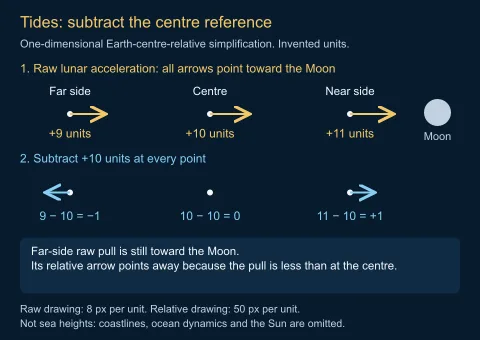
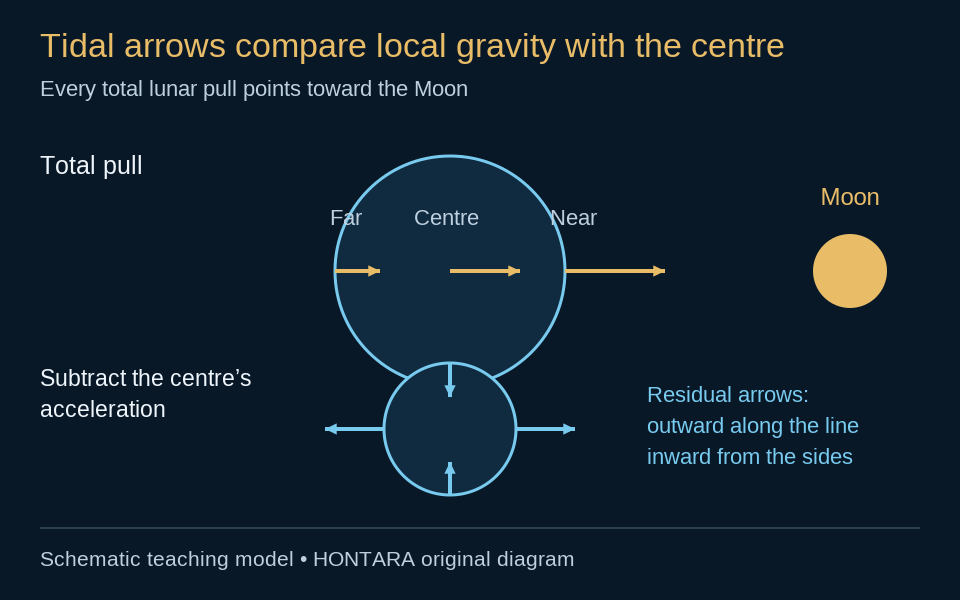
Tidal effects arise because an external gravitational pull is not identical everywhere across Earth. The Moon pulls the near side more strongly than Earth’s centre and the far side less strongly. Subtract the centre’s acceleration from each local acceleration to describe the lunar tidal effect in a freely falling Earth-centred frame.
The residual arrows point outward along the Earth-Moon line on both sides and inward toward that line at the sides. On the far side the Moon still pulls toward itself; it simply pulls less strongly than it pulls the centre. A far-side outward residual therefore does not require lunar gravity to reverse direction or repel water.
THE BIG IDEAS
- Tidal forcing compares local gravity with the acceleration of Earth’s centre.
- The Moon and Sun combine to modulate the forcing.
- Local tide times and heights require coastal information.
The Sun contributes a gradient too
The Sun’s total gravitational attraction on Earth exceeds the Moon’s but its variation across Earth is smaller. For a distant tide-raising body, the leading differential effect scales approximately as mass divided by distance cubed. This is why distance matters so strongly and the nearer Moon has the larger tide-raising influence despite its much smaller mass.
As a worked model, increase the distance to a tide-raising body by a factor of two without changing its mass. Its approximate tidal effect drops to one eighth. The ordinary gravitational acceleration drops to one quarter. Keeping these two scalings separate prevents the mistaken argument that the strongest total attraction must always produce the largest tides.
Alignment changes the combined forcing
Near new and full Moon the solar and lunar tidal patterns reinforce one another, producing the spring-tide part of the cycle. Spring here has nothing to do with the season. Around the quarter phases their patterns partly oppose, producing neap tides with a generally smaller tidal range. The forces do not cancel to zero.
The equilibrium picture imagines a simple ocean responding to the gravitational pattern. It is valuable for explaining forcing but cannot provide the time or height of a high tide at a particular beach. Earth rotates, continents obstruct motion and ocean basins have their own responses. The ocean behaves as a moving fluid rather than a static skin instantly matching two ideal bulges.
A real coast needs local evidence
Tidal waves interact with water depth, coastline shape, friction and basin resonance. Some places have two high tides of similar height each day, others have unequal highs and some have one dominant daily cycle. Weather can change measured sea level through wind and air pressure as well. These details cannot be recovered from lunar phase alone.
For an evidence task take a recognised local tide table and compare predicted highs across a week. Record its place, time zone and height reference. Then compare the pattern with the Moon’s phase without expecting high water exactly when the Moon is overhead. Use the table’s official guidance for coastal decisions. This diagram teaches differential gravity and deliberately makes no prediction for a Karnataka shore or any other named coast.
PAUSE AND THINK
Why does the far-side tidal arrow point away from the Moon?
Explore the answer
It is a residual relative to Earth’s centre. The Moon pulls the far side toward itself less strongly than it pulls the centre.