On this page
THE BIG IDEAS
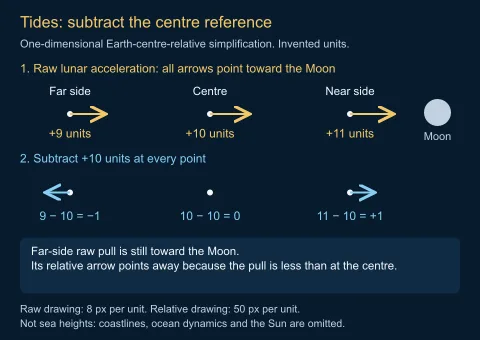
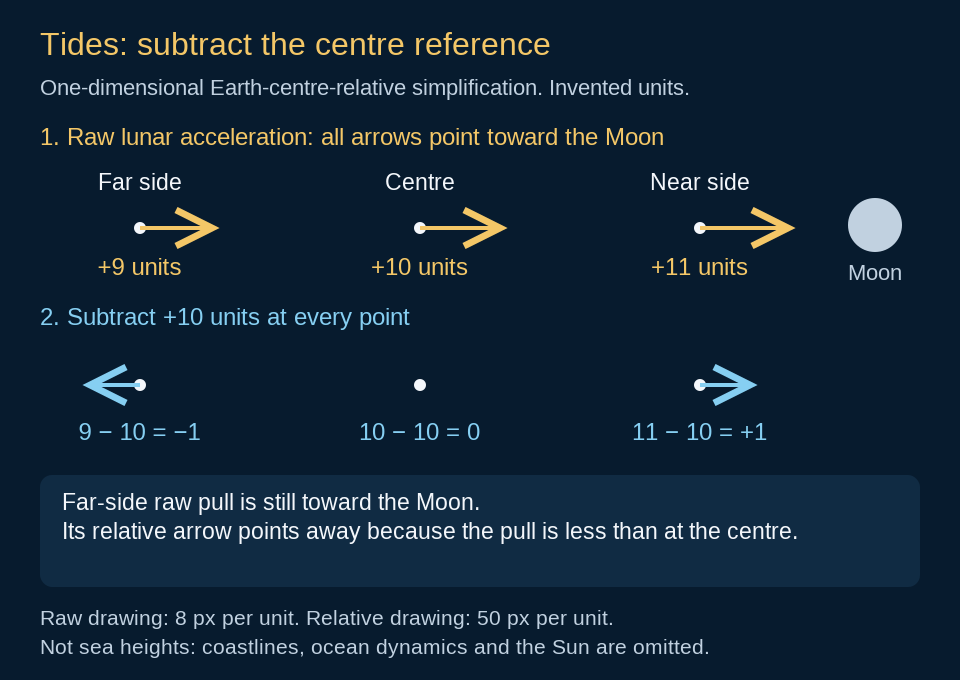
- All three raw lunar arrows point toward the Moon.
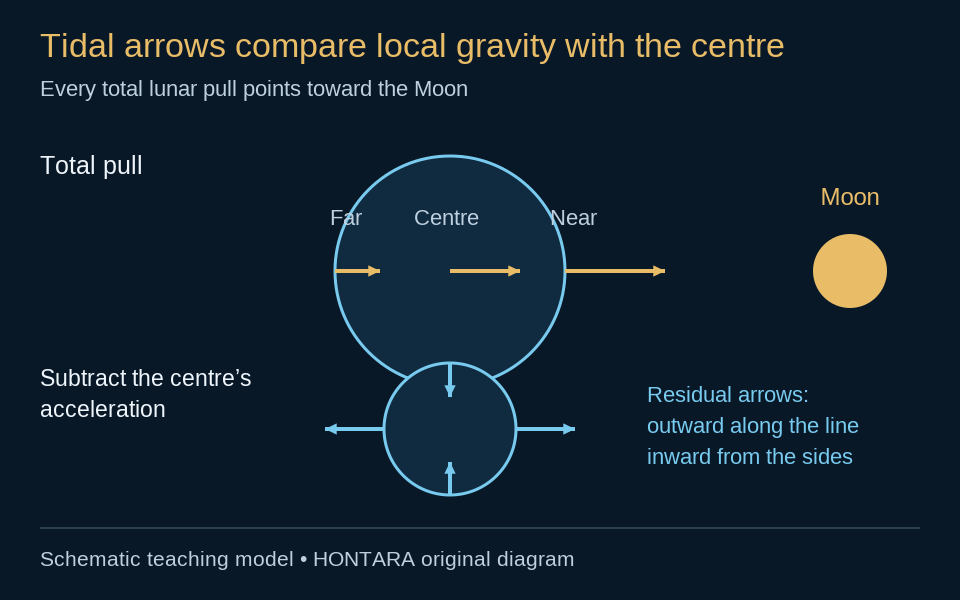
- Relative arrows show differences from the centre.
- A coastal tide needs more information than a static force sketch.
Compare a pull with a difference
The Moon attracts the whole Earth, not only its oceans. The attraction varies slightly across Earth. This activity represents that variation along the Earth-Moon line. You will draw one set of arrows for lunar acceleration then subtract the acceleration at Earth’s centre to construct a second set.
The supplied values are invented teaching units with exaggerated differences. They are not measured accelerations, realistic Earth-Moon proportions or predicted sea heights. The second diagram is an Earth-centre-relative simplification of one part of the tide-generating effect.
Draw the raw arrows
Use paper, ruler, pencil, two coloured pens and calculator. Place three labelled points on a horizontal line: far side at the left, Earth centre in the middle and near side at the right. Write Moon farther to the right. Space the points at least 8 cm apart so the arrows stay separate.
Give the far point 9 units of lunar acceleration rightward, the centre 10 units rightward and the near point 11 units rightward. At 4 mm per unit, draw rightward arrows 36 mm, 40 mm and 44 mm long from their respective points. Label every arrow as a raw lunar acceleration.
Remove the common reference
On a separate line copy the three points. Treat right as positive and subtract the centre value of +10 units from each raw value. The far point becomes 9 − 10 = −1, the centre 10 − 10 = 0 and the near point 11 − 10 = +1.
Use a different scale of 20 mm per unit for these relative arrows so they remain visible. Draw 20 mm left at the far point, no arrow at the centre and 20 mm right at the near point. Write the scale beside each diagram. Do not compare arrow lengths between diagrams without checking their different scales.
Explain the far-side arrow
The raw far-side attraction still points toward the Moon. Its leftward relative arrow says that it accelerates toward the Moon less than the centre does. It does not mean the Moon repels the far side or that gravity switches off there.
Write two sentences comparing the raw and relative diagrams. Then predict what happens if every raw value increases by 2 units while keeping the same differences. Subtracting the new centre value of 12 leaves the same relative results: −1, 0 and +1.
Keep the model within its limits
Real tide-generating effects form a three-dimensional pattern and include the Sun. Ocean water responds dynamically across rotating Earth with continents, varying depths and friction. A real coast may have one high tide, two high tides or unequal daily tides.
Label your final drawing “differential-acceleration model, not a tide prediction”. Name one feature you represented and two you omitted. Use a published local tide table for actual coastal timing rather than reading high water directly from these arrows.
PAUSE AND THINK
Does the far-side arrow show lunar repulsion?
Explore the answer
No. After subtraction it shows less acceleration toward the Moon than at Earth’s centre. The raw lunar attraction remains toward the Moon.
RECORD YOUR OWN EVIDENCE
Your activity sheet
You need: Paper, pencil, ruler, two coloured pens and calculator.
Place far, centre and near points on a horizontal Earth-Moon line with the Moon to the right. Use invented rightward lunar accelerations 9, 10 and 11 units respectively. Draw raw arrows at 4 mm per unit. Subtract the centre value from each and draw relative arrows at 20 mm per unit on a separate line.
Name or group: Date:
| Point | Raw acceleration right | Raw minus centre | Relative direction |
|---|---|---|---|
| Far | 9 units | ||
| Centre | 10 units | ||
| Near | 11 units |
Why does the far-side relative arrow point left when its raw lunar acceleration points right?
Which two missing ingredients prevent this diagram from predicting a harbour’s high tide?
Record what happened, including uncertain results. Use the answer guidance in this resource to discuss your explanation.