On this page
THE BIG IDEAS
- LIGO is a ground-based laser interferometer observatory.
- GW150914 was observed in 2015 and announced in 2016.
- Independent sites and environmental checks help test an event.
Begin with an observatory, not a spacecraft
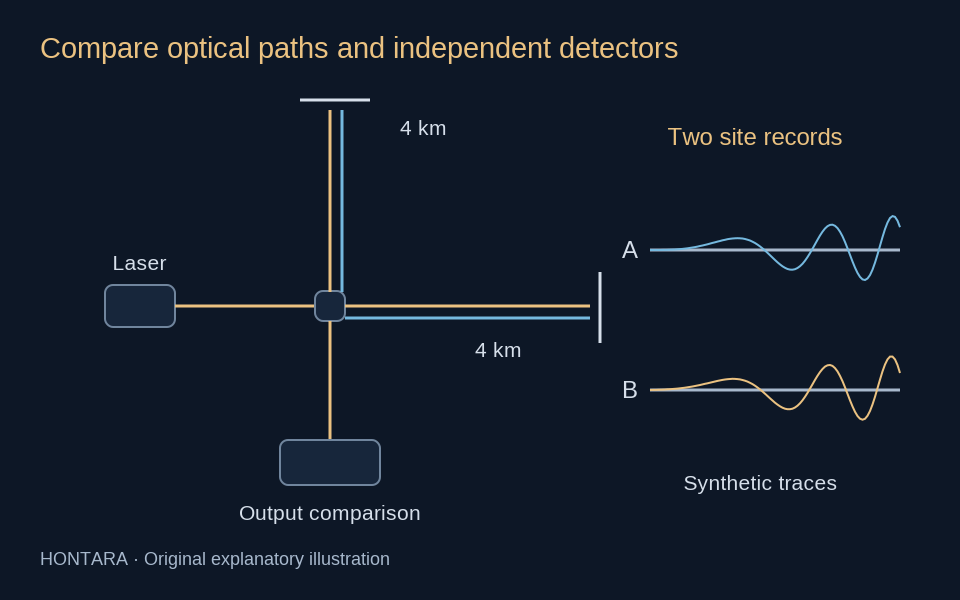
The Laser Interferometer Gravitational-Wave Observatory, LIGO, uses ground-based instruments in the United States. Its two widely separated sites at Hanford and Livingston compare extremely small changes in perpendicular optical paths. LIGO does not photograph a passing wave with a camera or travel toward its astronomical source.
On 14 September 2015 the detectors recorded the event known as GW150914, interpreted as gravitational waves from merging black holes. The discovery was announced in 2016. Keeping the observation date separate from the announcement date avoids a simple but common historical confusion.
Understand what the interferometer compares
Laser light travels along perpendicular arms and is recombined so changes in relative optical phase affect the output. Mirrors, suspensions, vacuum systems and repeated optical paths support the sensitivity. A classroom drawing with two plain arms is only a schematic of a much more elaborate instrument.
The measured quantity is described through strain, a fractional change in length. For a simplified example, strain of 10⁻²¹ acting over a 4 km length corresponds to a length scale of 4 × 10⁻¹⁸ m. This arithmetic illustrates the scale; it is not a complete calibration model of the detector.
Ask why one unusual trace is insufficient
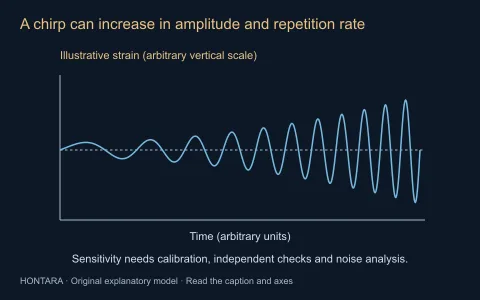
Ground motion, environmental disturbances and instrument behaviour can affect a detector. A compelling astrophysical interpretation therefore requires more than a striking waveform. Researchers inspect data quality, check environmental monitors and compare signals observed at different sites.
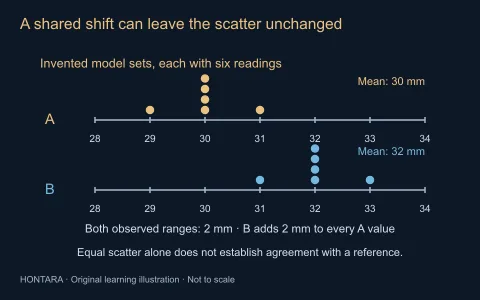
Agreement is not simply the demand that two raw traces look identical on a page. The detectors have different orientations and noise conditions. Comparisons account for those responses and a physically allowed time offset between sites before judging whether a shared event is plausible.
Use prediction and testing together
For a compact binary, theoretical waveforms connect changing orbital motion with a characteristic evolution in the signal. Analysts compare measurements with physically motivated predictions while also evaluating false-alarm behaviour. The goal is to establish a supported interpretation, not to choose the prettiest curve after looking at the data.
A useful exercise is to list three alternative explanations for an isolated pulse and identify what additional information would test each. A second independent detector and environmental measurements answer different questions. Neither should be replaced by confidence based only on the pulse’s visual appearance.
Read the event as a chain of inference
The strain data support an event identification through calibration, detector checks and analysis. Source properties then follow through comparisons with waveforms and uncertainty estimates. The resulting black-hole masses or distance are inferred quantities rather than labels directly printed by a laser sensor.
LIGO opens a complementary way to investigate cosmic systems alongside light-based observations. Its discovery is especially useful for understanding why extraordinary sensitivity must be joined with independent checks. A measurement becomes persuasive through the strength of that evidence chain rather than through an instrument’s fame alone.
PAUSE AND THINK
Why should a coincident event in two detectors still be checked against instrument and environmental information?
Explore the answer
Coincidence is valuable evidence but does not replace calibration and noise analysis. A supported astrophysical interpretation must test plausible non-astronomical explanations too.